Posted by: Caroline | June 27, 2012

Sans Souci Palace

Haiti is not a country designed for the independent traveler. In our week or so here, other tourists have not been as sparse as I expected, but they’ve often been NGO workers or wealthy Haitians with their own 4WD vehicle. Without our own wheels, we earn the bonus experience of Haitian public transport–all of which hinges on the tap-tap, basically a pick-up truck that has been outfitted with wooden benches and maybe a metal covering to protect us from the Caribbean sun. A conductor hangs precariously from the back, yelling out the destination. When we heard “MILOT-MILOT-MILOT,” we hopped on and settled in for a not-too-bumpy journey to the jumping off point for Haiti’s most impressive historical attractions: The Citadelle and Sans Souci.

A view of the town of Milot and our destination: the palace of Sans Souci.

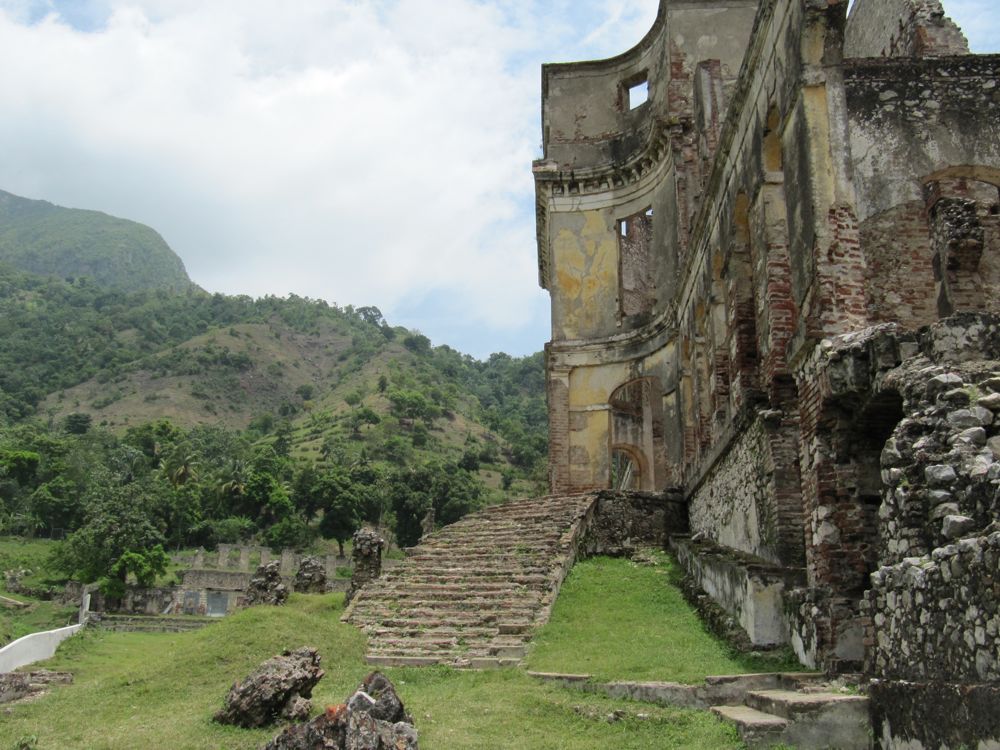
Henri Christophe is one of Haiti’s most notable figures (as I write, I sit at the Hostellerie du Roi Christophe–Hotel of King Christophe). After Haiti gained its independence and ousted its first dictator, the country split in two. Henri Christophe took control of the north and, eager to prove  Haiti’s political and cultural power to the European former rulers, built a palace to rival that of Versailles.

A statue of Henri Christophe outside Sans Souci’s gates.

This fountain marks the entrance to the palace. A mirror once hung behind it, reflecting the Sun so powerfully that entrants needed to walk in backwards.

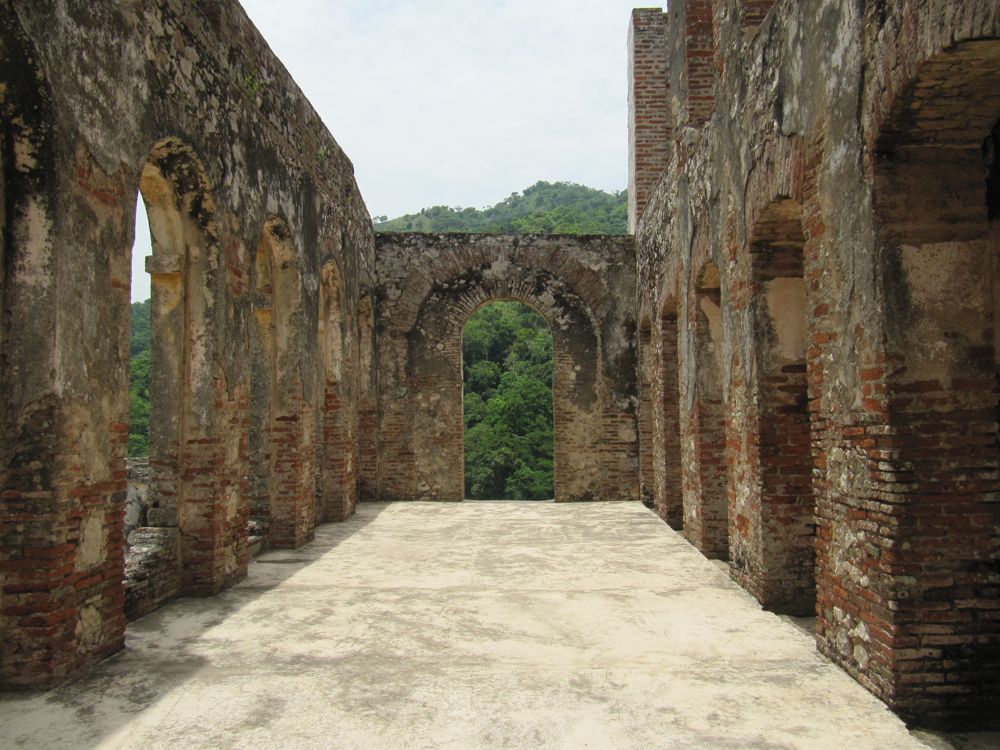
The whole place feels eerie. Despite being mostly destroyed by an earthquake in the mid-1800s and further by time, you can easily imagine its former opulence.

Adding to the spookiness is the fact that Christophe died here. When he caught word of an internal uprising and suffered a stroke in short succession, he committed suicide on the second floor of the palace.

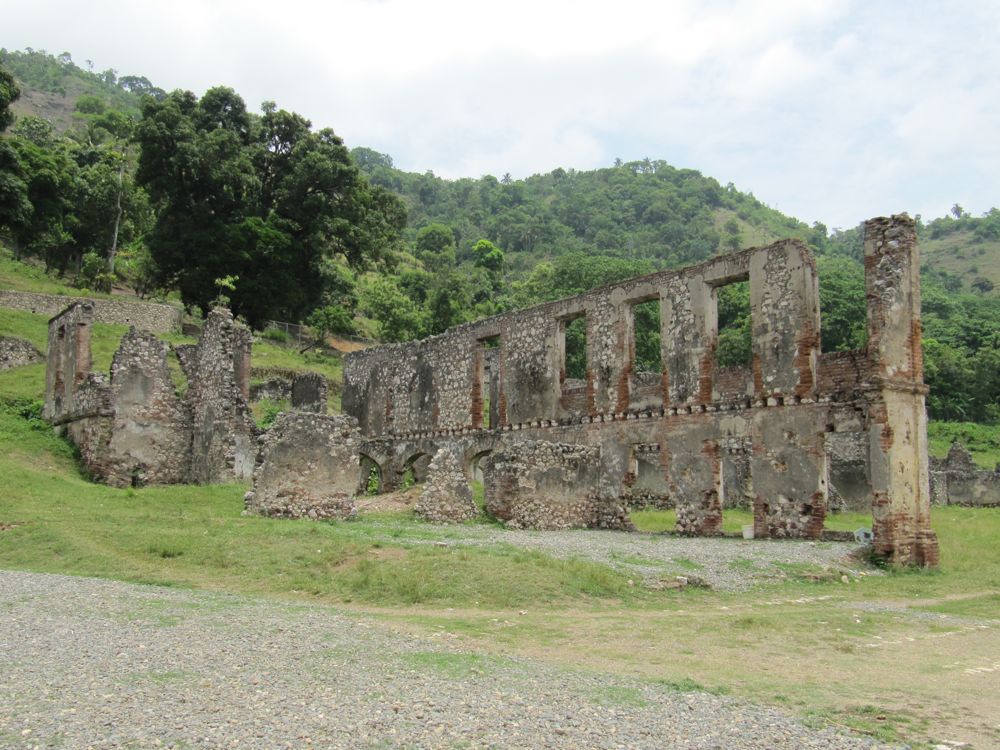
The queen also had her own palace, seen in the background of this picture.

Our guide claimed this tree was 2000 years old. Not sure, but it’s definitely old!

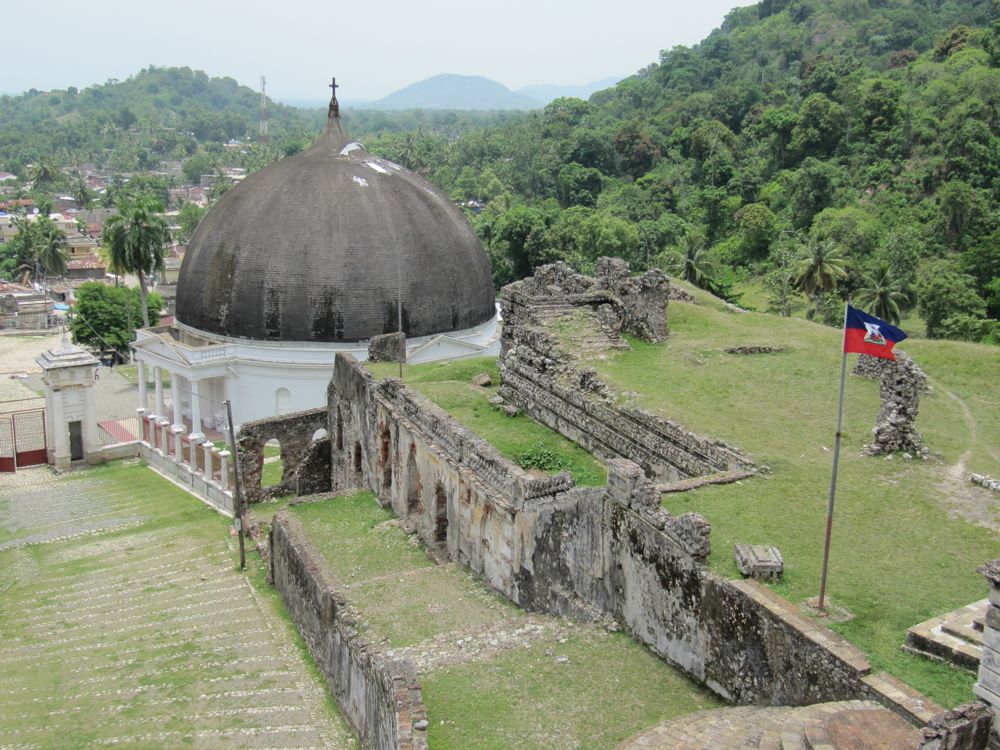
A church that was built around the same time as the palace.

The palace also serves as the start of the trail to something even more impressive: Christophe’s mountain fortress, The Citadelle. We’ll tell you about that next.

Posted by: Alex MacGregor | June 25, 2012

The Ruins of Fort Picolet

Cap Haitien was an important place during Haiti’s infancy. For a while during the colonial era, Cap Haitien was France’s chosen capital of the island. It enjoys a strategic geographic position: occupying the side of an easily defendable mountain, along with a river to supply fresh water and a harbor.

For this reason, the French built some substantial forts. They still are more or less here, within walking distance of downtown. We set off to find them.

The ouskirts of town to the north–on a road that dead-ends into the sea–are a lot more sleepy than the bustling areas to the south of town.

Haiti is the perfect place to see new and interesting things. Like goats hanging out in front of political graffiti.

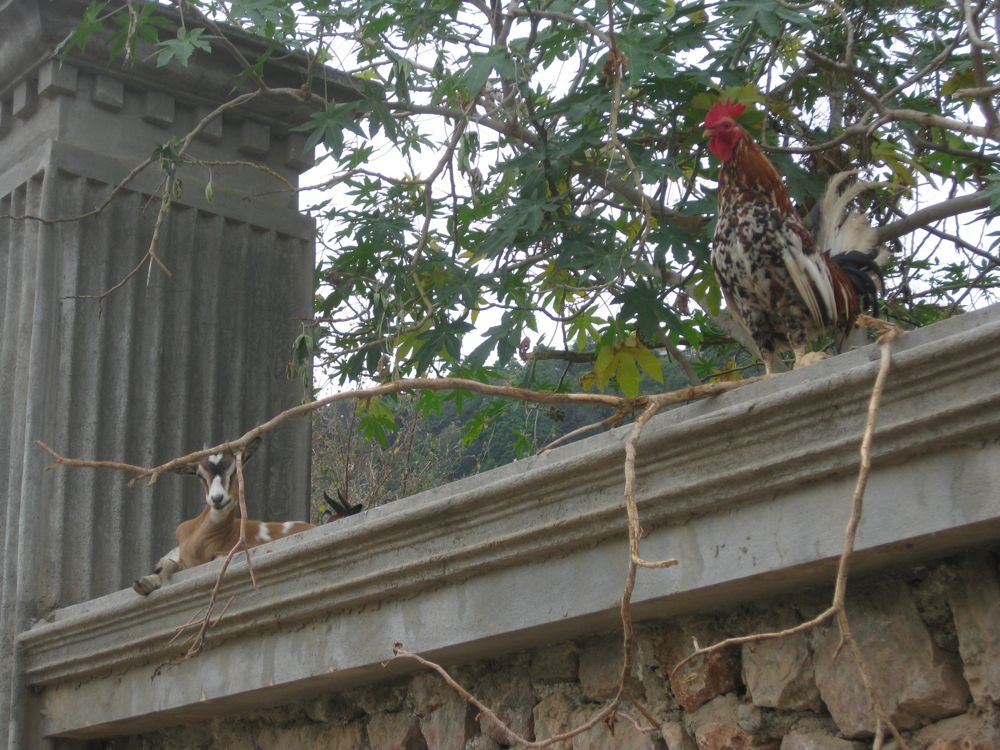
Or a goat and a rooster hanging out on a wall somewhat tackily designed to look like an old palace.

A beach along the way. A working beach, not a swimming beach.

Further along, you come across minor military fortifications. All French-built. For a while, the rich coffee and sugar producing colony of Haiti was the envy of Europe. Unfortunately, the highly agricultural colony relied heavily on slavery. Revolts followed, and Haiti became the first black republic, and second independent nation in the new world, after the US.

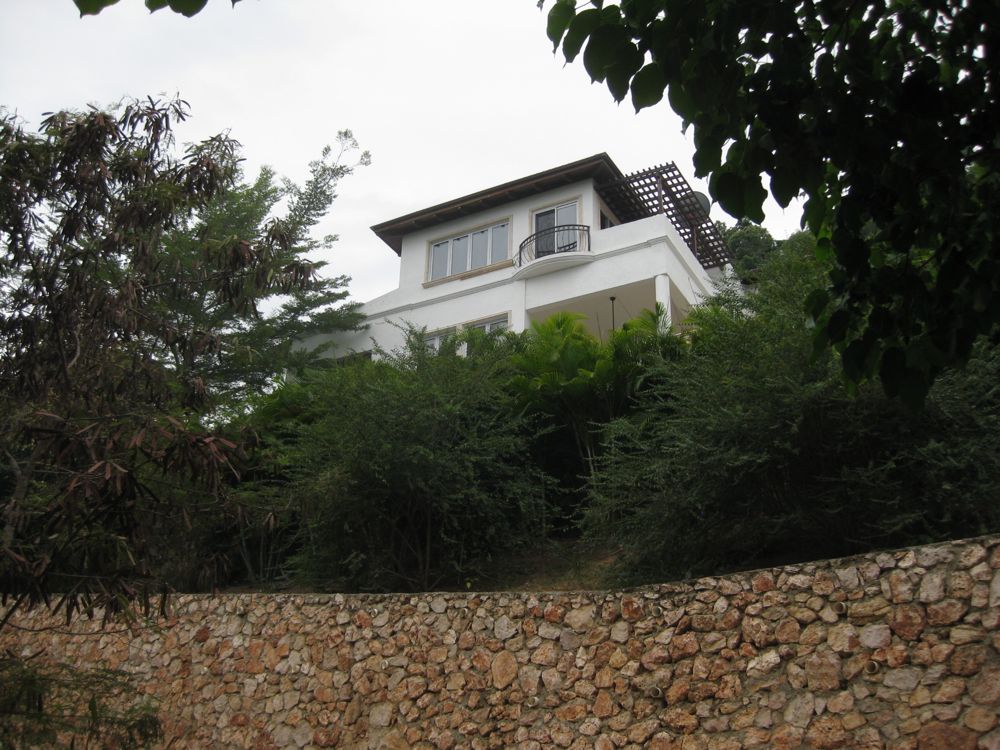
As the road that goes north out of town peters out, you wind up among the estates of Haiti’s elite. The guard of this house was very nice, and let us know we were going the wrong way.

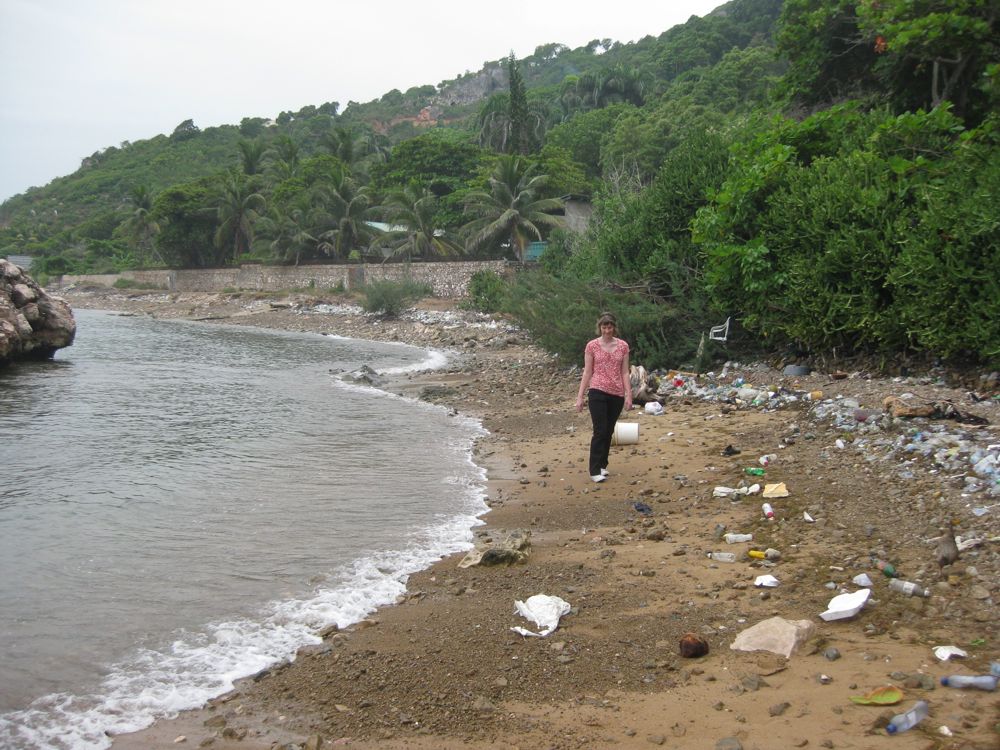
Ah yes, we made a naive mistake, assuming a road must go to the potential tourist attraction. Instead, this is the path: across a particularly unattractive beach. What do you do if the tide goes up in the meantime? I have no idea.

Eventually, the beach gives away to rocky coastline, and a broken stairway leads up to the entrance.

Caroline entering the spooky old fort, with the last bits of town in the background.

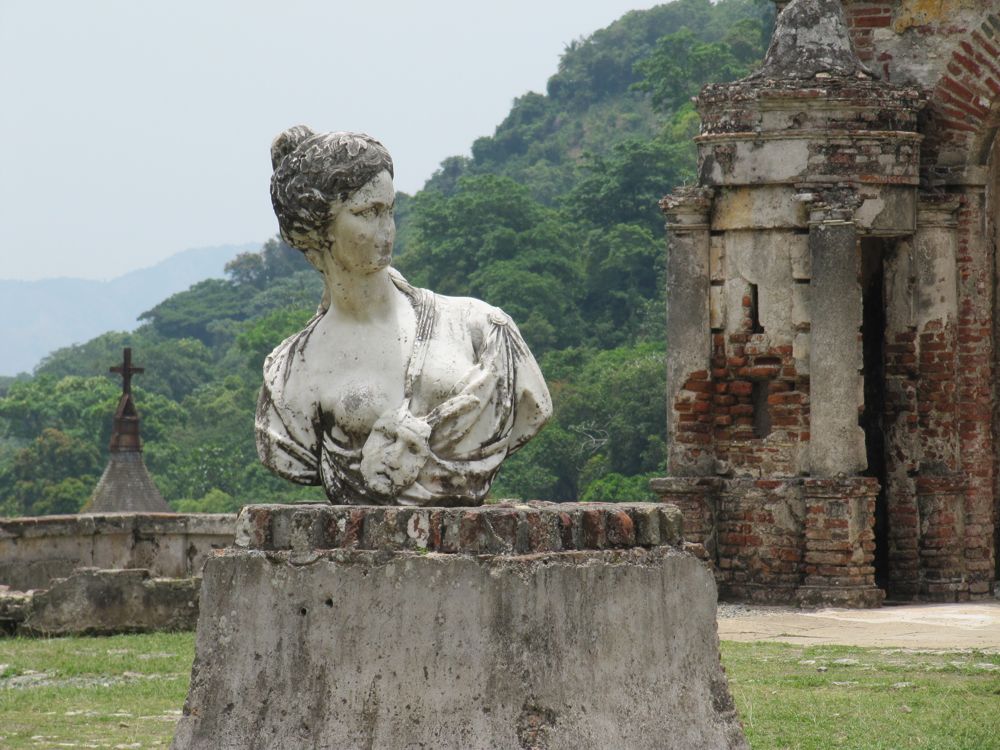
The surreal-looking ruins. A much different experience than visiting a restored fort.

Our outing–and my picture-taking–was interrupted by a guy who appears to live in the fort, and seemed mentally unstable. We had been worried the whole time about someone following us and using our vulnerability to their advantage. This guy didn’t seem to have any weapons, but he wasn’t responding to the typical “Au revoir!” we give when when someone has overstayed their welcome.

This guy didn’t seem to mean any harm directly. He just seemed drugged out. He followed us the whole two-mile walk back into town, where we managed to lose him.

Just another day in Haiti.

Posted by: Alex MacGregor | June 23, 2012

Haiti’s Second City: Cap Haitien

For years, I’ve wanted to go to Haiti. For whatever reason, it’s always been a country that’s fascinated me. Obviously, on any pan-Caribbean adventure, Haiti is an obligatory stop. So, here we are.

Sadly, Haiti’s recent history has been especially tragic. In 2004, president Jean-Bertrand Aristide was removed from office in a coup-d’etat. In the years thereafter, kidnapping–especially of foreigners–was unacceptably common.

In the wake of the 2004 coup, after which the country fell into near anarchy for a while, the UN started a mission here called MINUSTAH, with the objective of stabilizing the country. By 2008, things were stable enough that travel seemed possible.

However, in 2008, the hurricane season was particularly devastating. Many of Haiti’s roads and bridges were knocked out. Then, in January 2010, the big one: a 7.0 magnitude earthquake hit Port-au-Prince, the capital, changing the course of the already-struggling country forever. Even in 2012, travel to the capital seems ill-advised. Many of the city’s former common areas are covered with temporary tent cities, and former neighborhoods remain rubble.

But now, in 2012, travel to the northern part of the country seems possible.

Cap Haitien–Haiti’s second city, and rival to Port-au-Prince–is doing fine. The disasters and unrest that have plagued the capital have largely spared the north.
And that’s not to say the north is second best or anything. With a more relaxed vibe and no shortage of French-style architecture, the north has plenty going for it. The north also boasts some of Haiti’s best tourist treasures–and I’m not just saying that, these are legitimately world-class tourist attractions that one would think foreigners would flock to. You’ll see what I mean in the coming posts.
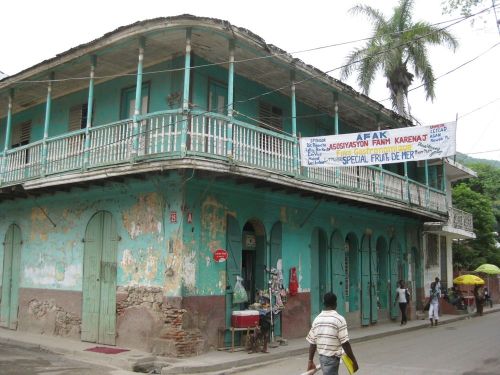
But for now, let’s stay focused on Cap Haitien itself.
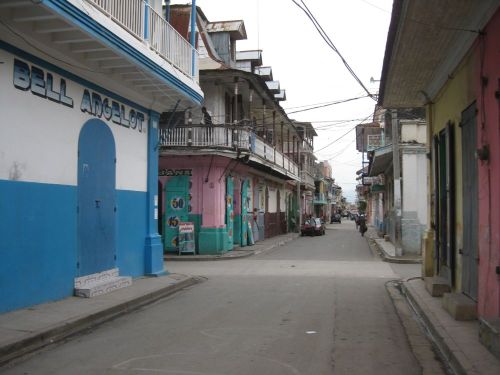
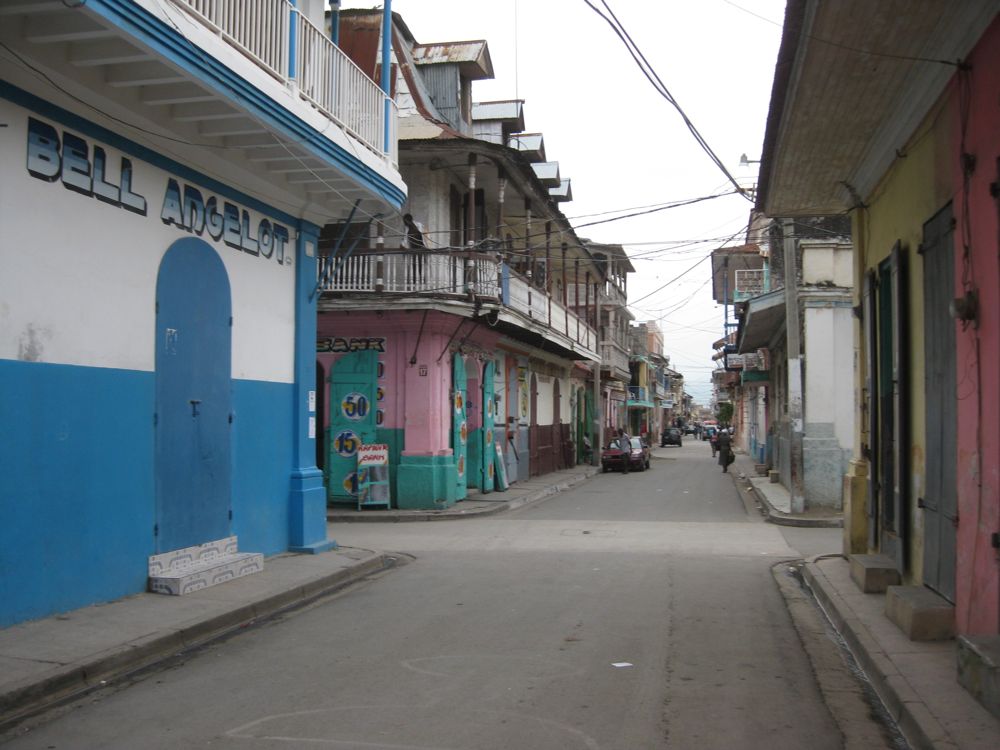
If you squint your eyes hard enough, it almost feels like you’re in a really colorful version of New Orleans.
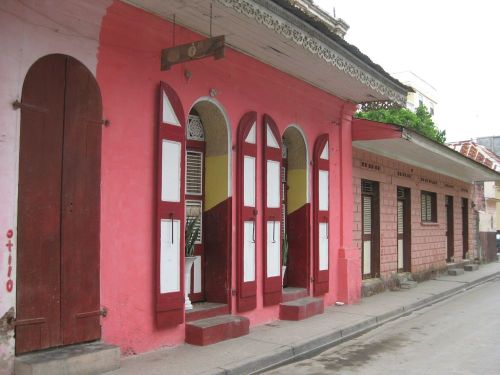
One thing Cap Haitien definitely has going for it is navigability. When US Marines ran the country for 20-odd years back in the early 1900s, they got sick of Cap Haitien’s French street names. They decided to rename the streets Rue 1…2…3… and A…B…C… That, coupled with the very small blocks (you can easily walk a block in 30 seconds), means finding anything in the city is a breeze.

Something is located at 18C? No need to look at a map. you already know exactly where it is.
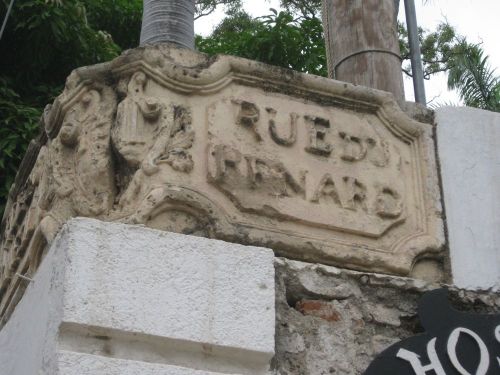
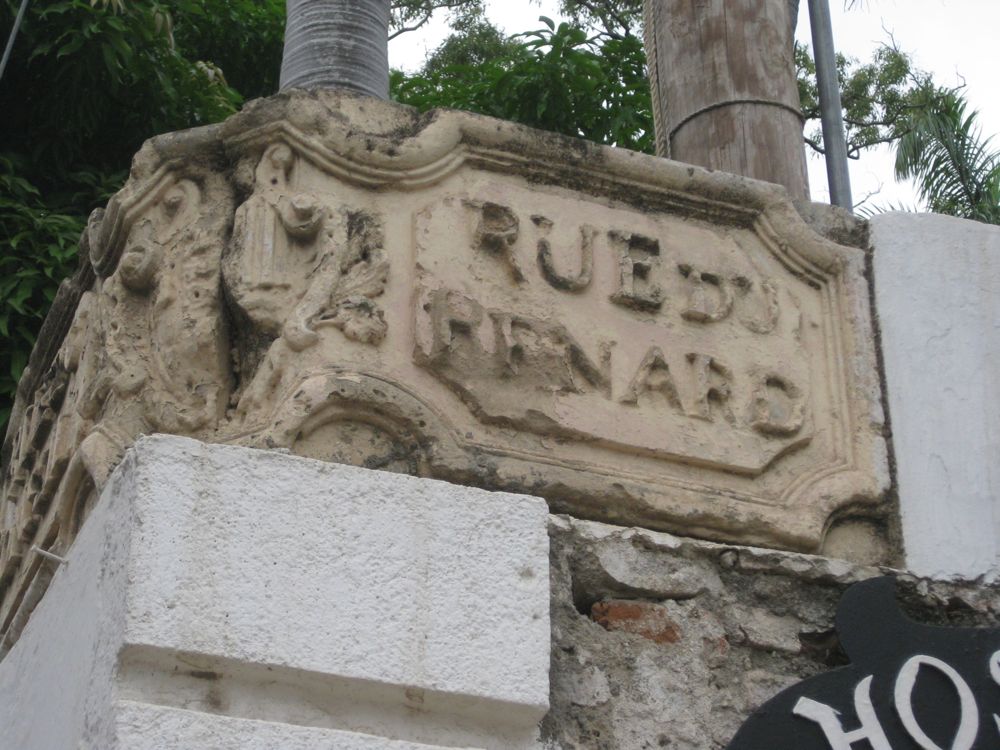
Of course, the beautiful old French street names were a casualty of all this. You can still see them all over–it’s an easy way to tell if a building is actually really old, or just looks old.

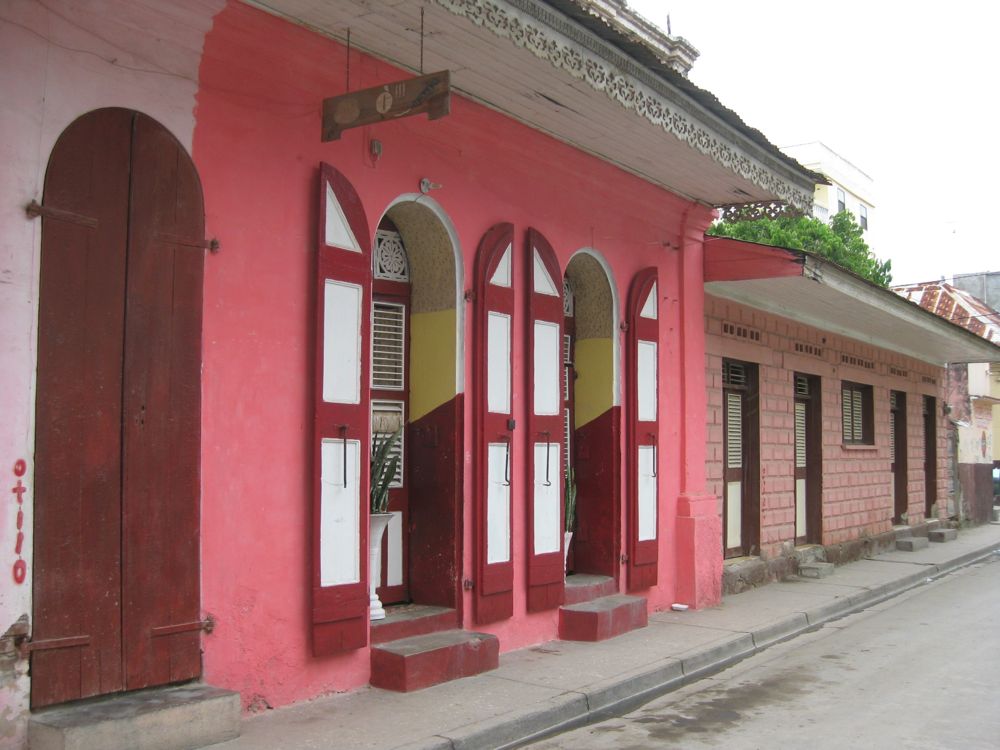
Historic buildings, by the way, are subject to some shades of grey here. This building has a real historic first floor, but is being added onto in the modern way. Which means cheap, ugly cinder blocks. Sadly, when finished, the whole thing will probably just get covered up with plaster and painted, so you won’t even be able to tell it’s 150 years old, except by the arched doorways.

I’m sorry to say that the same construction practices that failed so catastrophically during the earthquake in 2010 still appear commonplace. Cheap concrete blocks. Patchy mortar. A rebar-supported column every 8 or so feet. And new construction is everywhere–the living chaos that is Port-au-Prince these days has sent a lot of economic activity up north. People are buildings things everywhere (hotels are accordingly expensive–touring Norway would probably hit the wallet about the same).
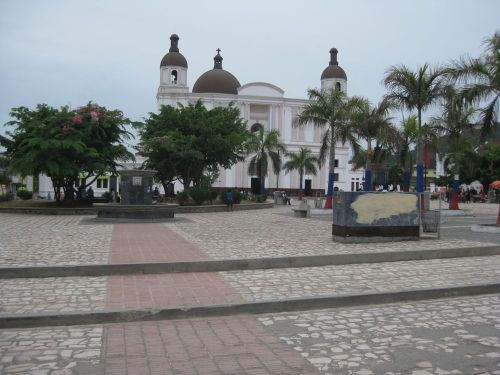
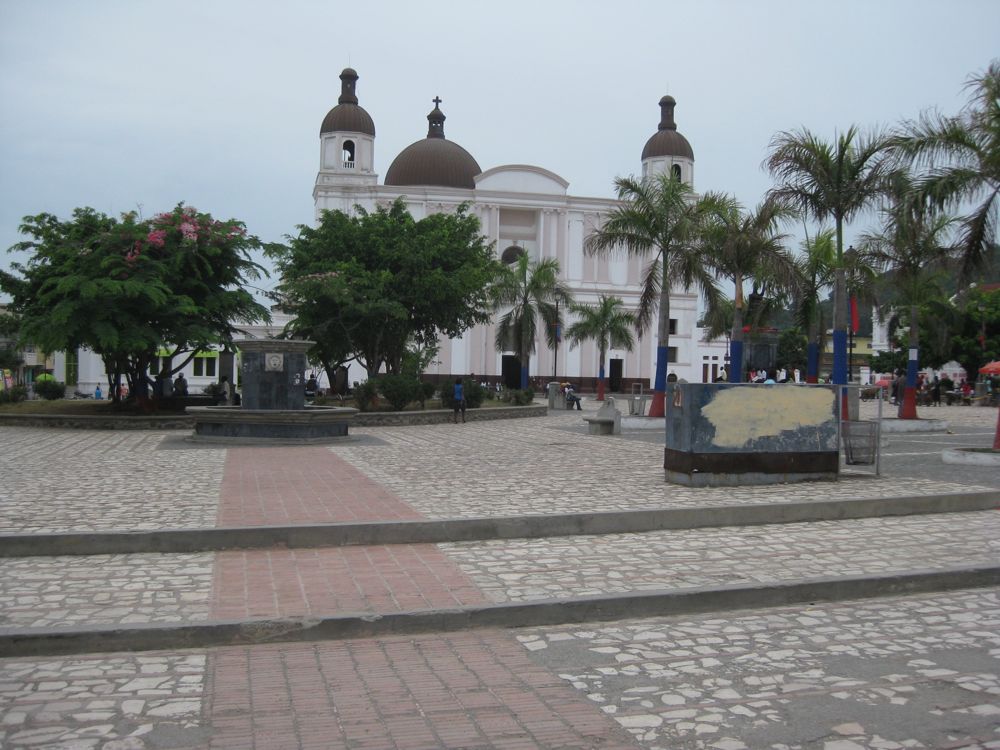
To focus on things that are a bit more positive for a moment, here’s Cap Haitien’s pleasant central square.
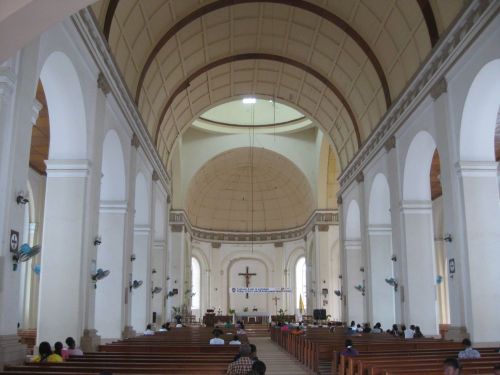
The main church.

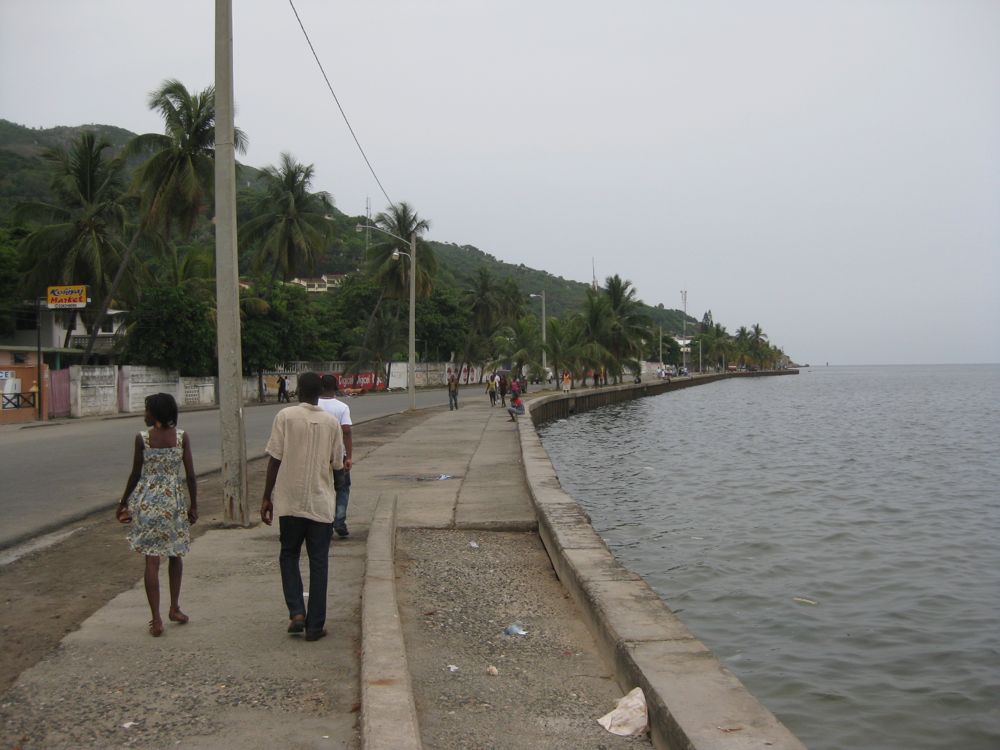
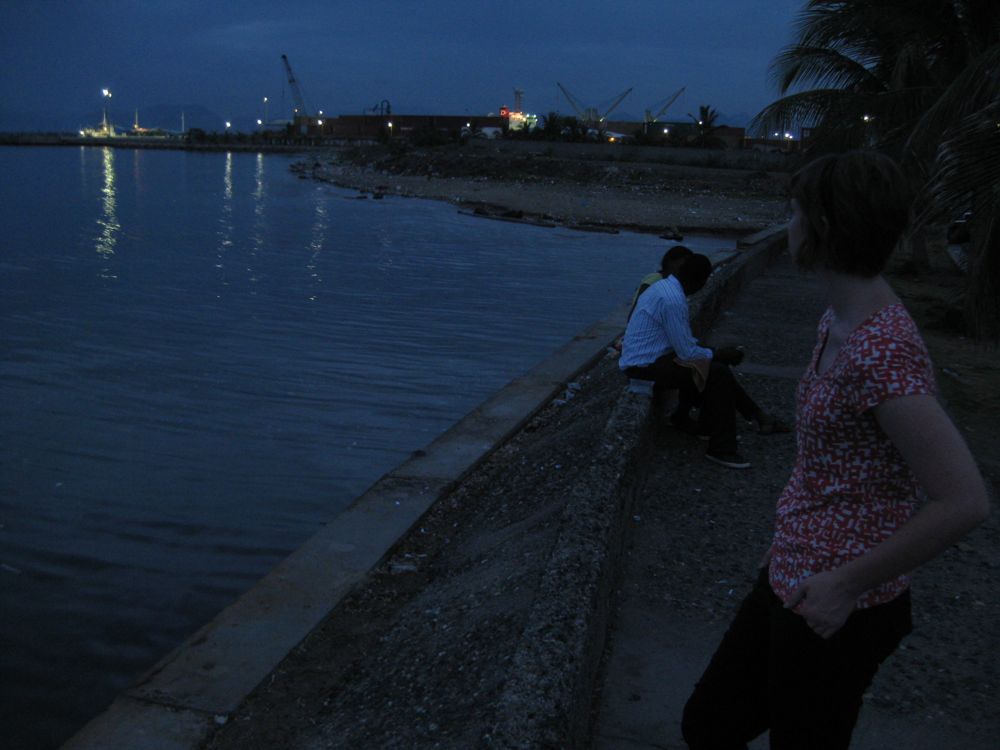
Caroline looking at the port at dusk. We called this area–the part of Blvd de Mer that is scenic rather than sketchy–the Malecon, as it would be called in any Spanish-speaking country, although I have no idea what the French would call it.
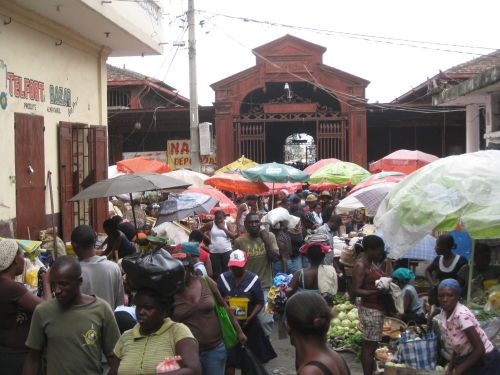
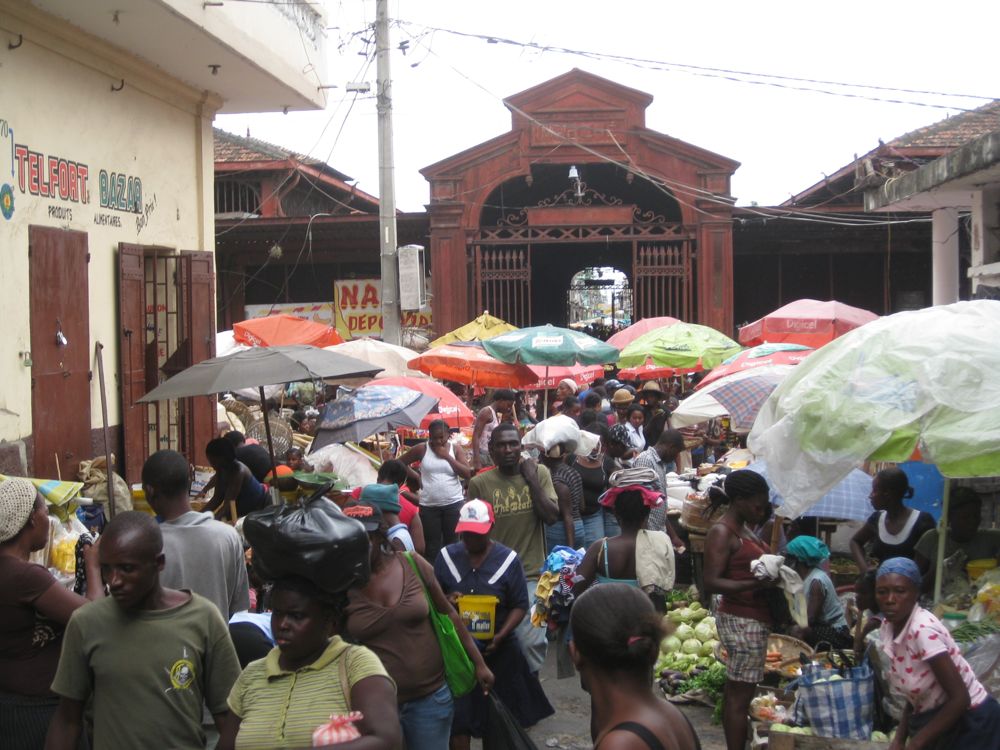
The main marche, south of the square. I’ve been to a lot of markets, and I can say that this one is the most dirty, hectic, and chaotic I’ve seen. It makes Maputo’s chicken market seem tolerable. When open sewers meet unpaved market streets, it’s a very rough situation indeed. Every sense is assaulted. Never sketchy or unsafe feeling, though.

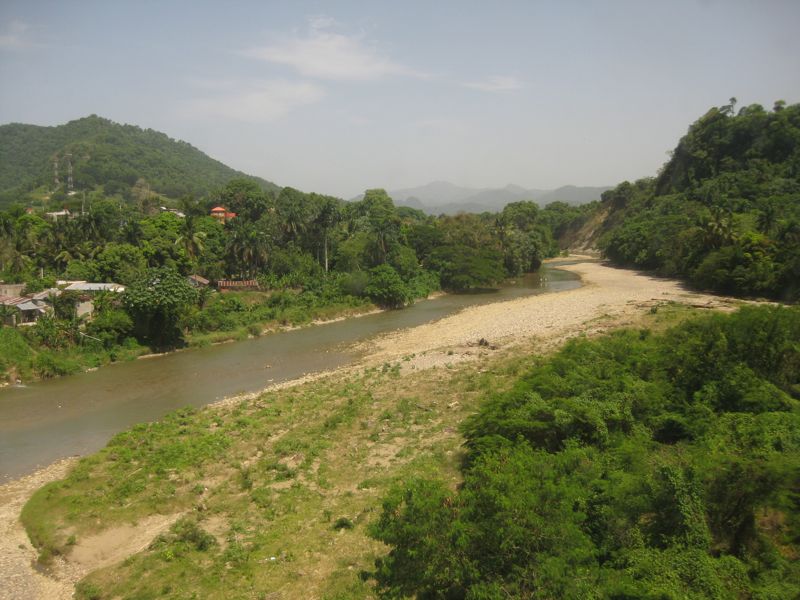
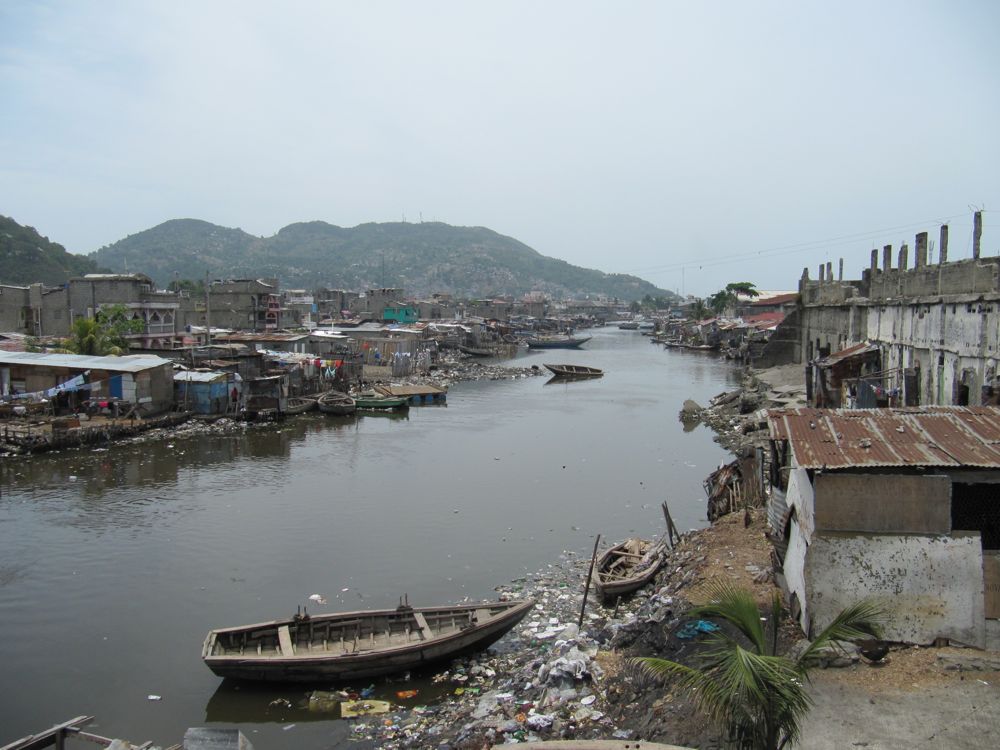
A bit further south–still in the market chaos–is the bridge over Cap Haitien’s main river, just before it meets the sea. Since this is where the roads come together, this is where the tap-taps (minibuses, sort of) leave from. I wish I had more pictures of this area–it’s an incredible, unforgettable sort of place–but alas, you are in a column of people and if you stop for more than two seconds people get antsy.

I’ll try to snap a few more next time. Au revoir!

Posted by: Caroline | June 22, 2012

27 Waterfalls

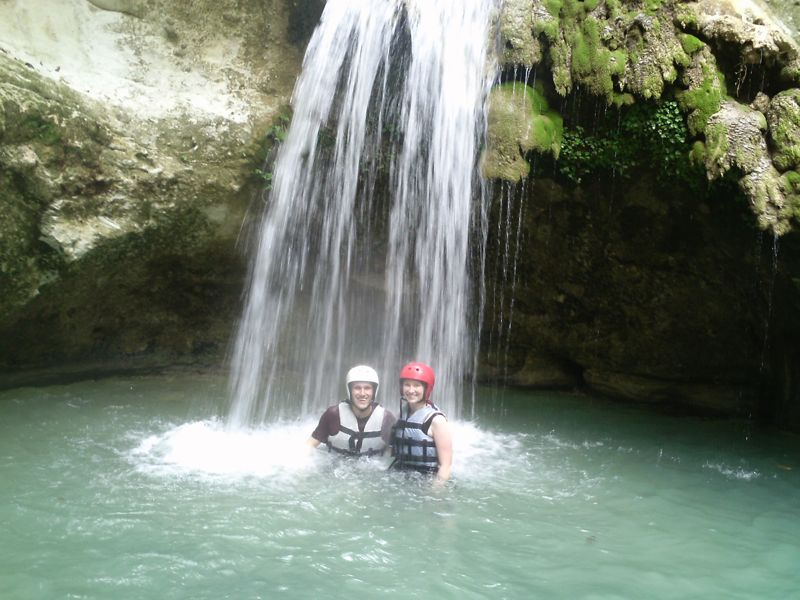
Alex and I have been lucky and/or stupid enough to do some incredible things during our travels, so trust me when I say that Damajagua is somewhere you need to be NOW. It is one of the most thrilling and enjoyable travel experiences we have had.

The Damajagua waterfalls flow into the Baja Bonita, which you see on your way into Puerto Plata.

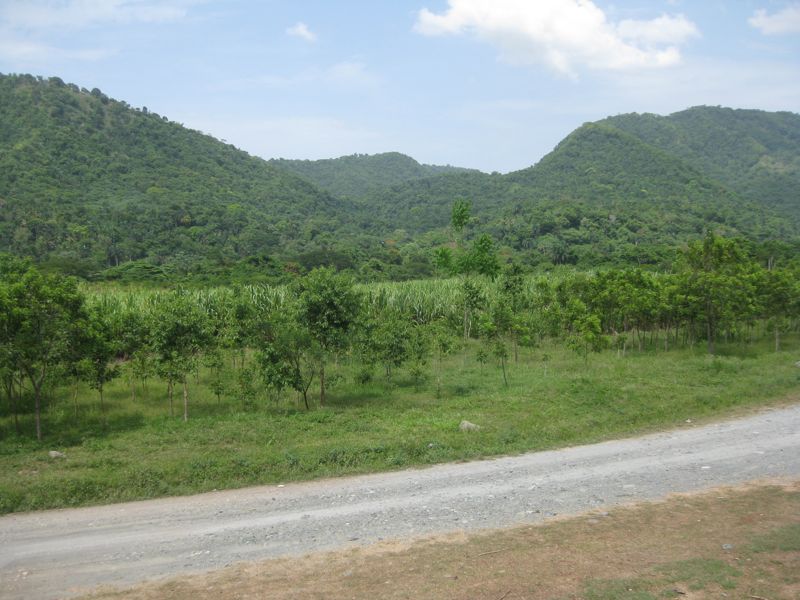
To get back to the waterfalls, you take a 50-peso guagua (minibus) ride through the green countryside to Las Cascadas, the 27 Charcos.

From the roadside sign, it’s a one kilometer walk to the visitors center. The waterfalls were once a very fly-by-night, low-to-the-ground operation, but some Peace Corps volunteers helped implement some new safety features (life jackets, helmets, mandatory guides) and build a visitors center and low-key restaurant. It still feels very community-driven and independent-traveler friendly–just great some added benefits.

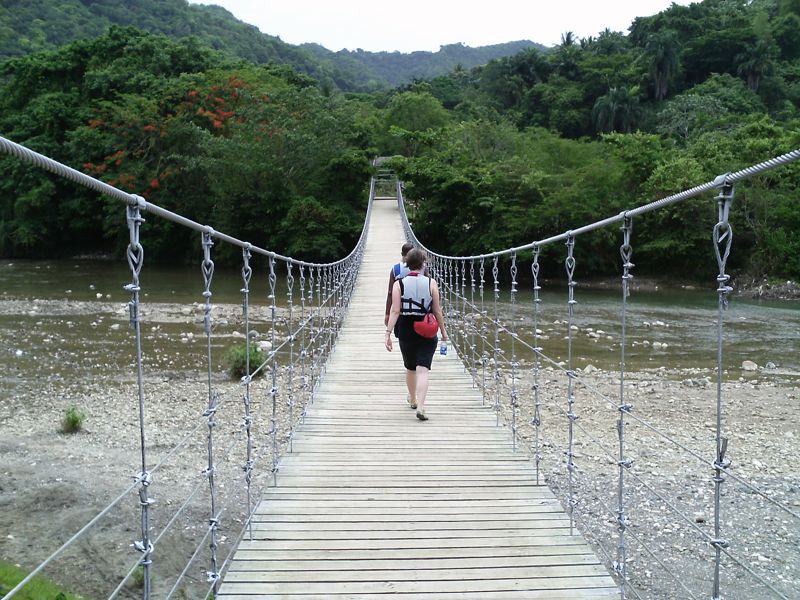
The bridge across the river is one such benefit. Earlier fall-jumpers had to wade across this thing (or so says our ever-present companion, the Lonely Planet guidebook).

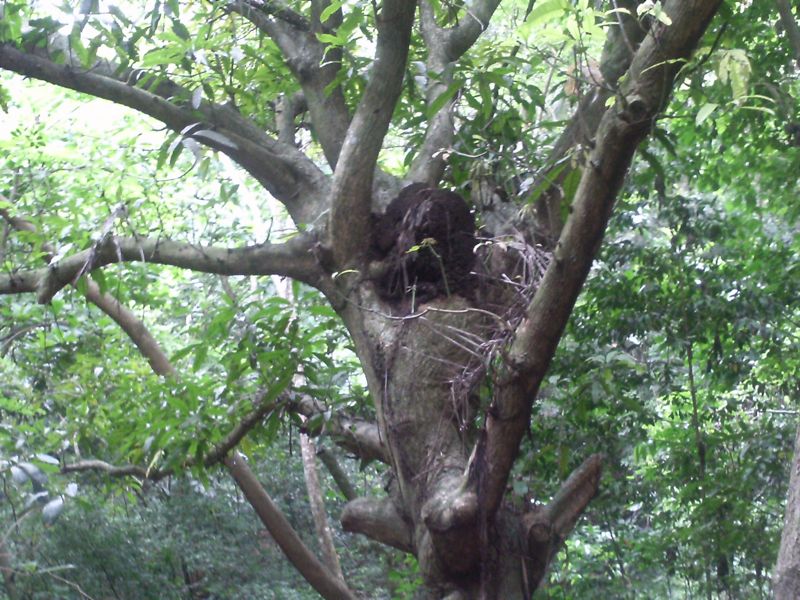
Although it is possible to do a truncated version of the trip, we decided to attempt all 27 waterfalls because– go big or go home, right? Shorter trips take you up the waterfalls themselves, but the full gamut takes you through a gorgeous rainforest path–complete with banana trees and termite…mounds?

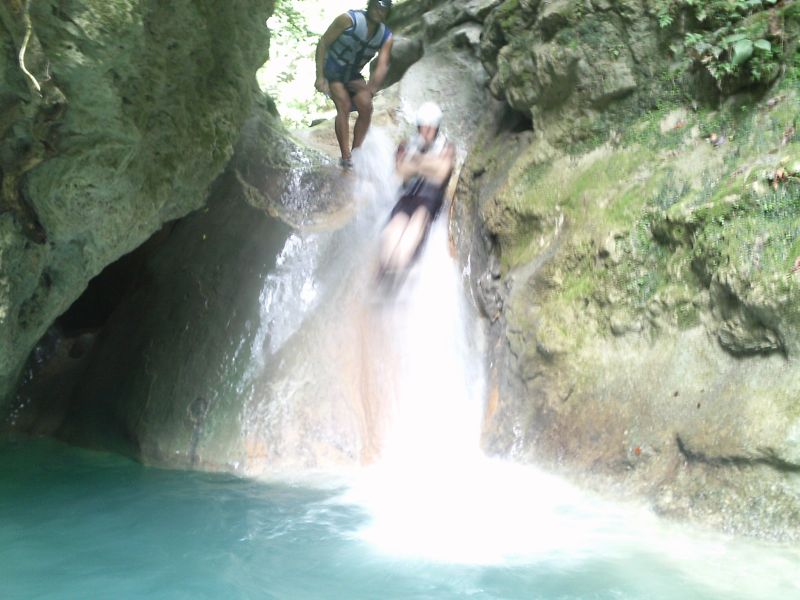
At the end of the trail, you get to experience your first waterfall–a baby compared to some of them. We got to swim in the natural pool, jump off a smallish rock ledge, and warm up for our long journet slipping and sliding down the river. 27 waterfalls lives up to its name; we truly slid…

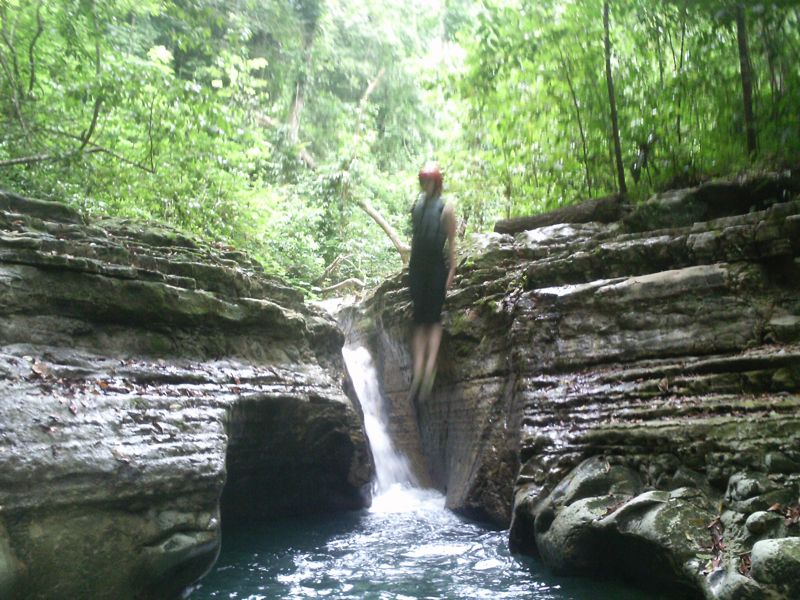
…or jumped…

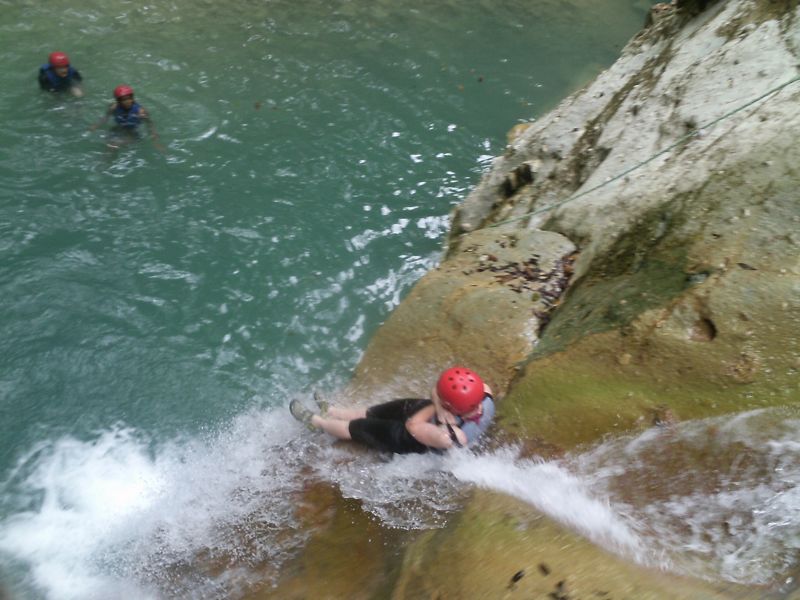
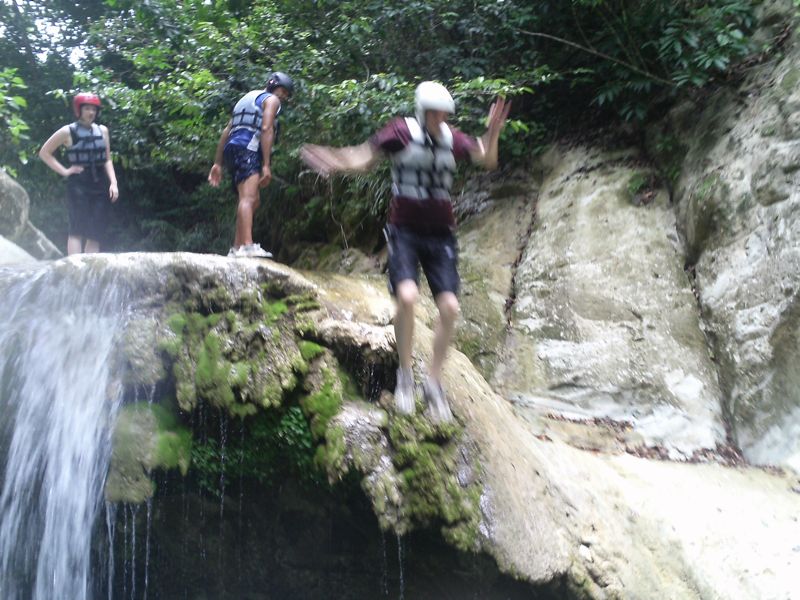
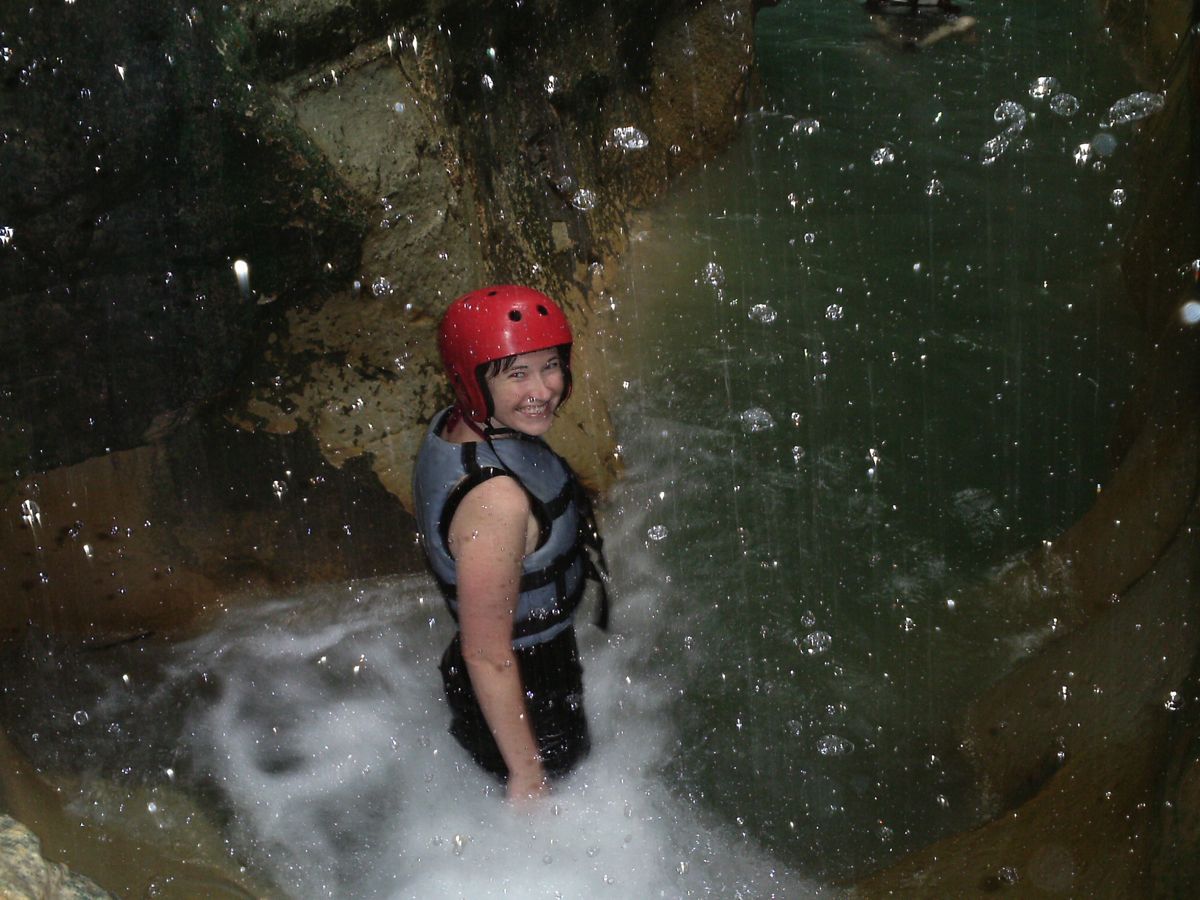
…down 27 waterfalls.

Some were as high as 27 feet!
And if pictures aren’t enough you convince you that this needs to be on your bucket list, how about a video?


Posted by: Caroline | June 20, 2012

Puerto Plata

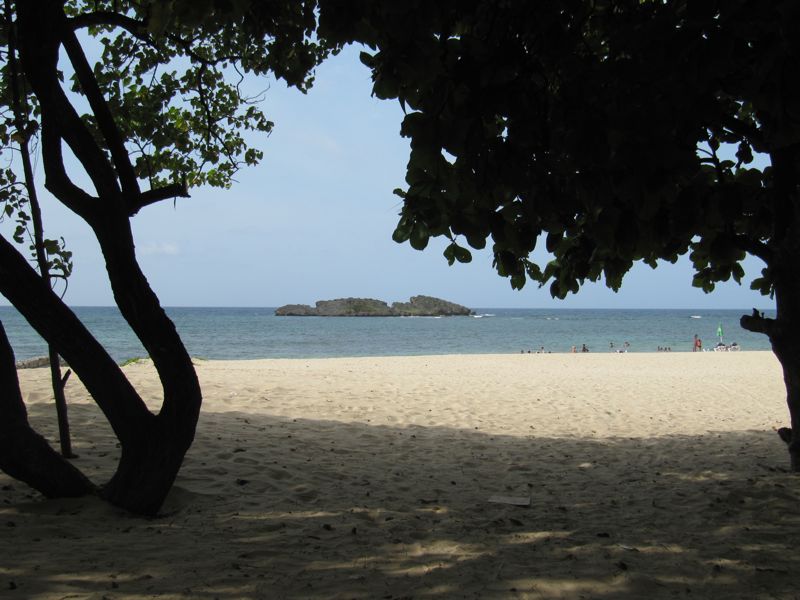
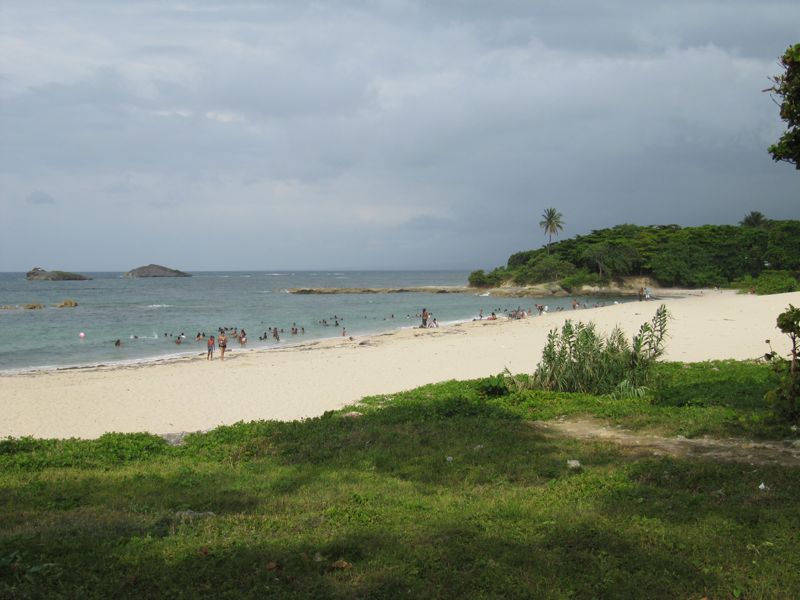
After enduring the grit and grime of Santo Domingo, I desperately wanted to cleanse myself in some non all-inclusive resort slice of the Caribbean. Enter Puerto Plata, a convenient base for our next journey (the waterfalls about a half hour away) as well as a sufficient beach front.

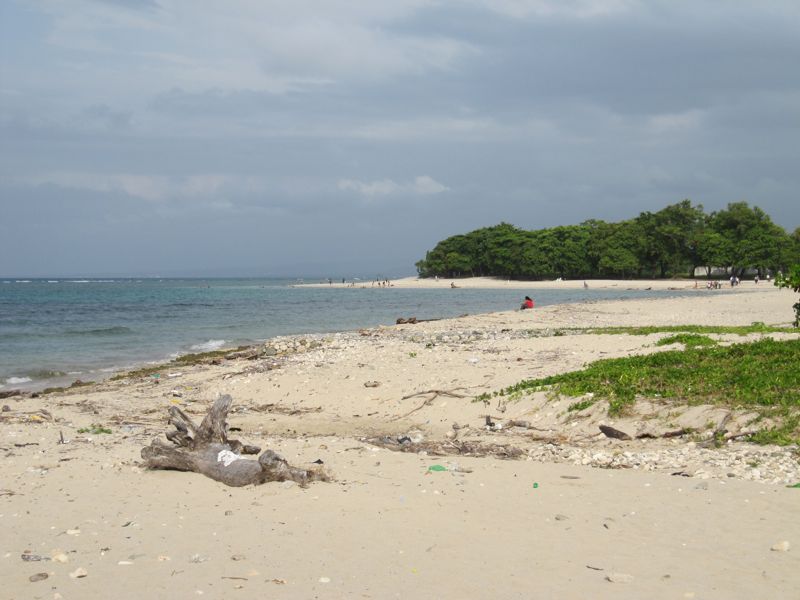
Maybe sufficient isn’t the word. All-inclusives work in the DR because someone is there to pick up the trash. Elsewhere (like here in Puerto Plata), the beach kind of becomes a tragedy of the commons– and an excellent anti-plastic advertisement.

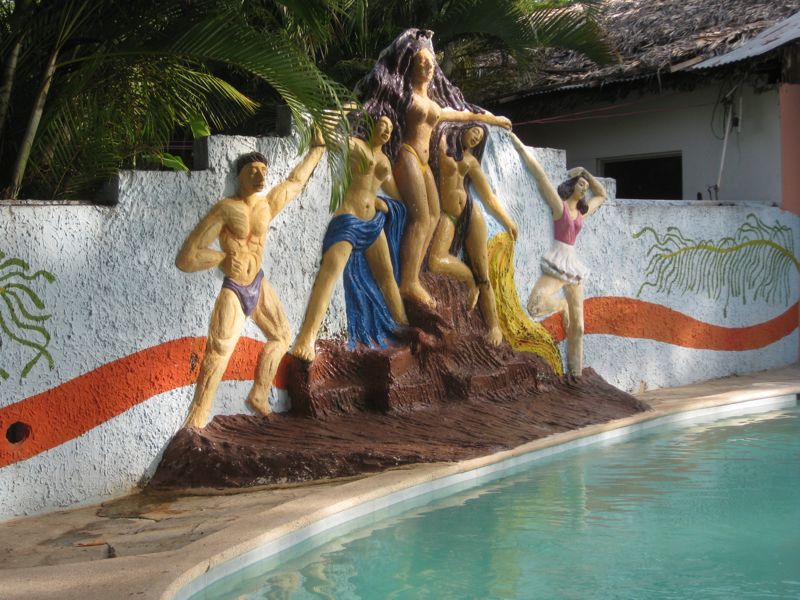
Though we did take one adventurous dip in the sea, most of our water time was spent in the Damajagua waterfalls or the hotel pool. I don’t know which was the better pool time view– the mango trees stretching above us or the kitsch fountain.

With plenty of distance from the trash, walking along the Malecon is quite pleasant (or at least entertaining, as when we saw two guys carted off by the police for unknown reasons while their friends–blasting Dominican rap at 120 decibels, much to the chagrin of EVERYONE else on the Malecon–were left completely alone). That is, until the storm comes in. We did choose to travel in hurricane season…

… but the storm wasn’t that bad. We managed to take shelter before the downpour. And it gave us plenty of time to blog!

Posted by: Alex MacGregor | June 19, 2012

The Oldest City in the New World

Well, Caroline and I are on the road again, and this time we’re sort of doing a pan-Caribbean journey. Of course, we’ll do our best to make sure this is no ordinary trip to the Caribbean.

Our first stop was the Dominican Republic’s capital, Santo Domingo. Founded by Bartholomew Columbus–Christopher’s little brother–in 1498, Santo Domingo is the oldest city in the Americas.

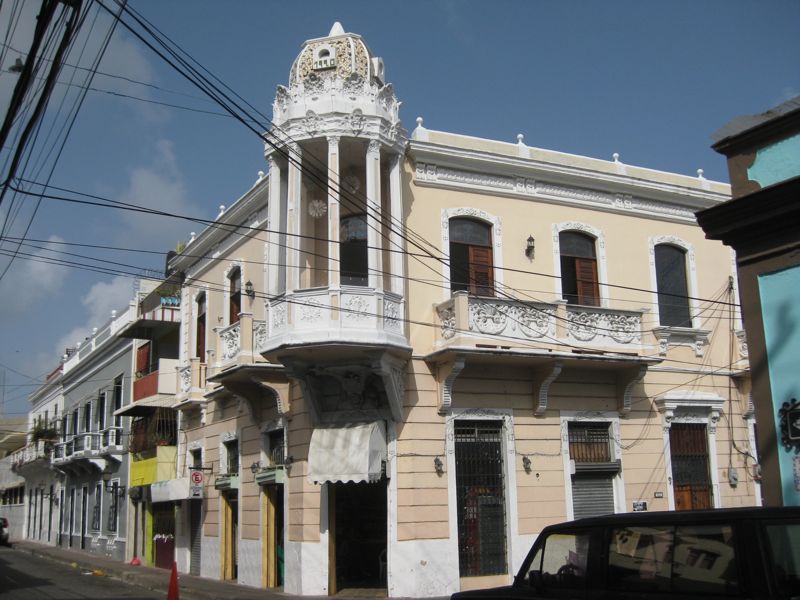
And, moreso than any place we’ve been besides maybe Europe, there’s just a ton of really old-looking stuff everywhere. Many of the walls in the Zona Colonial aren’t the uniform concrete you see elsewhere in Latin America. They’re a patchwork of basic building materials.

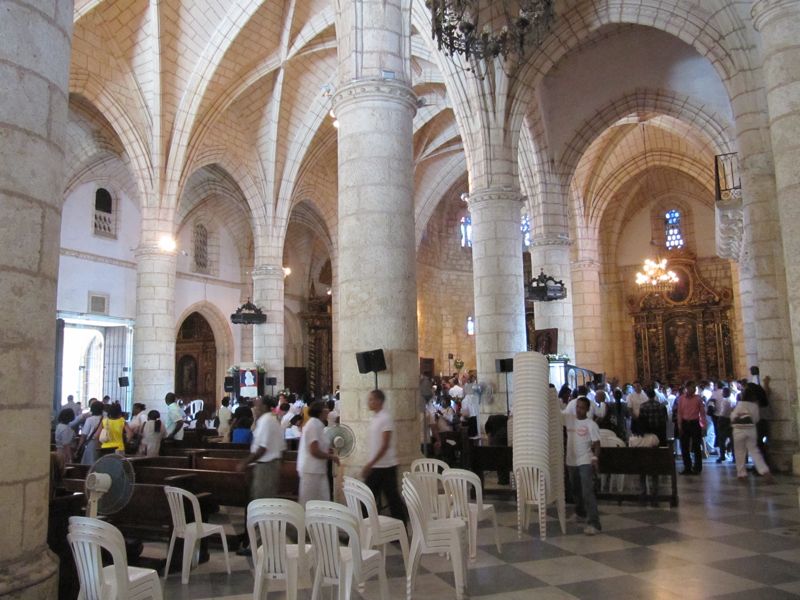
The oldest remaining church in the Americas. There was a graduation ceremony finishing up at the time we visited–cause for many plastic chairs to be brought in to supplement the pews.

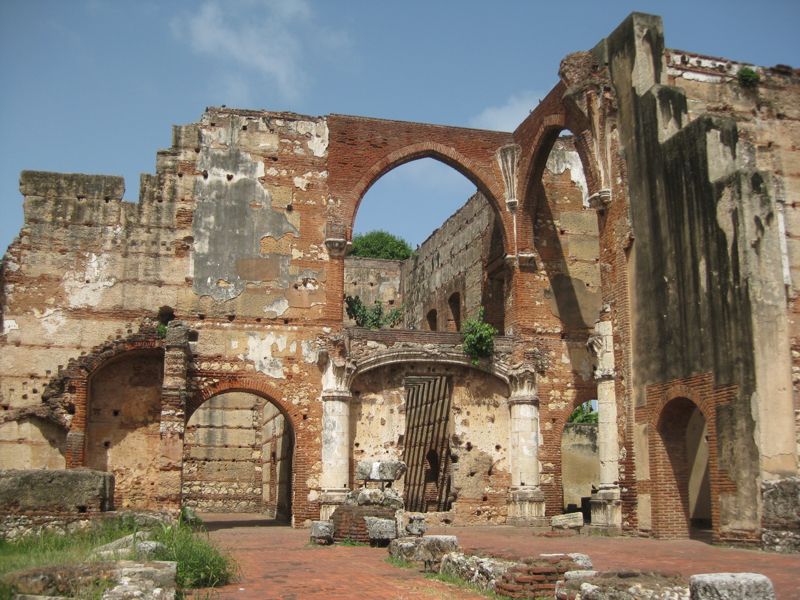
The oldest hospital in the Americas is now a park.

This monastery was a mental health hospital before being abandoned altogether. Now it’s used for the occasional concert or play.

Or as baseball diamond for the neighborhood kids (old concrete light pole foundations served as the bases).

Although small, the Zona Colonial seems to be where everything happens. All the fancy nightclubs are here. The tourists hang out here. Consulates and important government offices are here. It definitely feels a lot more like a small city when you’re wandering around, and not a metropolis of 4 million people.

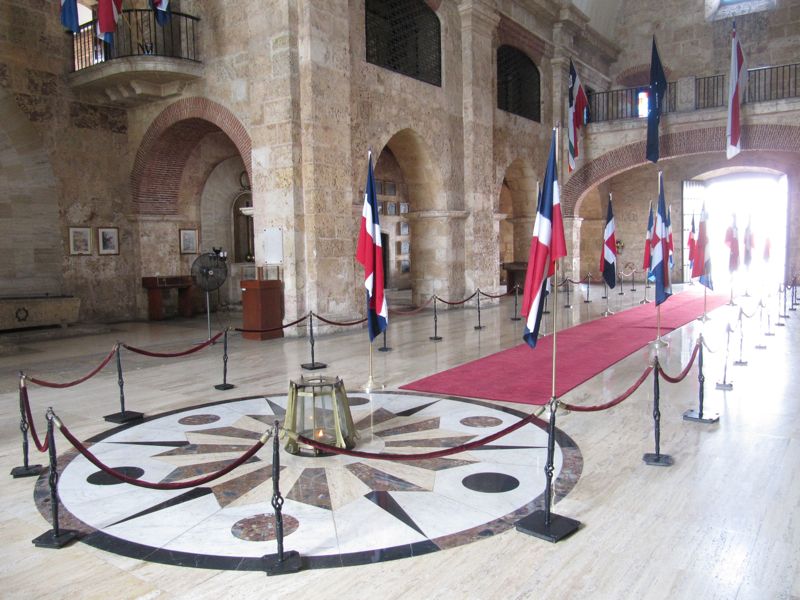
The Pantheon, where most of the DR’s main government events are held, is also where you can find…

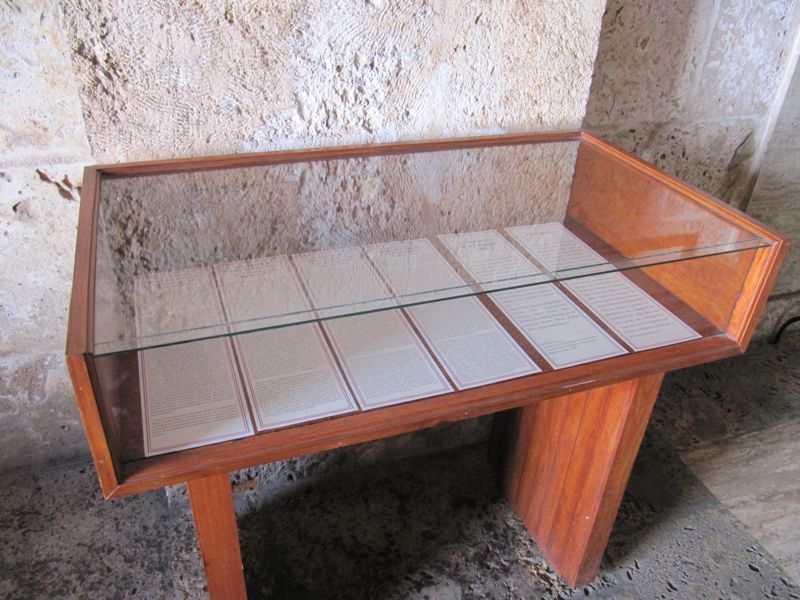
…the Declaration of Independence…from Haiti. Haiti actually controlled the DR for a couple decades back in the 1800s, when it was the wealthier of the two nations. The DR fell back under Spanish rule for a while after this declaration, but so hated was this period of their history that it is still called their independence day.

Honestly, the fact that Santo Domingo is the DR’s capital probably makes it less of a tourist destination than it otherwise would be. Traffic jams and big trucks clog the narrow streets, filling them with choking exhaust. Tangles of wires are above every street, sullying just about every picture you try to take.

Of course, there’s the obligatory picture of somebody doing something utterly reckless: in this case, lowering an air conditioner’s condensing unit from a 2-story building by the power chord, without even watching out for whether someone was walking below…

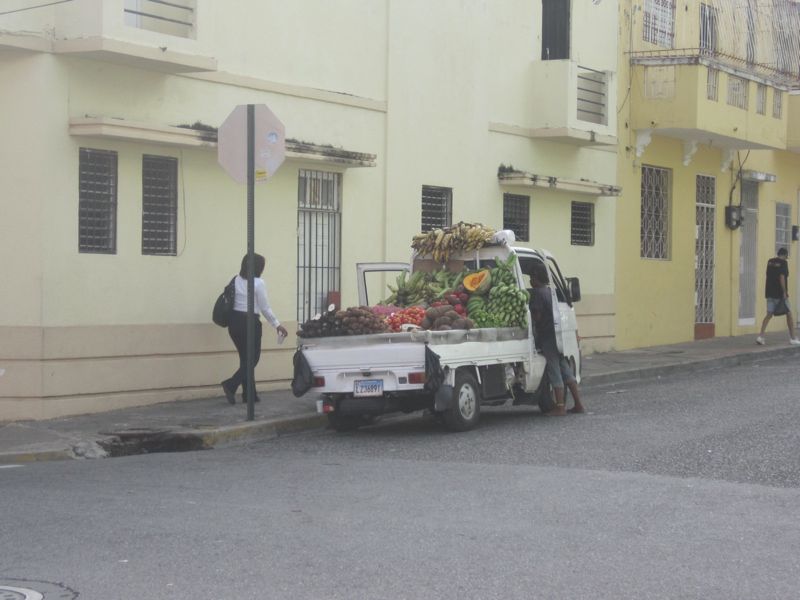
…and the truck comically overloaded with produce.

The colonial city’s Malecon, instead of being tranquil and scenic, is so clogged by all forms of traffic that simply crossing the street is a game of frogger.

Once you get to the Malecon, you can check out an old fort…

…or get a nice view of the city.

But it requires a pretty carefully framed picture to hide what’s actually going on. The trash floating in the ocean is simply staggering. Supposedly, another couple miles down the Malecon, is gets rather nice. Alas, we were sans car and had already walked a painfully lang way through the heat to get this far.

On the way back to the Zona Colonial, I stopped and grabbed a Coke that definitely hit the spot.

It’s not exactly fair to judge Santo Domingo like this. Instead of comparing it to colonial gems Granada, Nicaragua or Antigua, Guatemala, it really ought to be compared to Managua or Guatemala City. And the colonial district is certainly a heck of a lot nicer than anything in either of those cities. It also feels a lot safer, and we seemed to get hit up for cash or some sort of random service relatively seldom.

Modern art on display in the Zona Colonial.

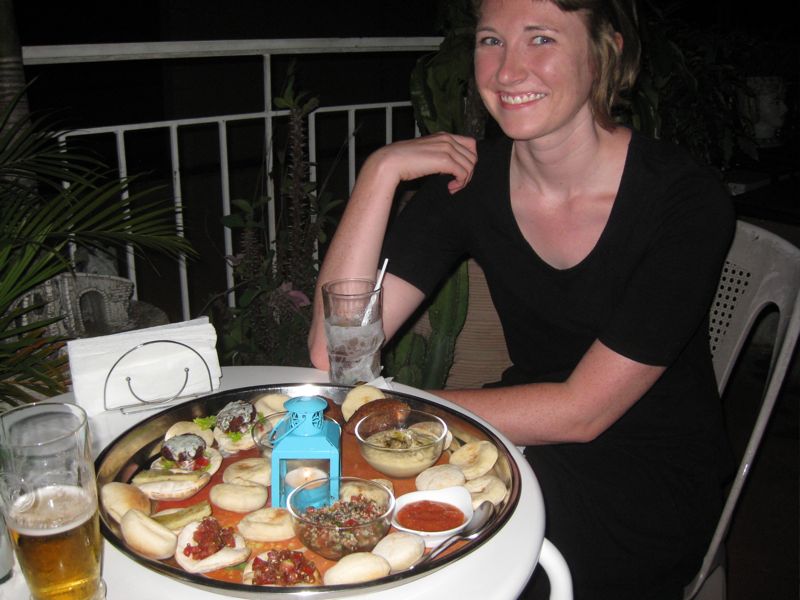
For some reason, Dominicans really seem to like Mediterranean food. Shawarma is a fixture on menus at all sorts of restaurants. Caroline and I enjoyed a fantastic Mediterranean feast.

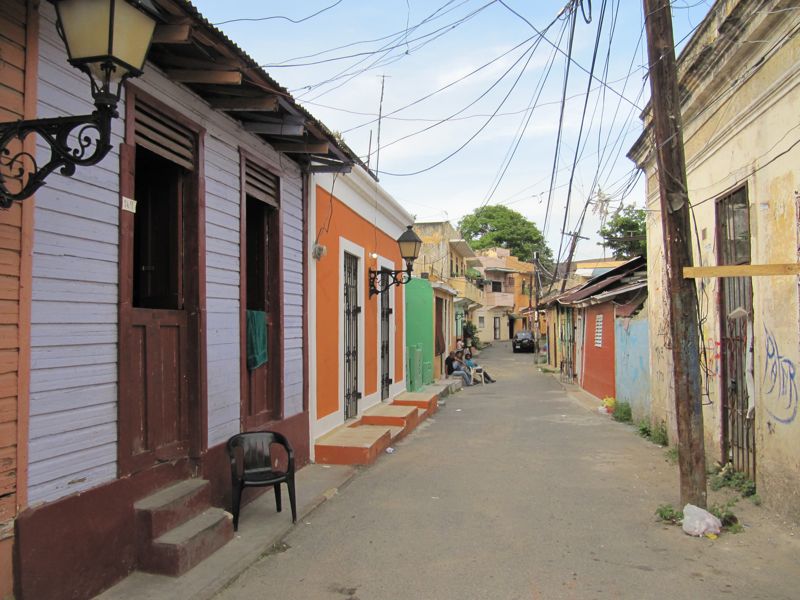
The Zona Colonial’s colorful backstreets, filled with old wooden houses. Everyone hangs out on the street in the DR. It’s a pretty cool vibe: self-contained bars are kind of uncommon. It’s far more typical for a “liquor store” to set tables up on the sidewalk, and customers just enjoy their beverages right there.

The old wall of the colonial city separates the gringo-friendly district from…well…the rest.

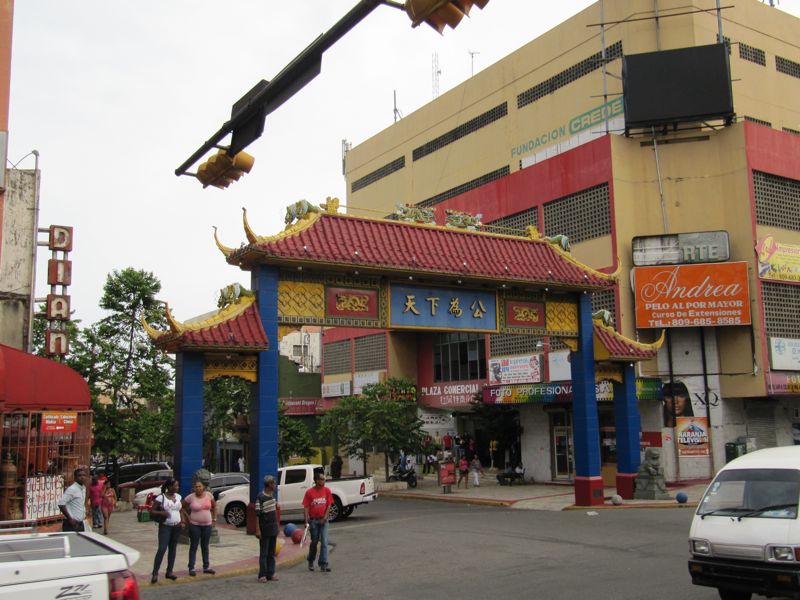
Just outside the city walls is the city’s Chinatown. Not much to say about it–it looked to us like a lot of fairly unappealing Chinese restaurants, many of which appeared to be Dominican-run–but the comparison of cultures was interesting nonetheless. Once you get outside of the Zona Colonial, it definitely feels a lot more like a city of 4 million.

Posted by: Caroline | October 15, 2011

Patagonia

The mountainous, vineyard-filled region of the Mountain Empire is a self-reliant liberal’s paradise.

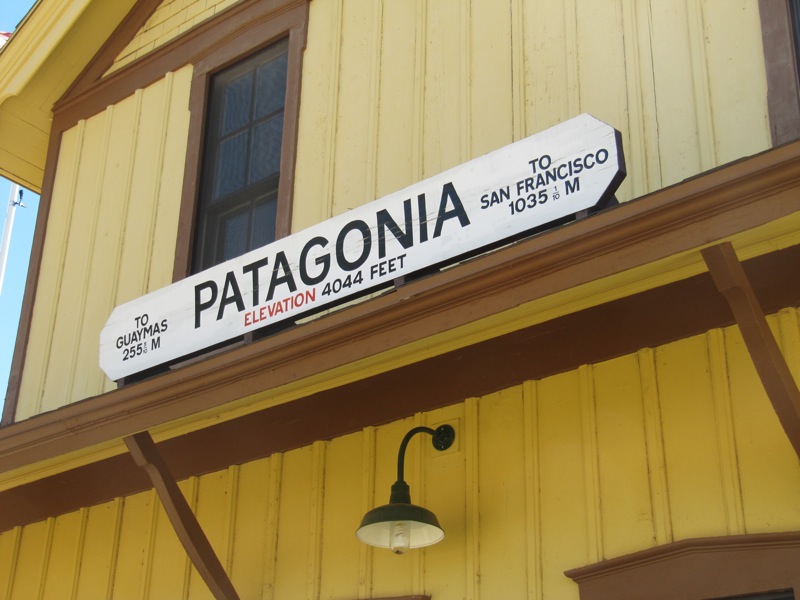
We stopped in Patagonia, home to 800 very positive people, per the rules in the town center.

The local Pilates studio.

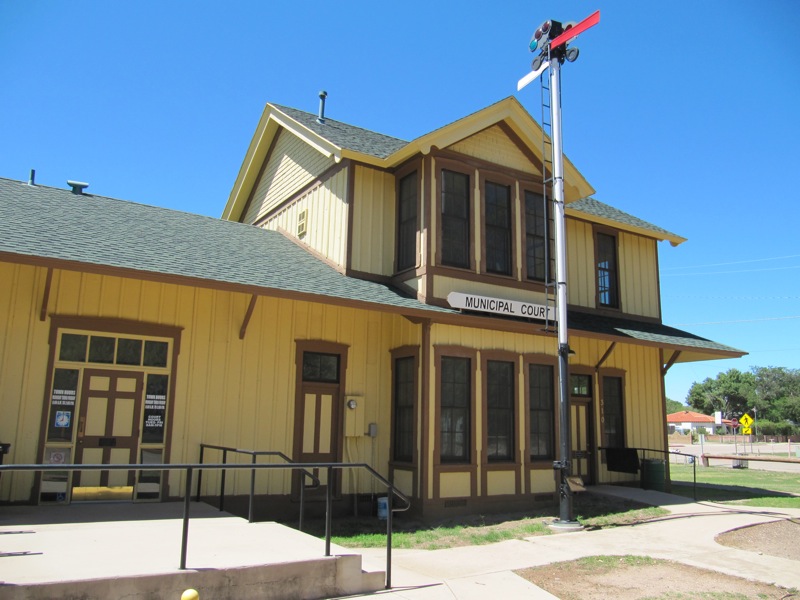
The old train station in the town center.

One of my favorite Arizonan acronyms.

It almost seems like an imaginary place, doesn’t it?

The surrounding mountains make for postcard-perfect shots.

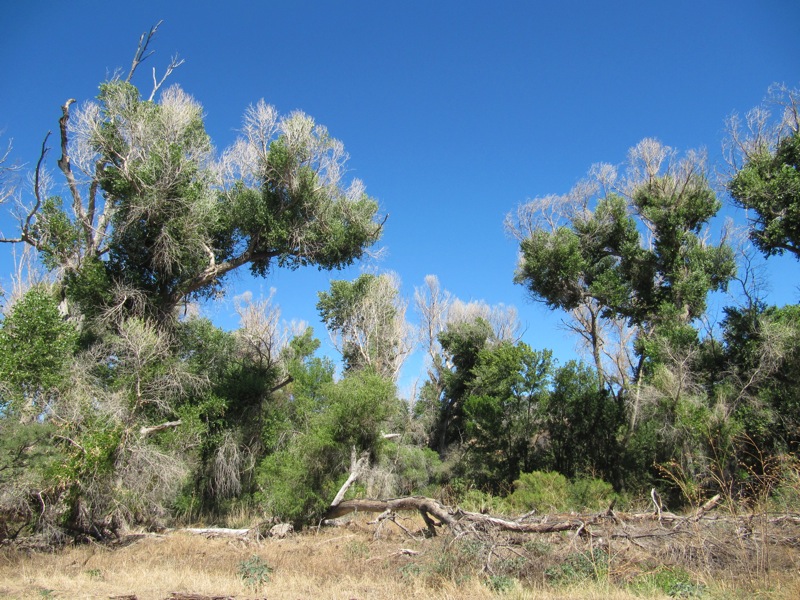
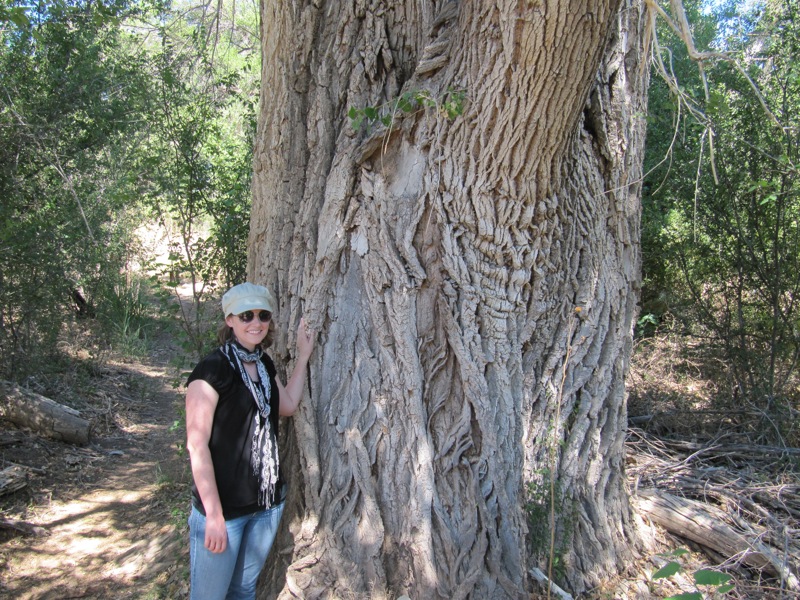
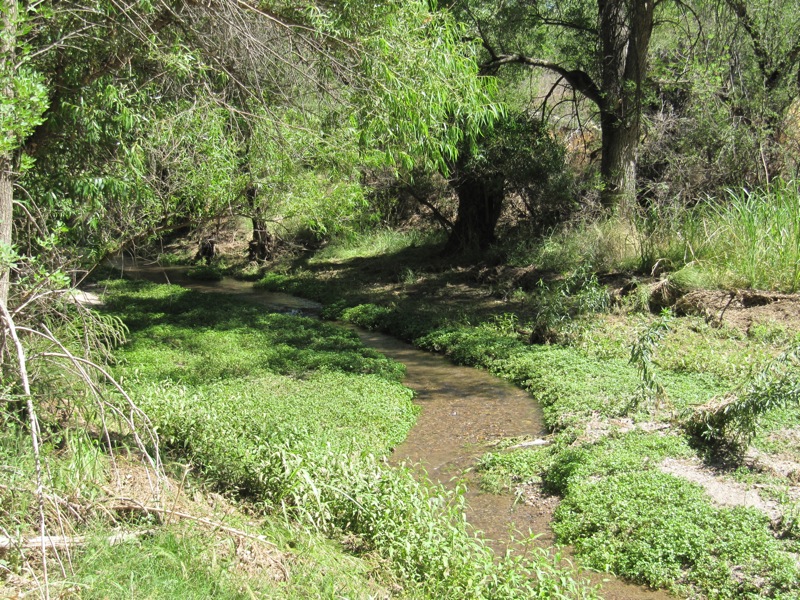
The town is close to an idyllic nature reserve, chock full of nature vistas and enormous trees.

We spotted some mule deer…

lizards…

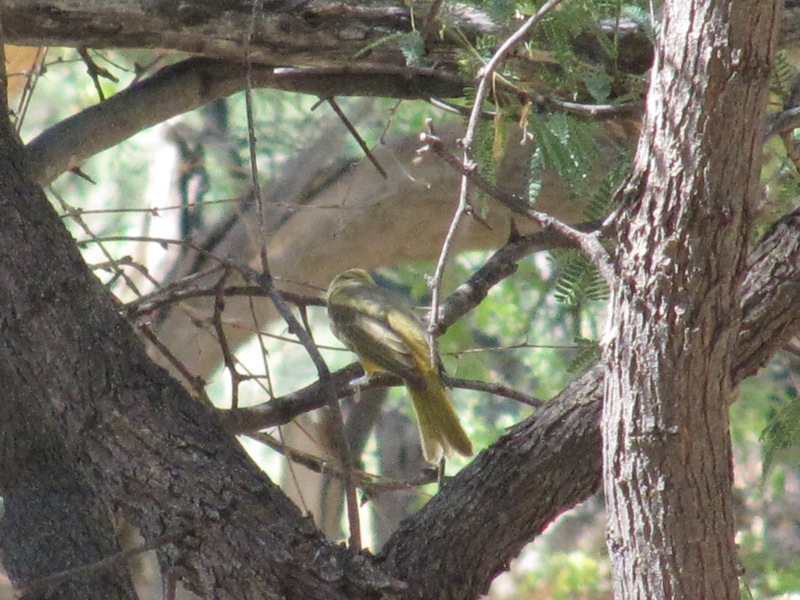
…and plenty of birds.

On the way back to Tucson, we tuned in to the local radio station, KPUP 100.5 (a Lonely Planet guidebook suggestion)–a fluid mix of jazz, rock, and random that keeps the road trip through the Mountain Empire as pleasant to the ears as to the eyes.

Posted by: Alex MacGregor | October 7, 2011

Heroica Nogales

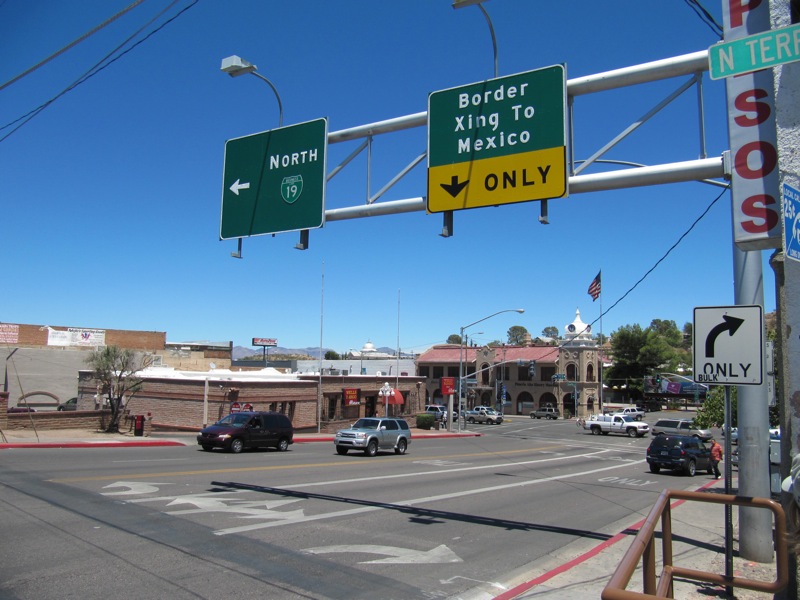
Let’s face it: we’re junkies for a good old border crossing. Whether it’s stopping off in Monaco for a couple frustrating hours or crossing into Kosovo just because, border crossing excursions–even rather pointless ones–are for some reason always on our list. This (also rather pointless) jaunt to Nogales, Sonora, just 60 miles from Tucson seemed like no exception.

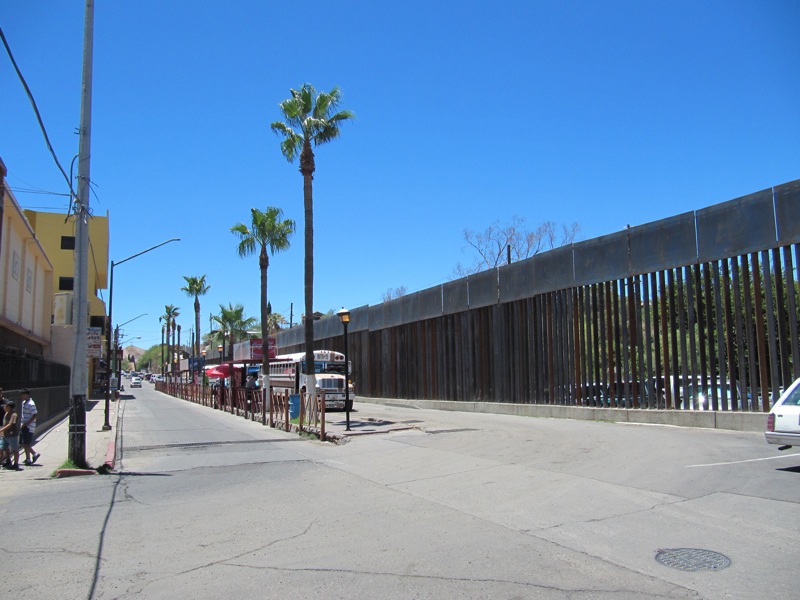
Can you guess which side is which?

Vamos a México!

Ahh, the border. The other side of the border.

Despite its reputation for all sorts of border mayhem–tunnels under the border, narco-violence, and so on–Central Nogales has an almost sleepy feel. Except, of course, for the onslaught of border touts who offer any number of amusing propositions (“Hey amigos, I don’t know how open-minded you are, but…”).

The last train station in Mexico.

The cathedral on the square.

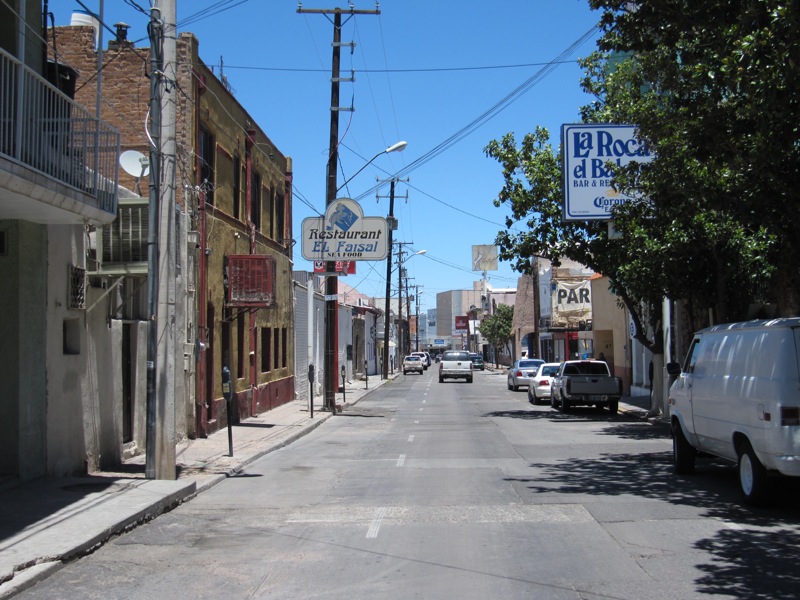
Hidden down a sidestreet within a couple hundred feet of the border, La Roca is Nogales’ go-to restaurant. I went to Nogales with my family several years ago and my dad told me about this place, but we couldn’t find it. Well, this time I was determined to find out what I was missing.

The place is set in a gorgeous Spanish-style house that happens to be built into the side of a rock face (hence the name)…

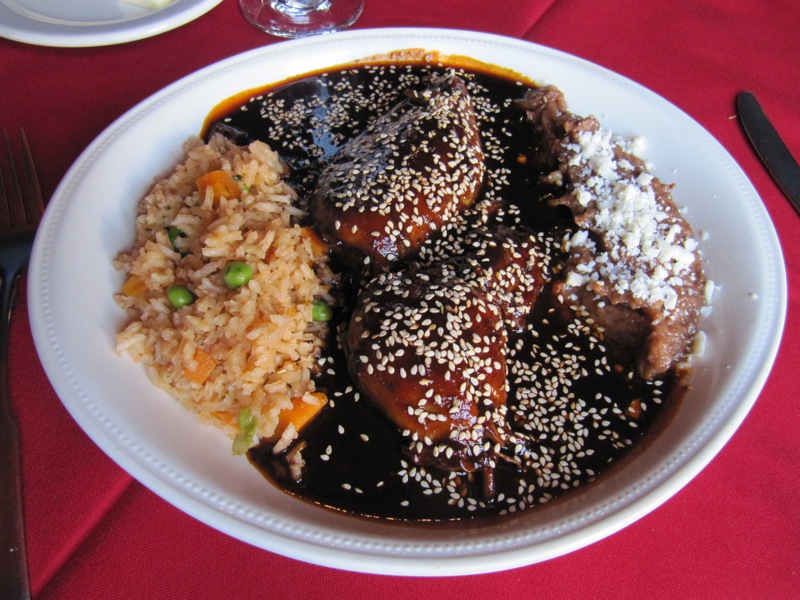
…but it’s the food that really makes this place special. I had a fantastic chicken molé and tortilla soup.

Delicioso!

Posted by: Alex MacGregor | September 19, 2011

Tucson Day Trips

I love a city with lots of nearby day trips. It gives you the opportunity to see lots of new stuff during the day, and soak up the city in the morning and evening (and, in this case, visit my grandmother). Cape Town, with vineyards, Table Mountain, and the Cape of Good Hope–as well as a ton of other amazing stuff–all within spitting distance of town, could probably be crowned the Day Trip Capital of the World. But Tucson certainly ain’t bad either–we found tons of interesting trips close by.

Saguaro National Park

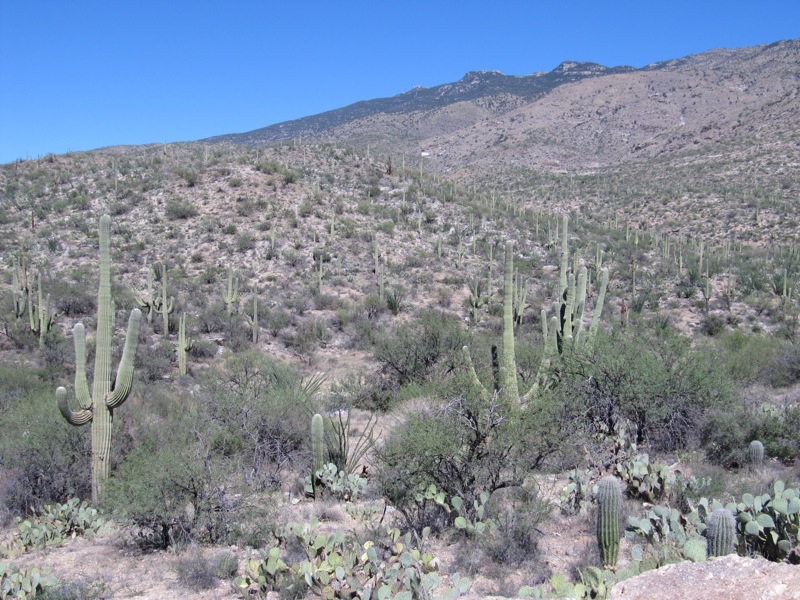
Straddling the city, Saguaro National Park is exactly what it sounds like: classic desert landscapes filled with, well, lots and lot of Sagauros.

Unfortunately, the abundance of dead saguaros underlined the drought Tucson is going through.

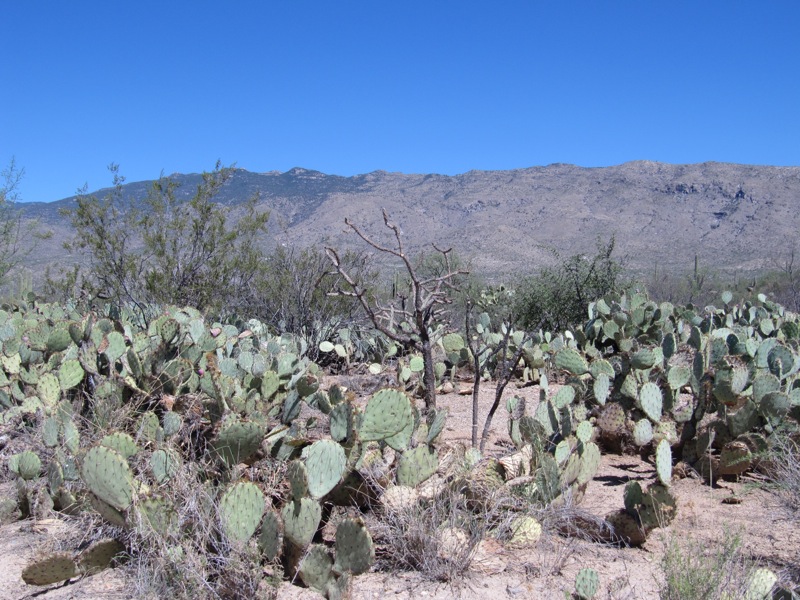
Lack of water defines these landscapes, and everything is covered with spikes to prevent anything from taking the precious water. The concentration of pirckly pears is incredible.

Back at the visitor’s center, we watch from inside the building as javelinas run to escape the desert sun. Apparently these piglike creatures (that most certainly are NOT pigs) are pretty aggressive, and will make short work of a small dog.

San Xavier del Bac Mission

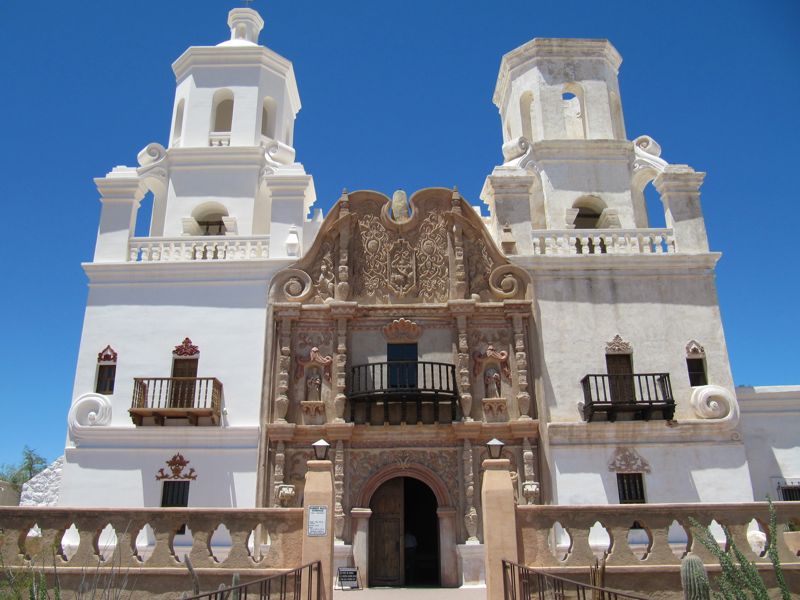
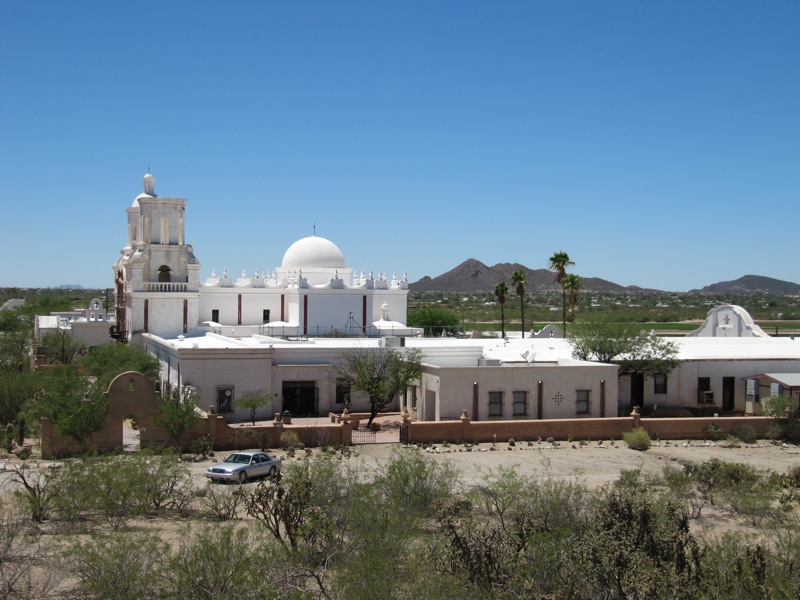
If you need a reminder this part of Arizona was previously part of Mexico (and colonial Spain, before that), the San Xavier Mission, which was constructed in the late 1700s, does a great job: its magnificent whitewashed walls would fit in wonderfully anywhere in Latin America.

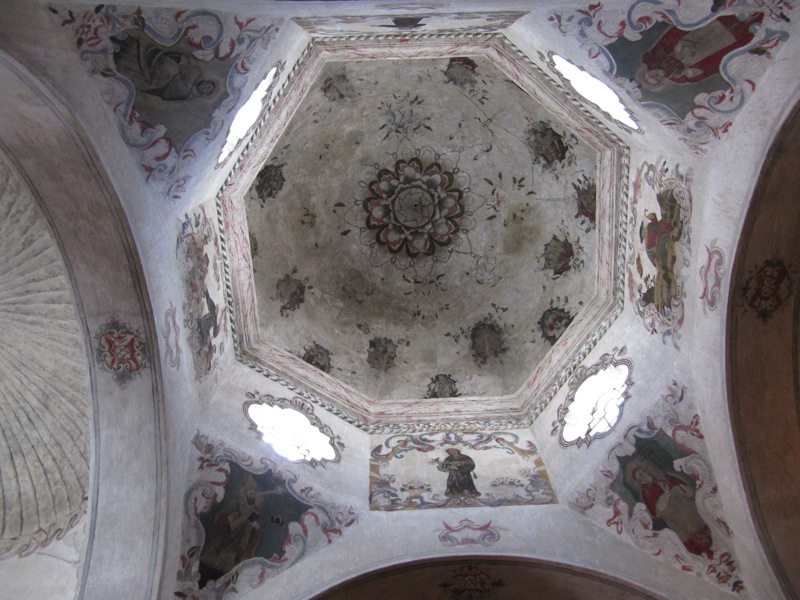
The church has an incredible interior.

Sabino Canyon

If there’s one wonder Tucsonans seemed most proud of, it’s Sabino Canyon, a nature area located in the northern part of the city. And why not? Mile-high desert peaks surrounding a picturesque valley, complete with a flowing stream and oasis-like swimming pools.

Unfortunately, the stream was another casualty of the drought, so we just had to enjoy the desert scenery and ignore the fact that we were hiking in our bathing suits.

We had limited time and water, and after being thoroughly spooked by the horror stories of hiking dehydration at the Grand Canyon we decided to take it easy in the 100 degree whiteout sunshine, so we headed back to the bottom of the canyon.

This cactus almost looks furry!

A crested saguaro near the park entrance, apparently quite rare.

Although we didn’t hike far, we saw tons of wildlife–pretty surprising, given how dry it is!

Posted by: Caroline | September 13, 2011

Tucson

After a stay in clean-cut, conservative Phoenix, Tucson’s funky desert charm is irresistible. The nearby University of Arizona injects youth and vibrance into the saguaro-filled city.

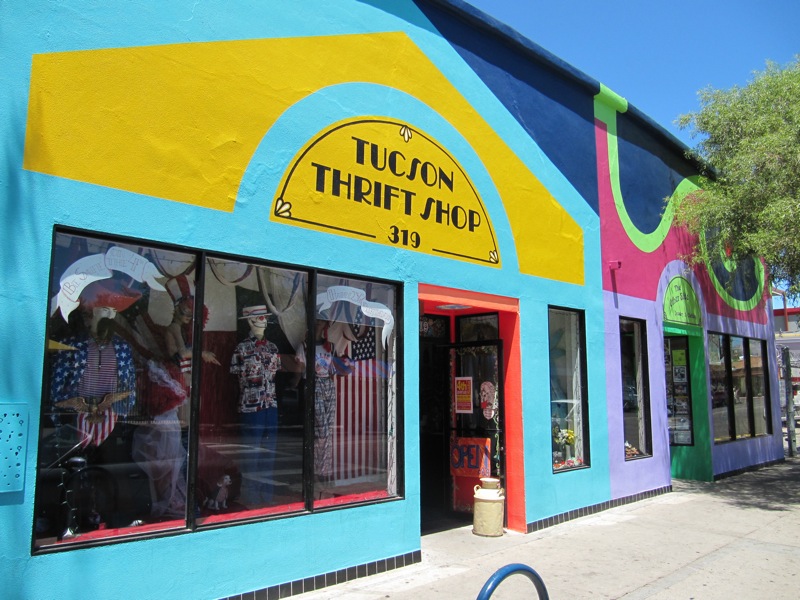
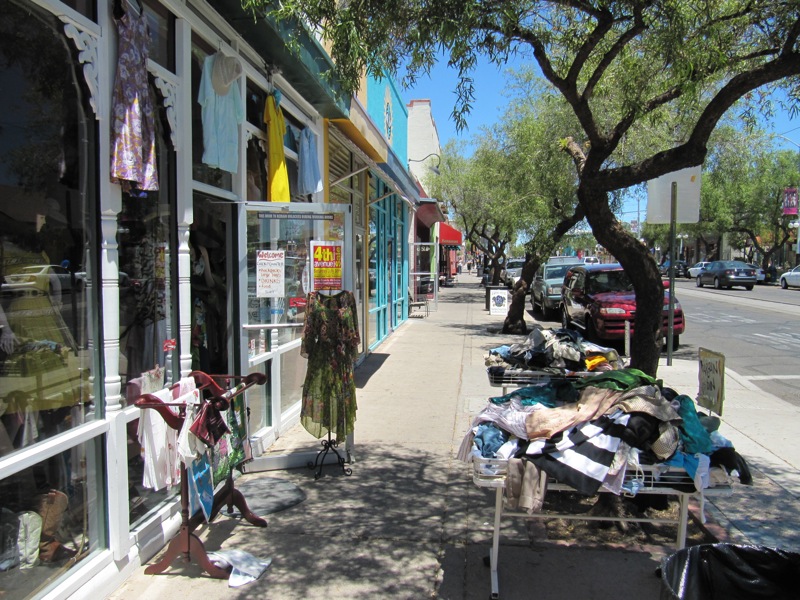
Fourth Avenue is the premier shopping, eating, and nightlife district. With its bold colors and vintage stores, the street is like a mashup of downtown Athens and Atlanta’s Little Five Points.

The open courtyards remind me a lot of Nicaragua and are a must in such a sweltering place. At least there’s iced coffee to keep you cool.

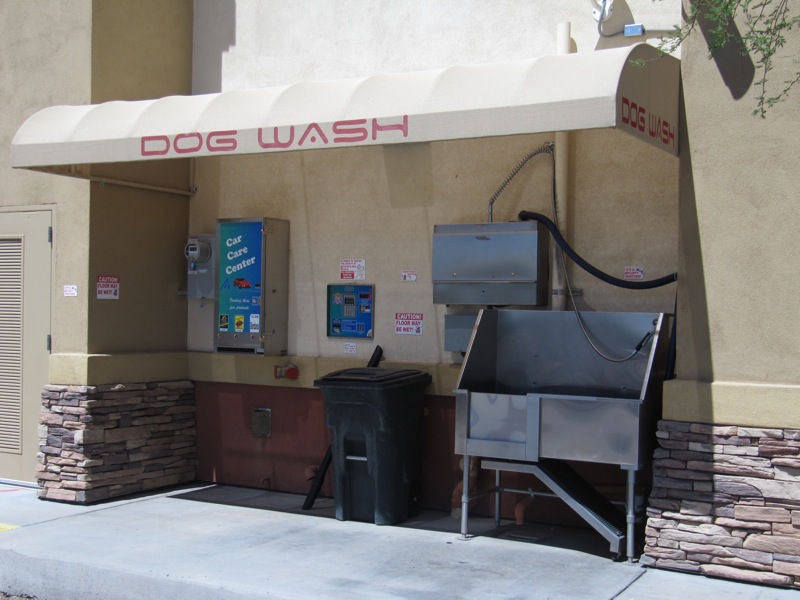
Can you imagine seeing this sign in Phoenix?

Or this?

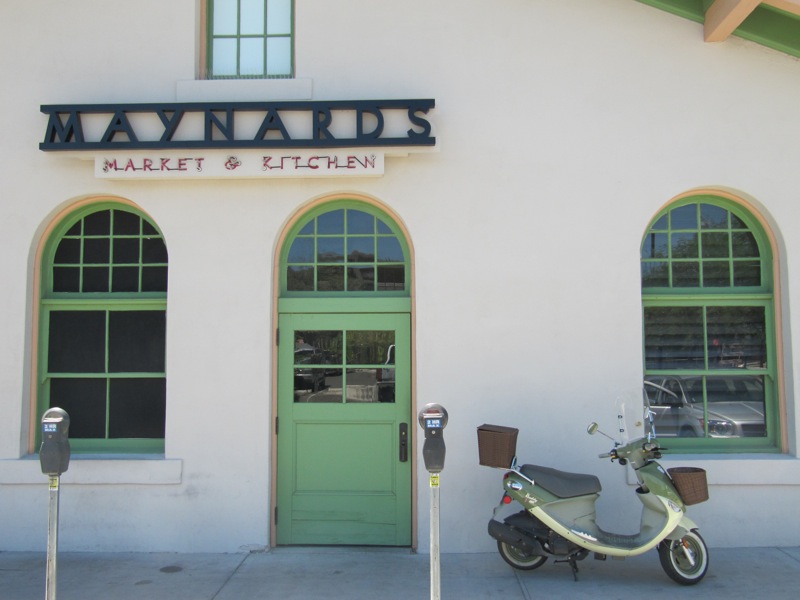
One of my favorite Tucson finds was this local/organic grocery store and restaurant operated out of the historic train station.

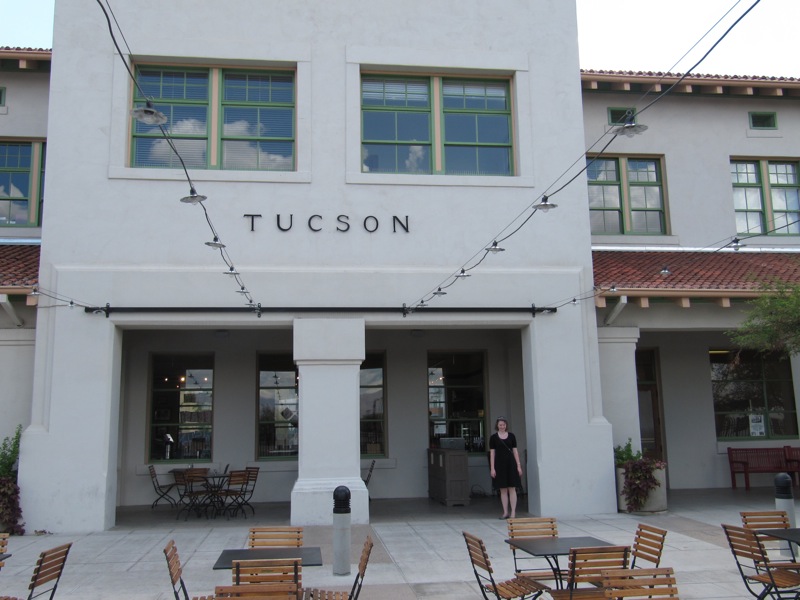
The patio is a pleasant place to sip a local beer or eat some lavender-honey ice cream…

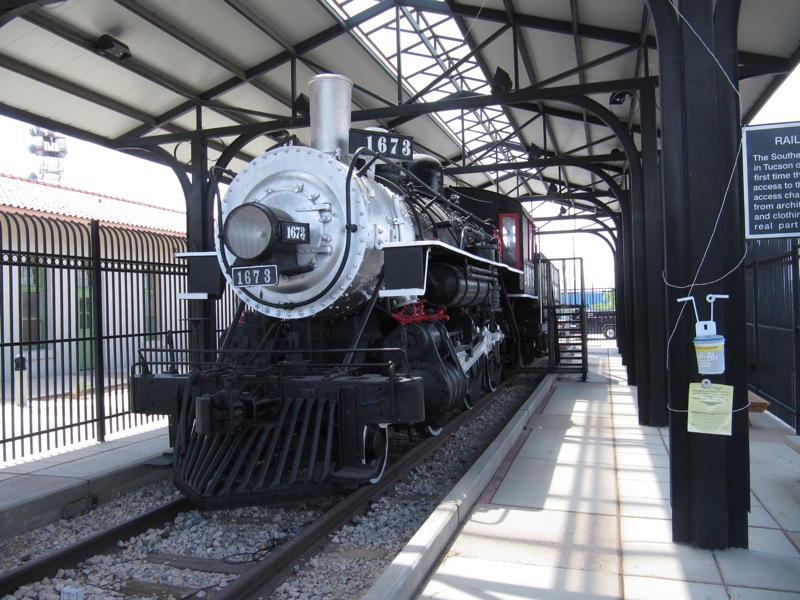
…and a good place to catch a glimpse of what used to populate this space.

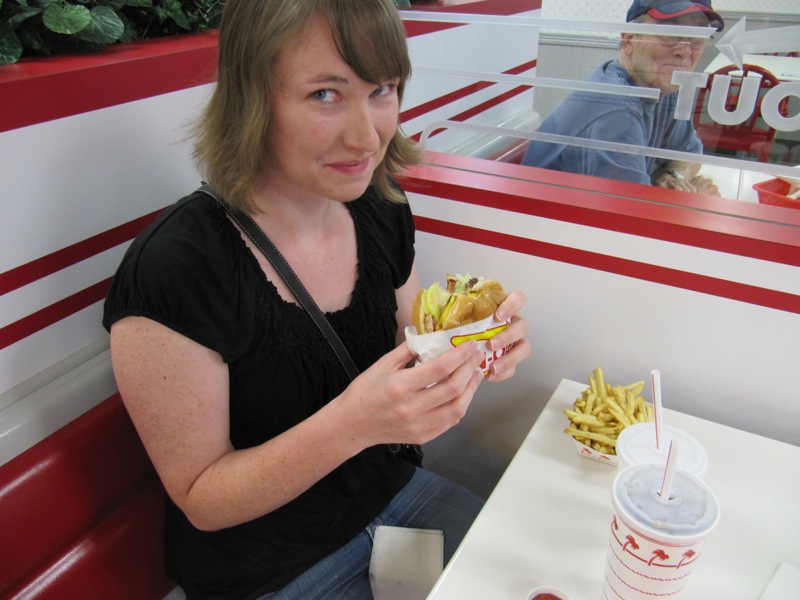
Although I would have happily eaten every meal at Maynard’s, we decided to try out that famous West coast burger joint, In-N-Out. I loved it, but I don’t know if it was the burger–or just the fact that their super-simple menu (with only three choices) is perfect for the indecisive eater (e.g., me).

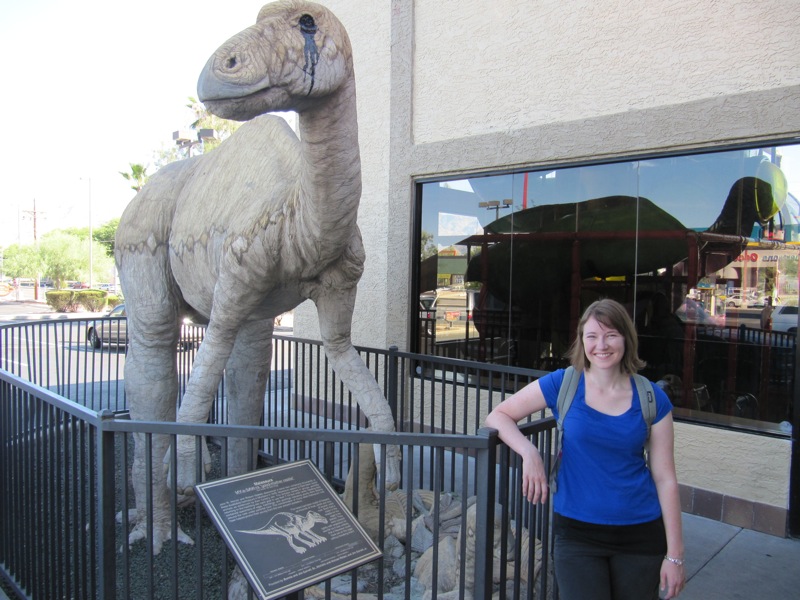
And although this McDonald’s stop was intended to be a quick charge-up for a hike in Sabino Canyon, we had to linger a bit when we noticed the whole store was dinosaur-themed.

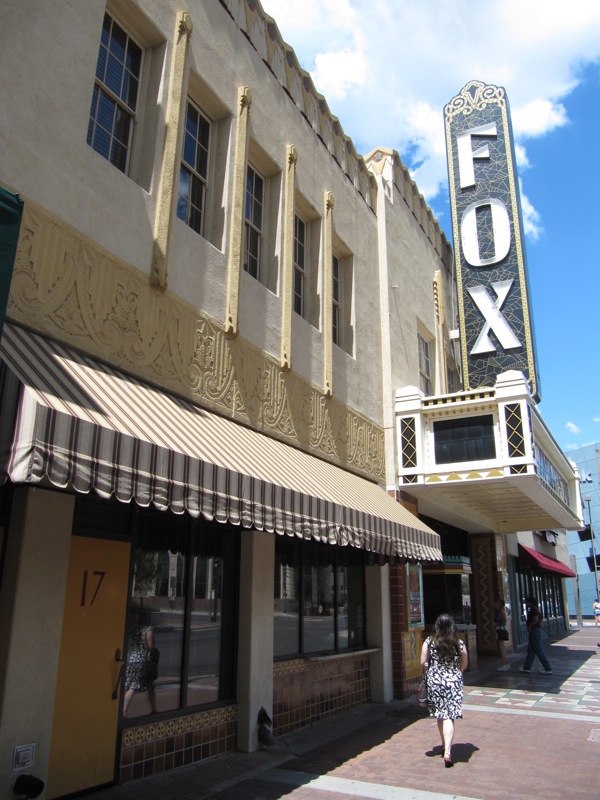
On our walk around downtown, we noticed something that looked a little familiar to our Midtown eyes.

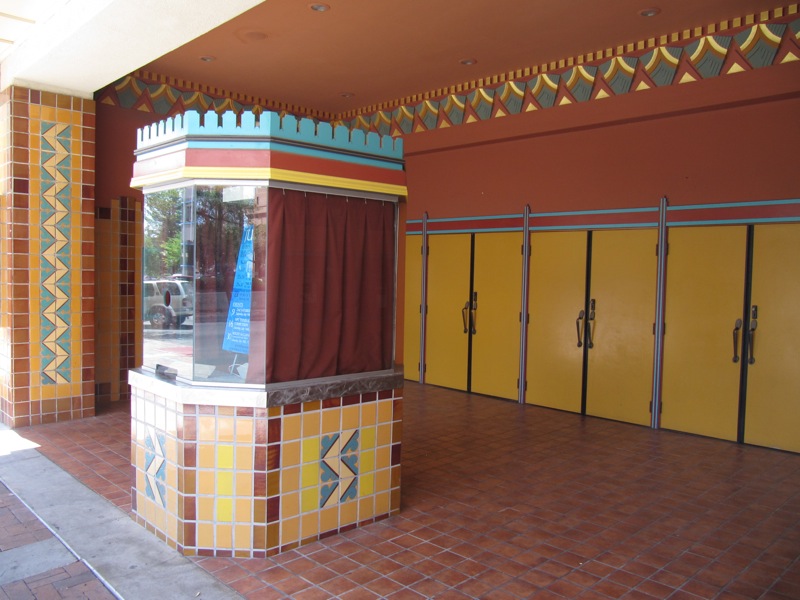
Tucson’s version of the Fox Theatre was distinctly Arizonan, but with enough similarities to our own Fox Theatre at Ponce and Peachtree that we did a double take.

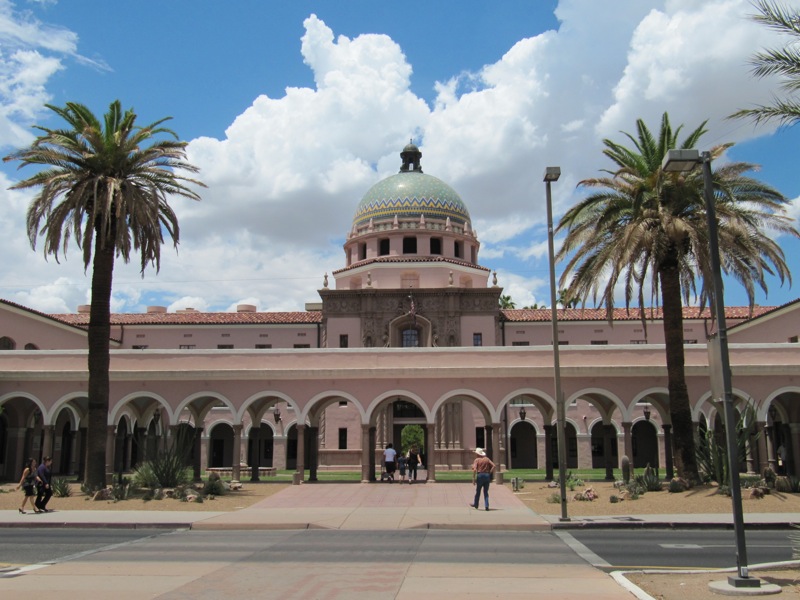
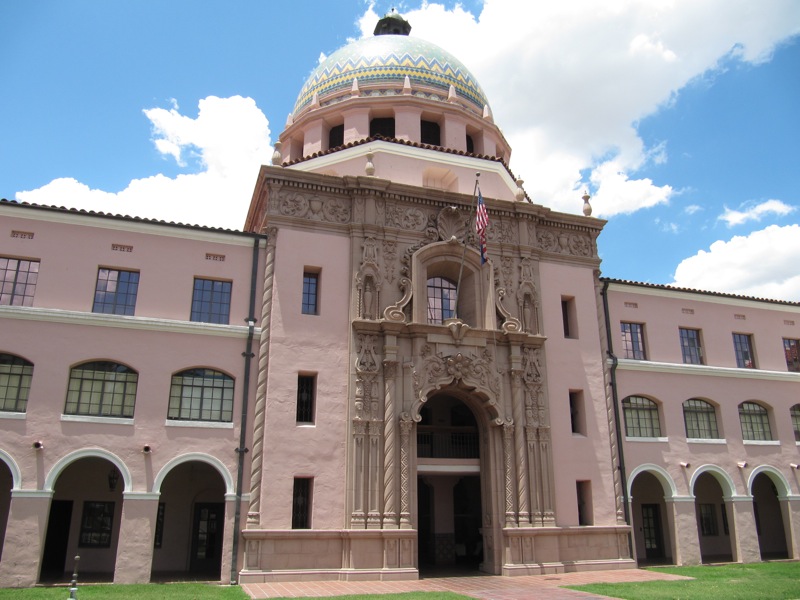
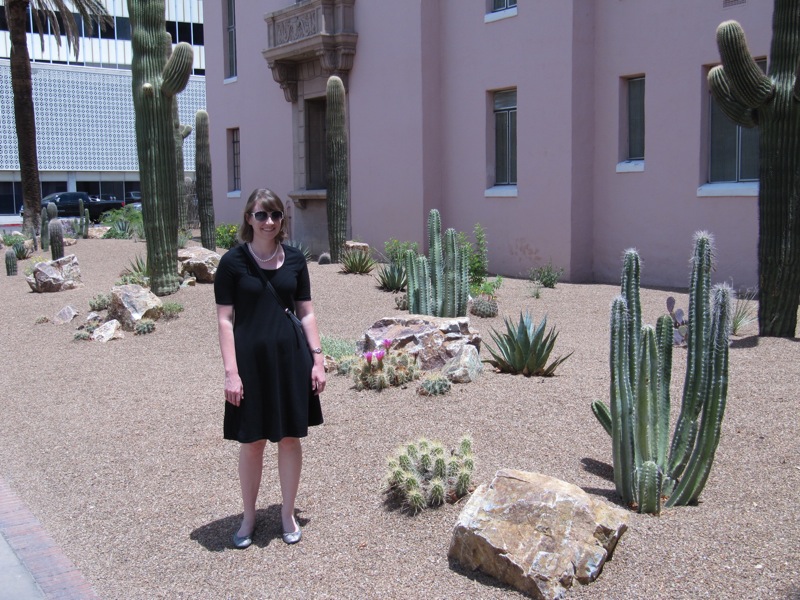
The Pima County Courthouse downtown is another landmark that fits perfectly into its environment, with desert flora and airy corridors.

After our downtown walk, we ventured out in the rental car–not a difficult feat thanks to Tucson’s mind-numbingly precise street grid. This pastel adobe house is typical in Tucson neighborhoods.

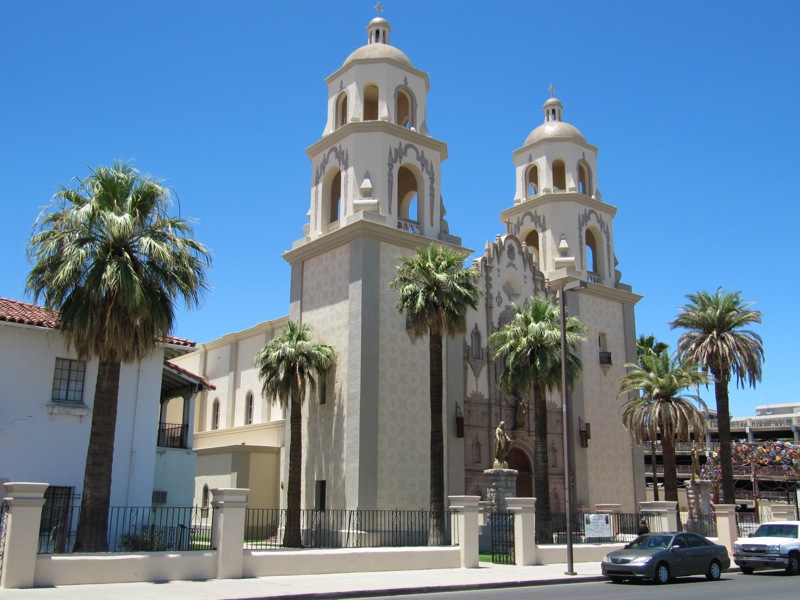
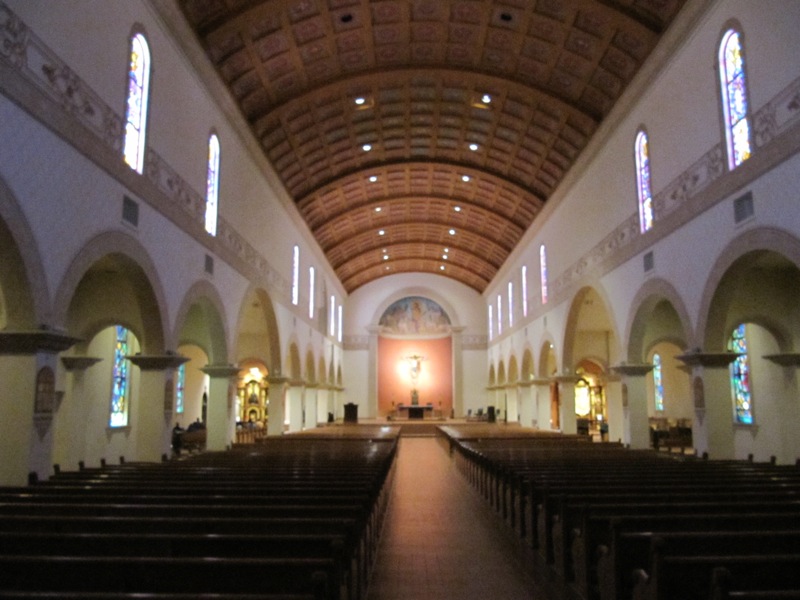
We stopped by this beautiful church to take a look inside.

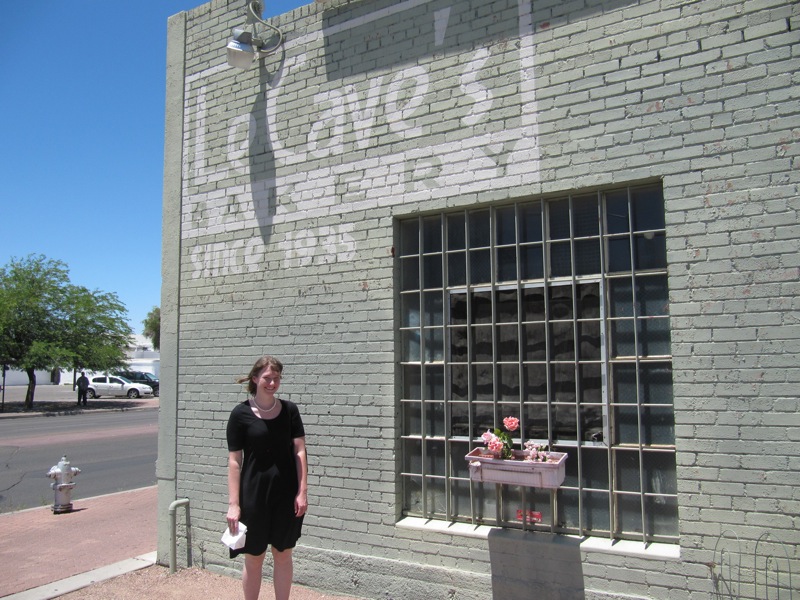
According to our Lonely Planet, no trip to Tucson is complete without indulging at Le Cave’s Bakery.

Proceed with caution; these perfectly soft and sugary doughnuts are addictive.

« Newer Posts - Older Posts »

Categories