Posted by: Caroline | May 3, 2010

Islands of Perast

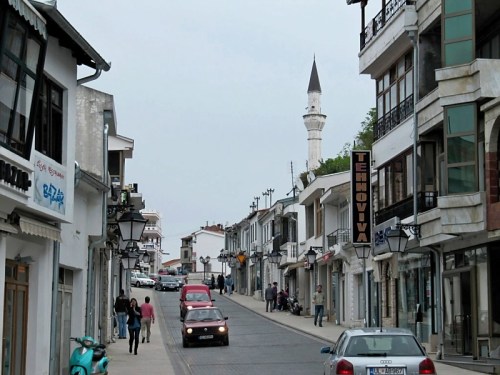
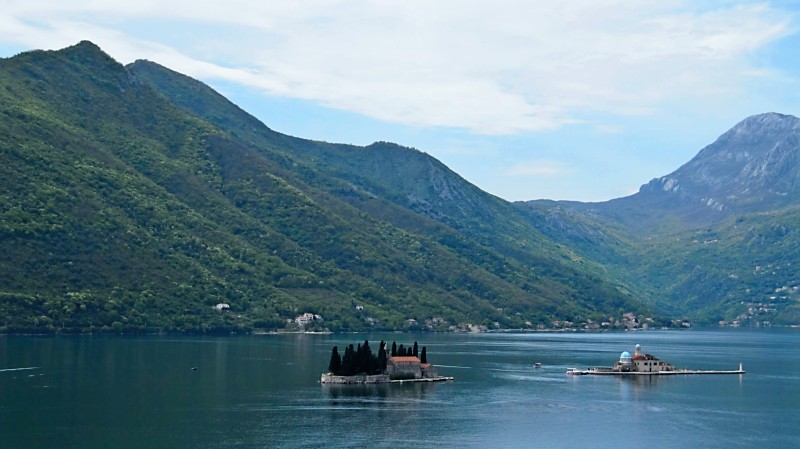
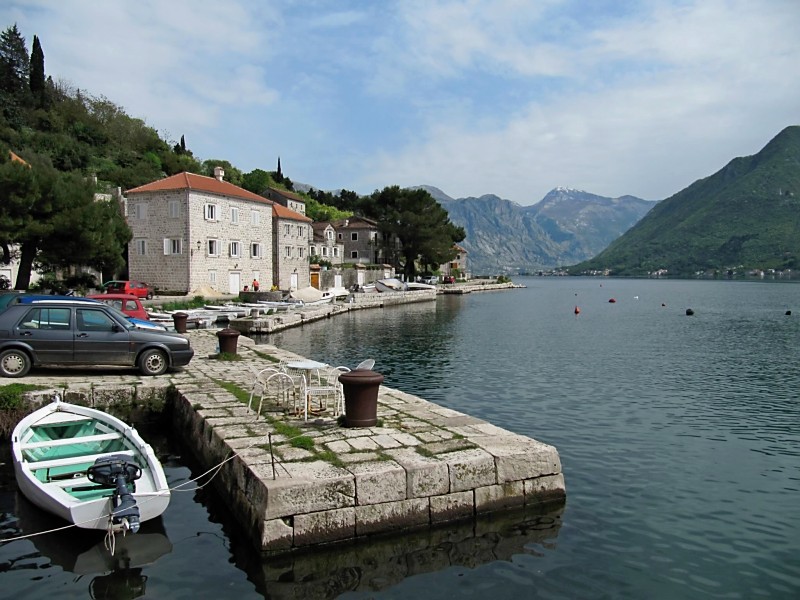
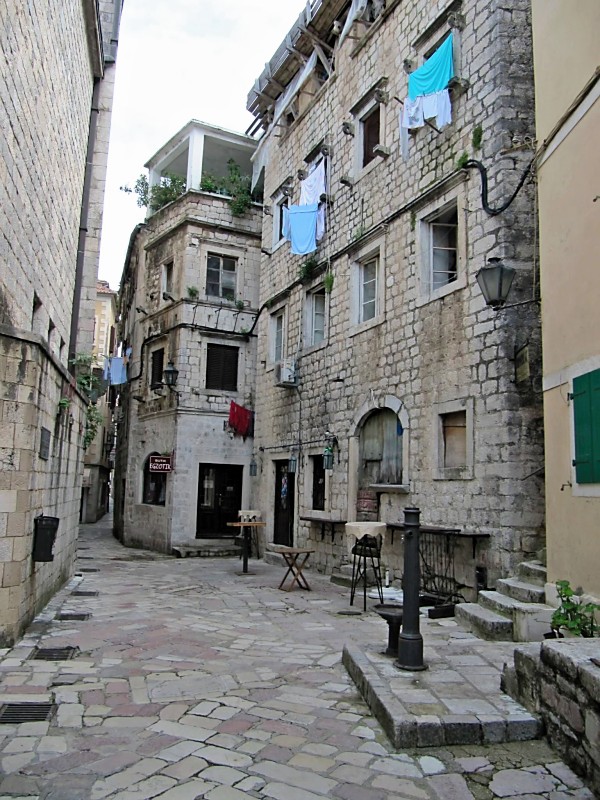
Beautiful Perast is a tiny town just north of Kotor and the proud owner of two charming islands in the translucent bay. We arrived by bus after some half-English, half-Montenegrin encouragement from the Kotor-based couple we stayed with. Sadly I must report that we did not see the one thing about Perast that our female host loved so much: “ALL THE LITTLE SHEEP!”  But what Perast lacked in (little) sheep, it made up for with gorgeous water and fun winding alleyways.

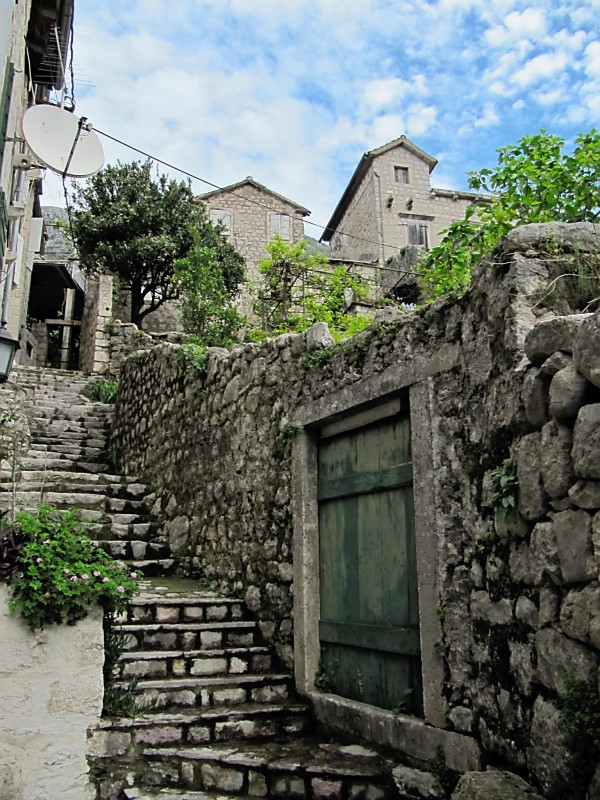
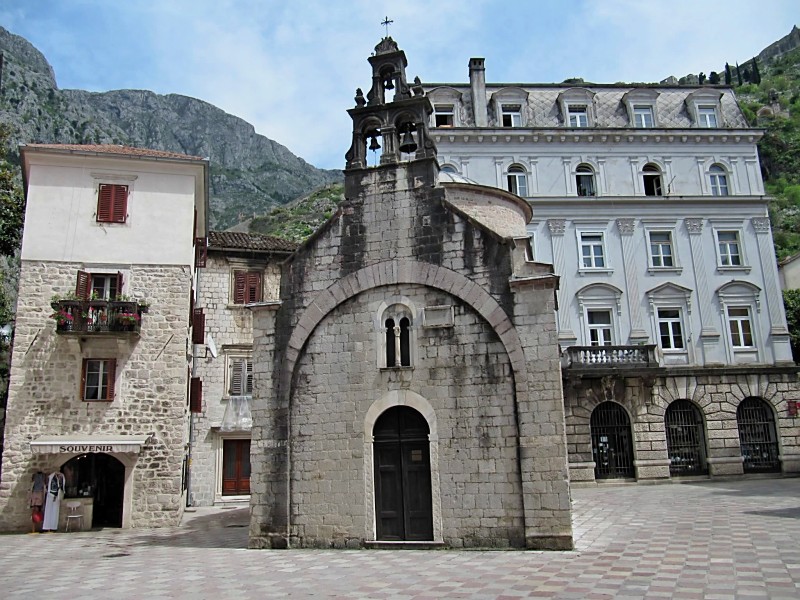
Today Perast is home to only a few hundred people (including Catherine Zeta-Jones and Michael Douglas in the summer) but was once a wealthy Venetian maritime hub. The town’s grand architecture–cathedrals, palaces, and imposing towers–reflects its rich past, and all of it is set along quaint stone pathways with a few sleepy cafes and even sleepier stray cats.

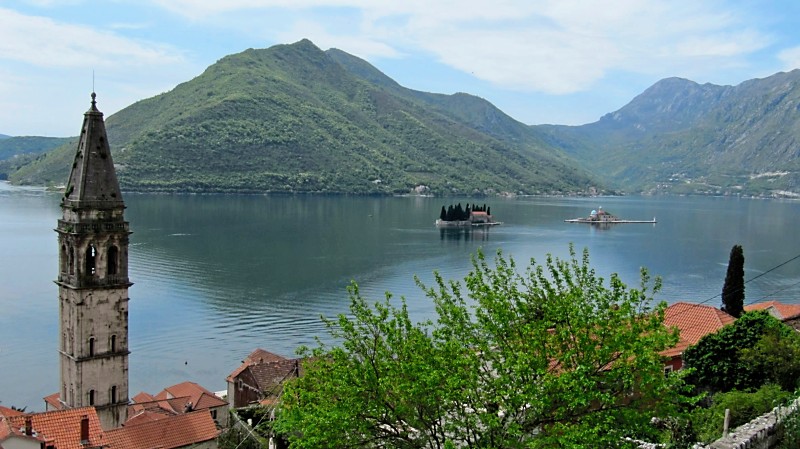
The 55m bell tower of this Catholic church is impressive from below and seems to almost pose for your pictures from above.

Case in point.

We took a boat out to Our Lady of the Rock Island, home to this pretty blue-domed cathedral. Two sailors created this artificial island stone-by-stone after finding an icon of the Virgin Mary on a rock there. The tradition continues today; each July 22, the men of Perast still sail out to the island to drop stones.

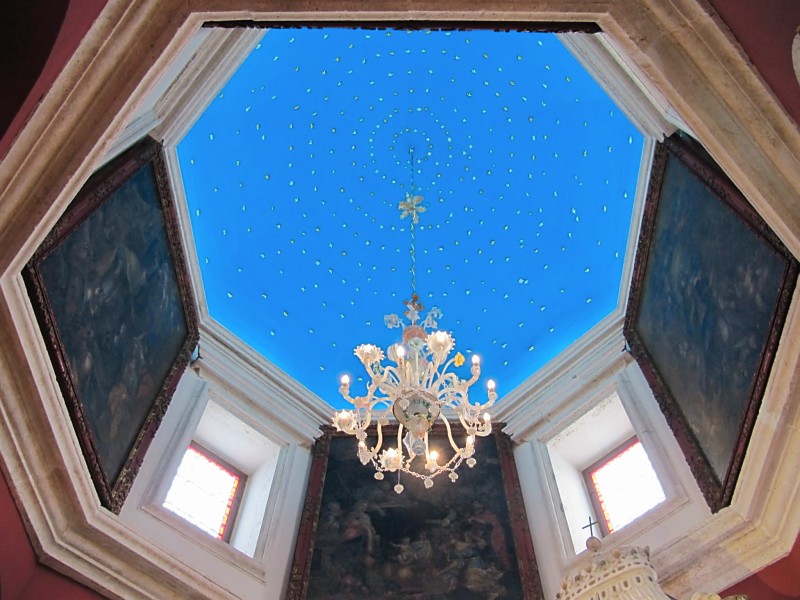
The ornate interior…

including this blue dome…

… and silver-plated images.

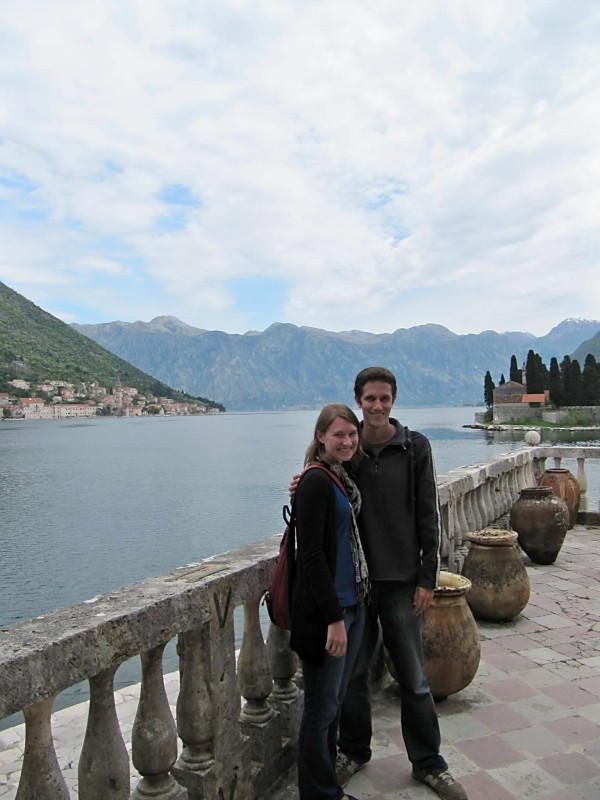
Outside of the church with Perast to the left.

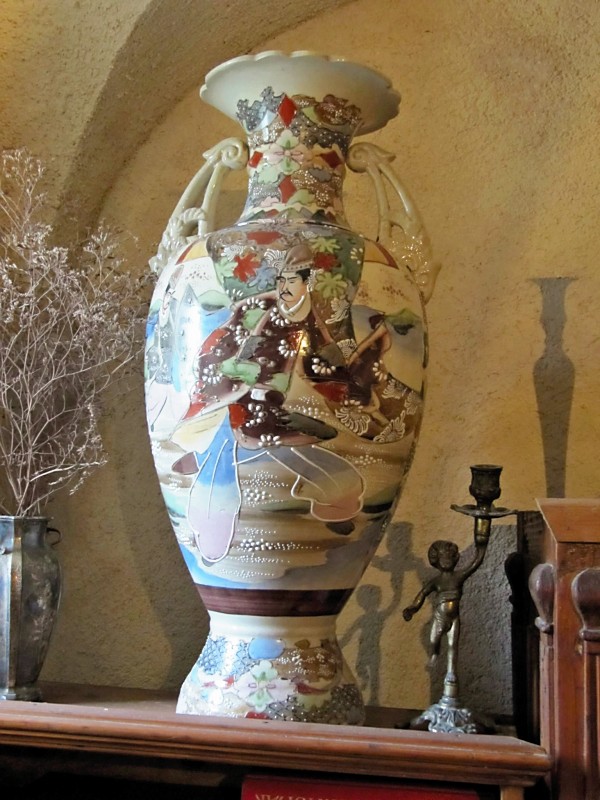
The church also houses a sea-centered museum. This 200 year-old vase was a gift from Japanese sailors.

A woman waiting for her seafaring love’s return stitched this embroidery piece for the duration of his absence (although legend is that he actually never returned). She incorporated gold and silver lace, Chinese silk, and even her own hair; you can see the hair of the stitched people change from blonde to whitish-gray.

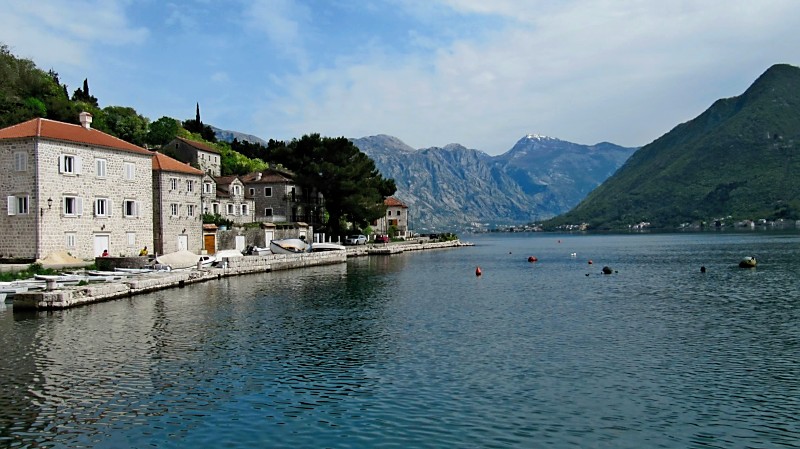
More pretty views:

We went at the perfect time of year as well; the weather was pleasantly cool, and we didn’t have to put up with cheesy summertime businesses like this one:

Posted by: Alex MacGregor | May 1, 2010

The Bay Called Kotor

With Budva behind us, we made the quick journey to a place that we felt would be a bit more our style: Kotor.

We soon found that Kotor isn’t just a pleasant place; it’s absolutely incredible! It’s easily be worth a ferry ride from Italy if you find yourself in Europe anytime soon.

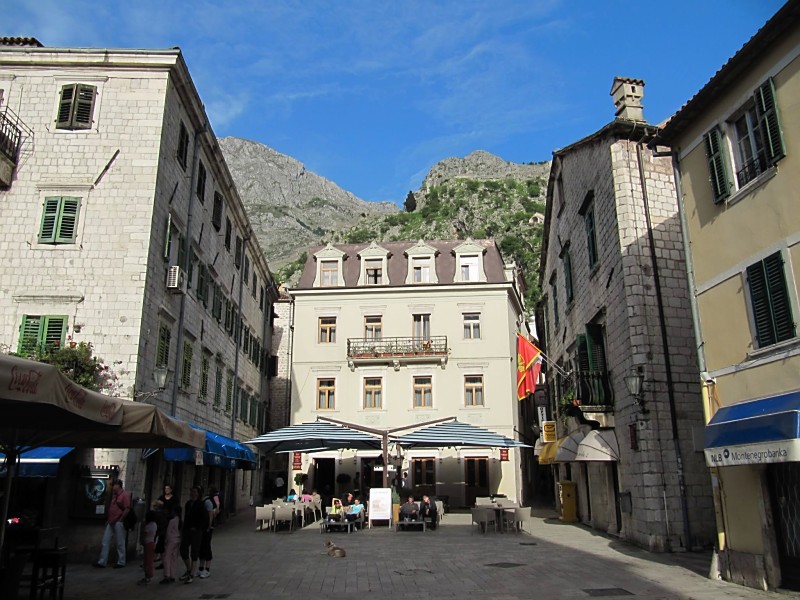
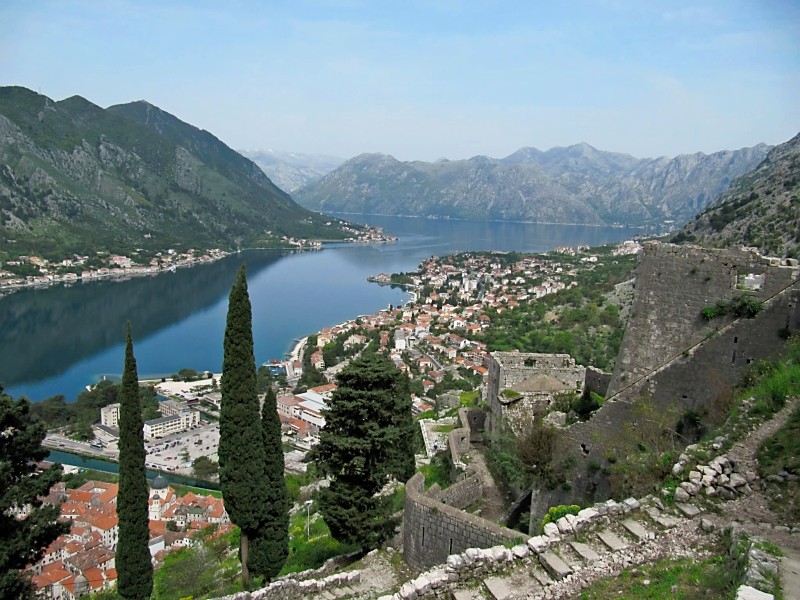
The city itself consists of a densely-packed old town at the bottom of a cliff. I’ll spare you more explanation and cut straight to the pictures.

Heavily fortified Kotor was built by Venice over 500 years ago.

The position of the city is as good as it gets from the standpoint of defense. Not only does it sit at the foot of a nearly impassable chain of mountains, protecting it from land attacks, but it is also located at the far end of a long, deep bay, making it difficult to attack by sea as well.

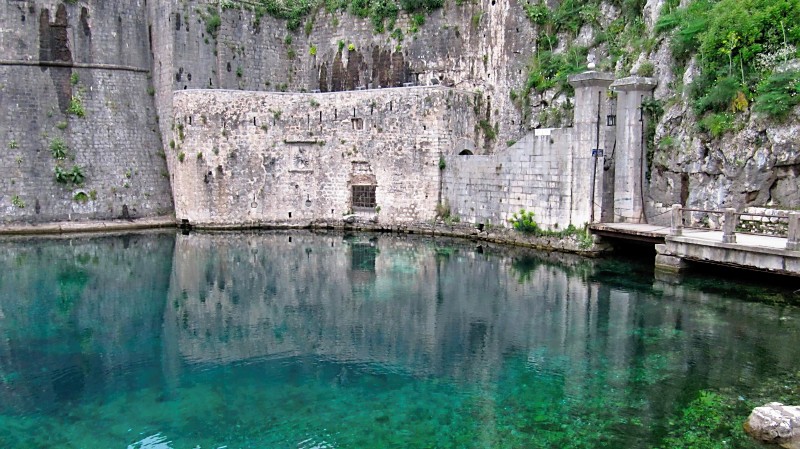
As you might expect, the city is protected by thick walls and a wide moat.

Kotor’s south gate, with a drawbridge right against the cliff.

Most surprising is how the moat is formed. Even though the Bay of Kotor is salt water, connected to the Adriatic Sea, Kotor’s moats are fresh water. That’s because on either end of the city, very strong springs force water right out of the bottom of the rocky cliffs, giving the water a blue-green glow just like we saw in Sveti Naum.

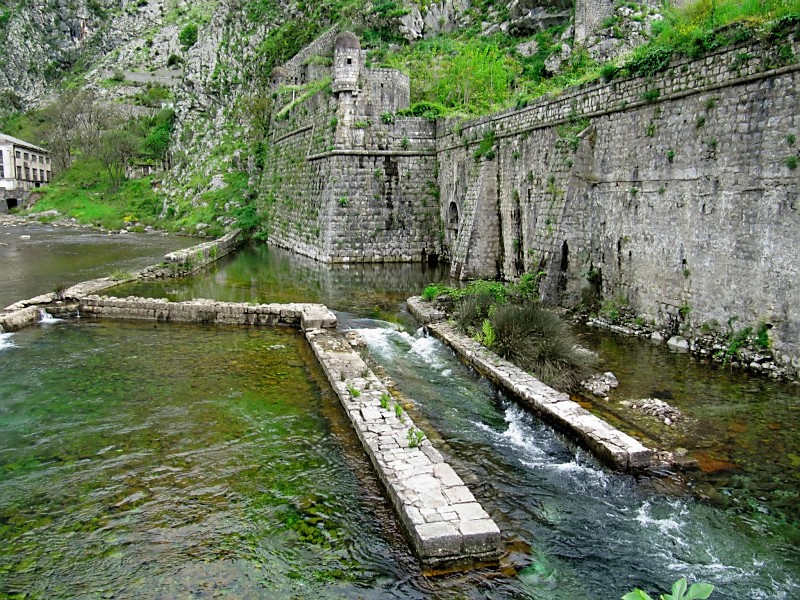
Can you see what’s wrong with this picture of the moat next to the north gate?

Water flows out of the walled-in area, but none flows in. That’s because the flow is created by freshwater getting forced out of the earth at great volume.

Not only does this make for perfect defense–unlike a river, these springs won’t move about over time and ruin the walls–but they also give Kotor an endless supply of fresh water that can be accessed during a siege.

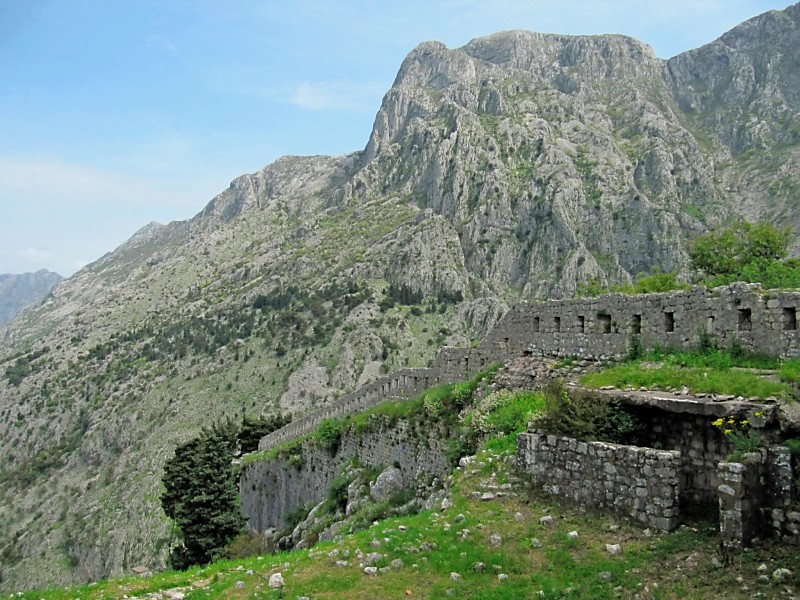
But Kotor didn’t stop there in the effort to defend itself. Also worried about an attack from land, the city features a massive network of fortifications that climbs its way all over the mountain above town.

Nowadays, you can walk all the way up to the top of these fortifications to see just how the city was defended…

…and, of course, soak up the great views!

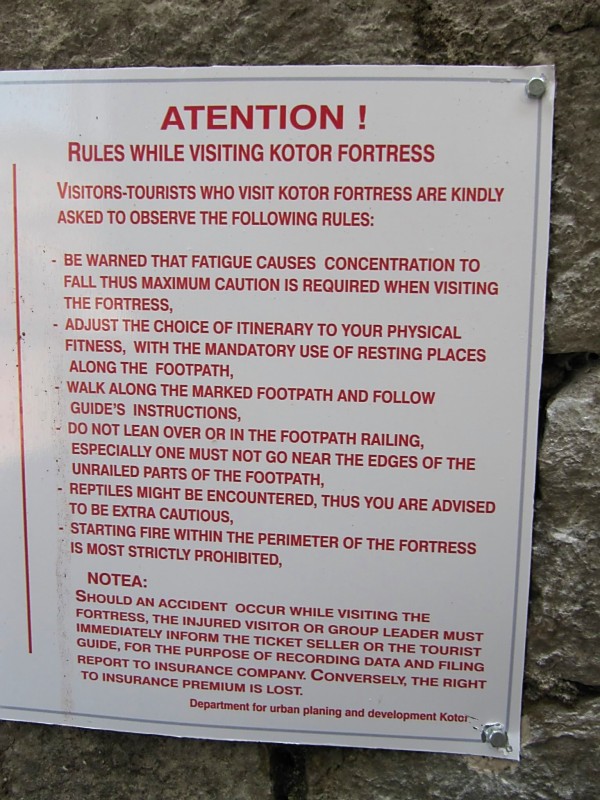
One sign that we are getting into wealthier countries is that hoity toity concepts like ‘liability’ and ‘insurace’ seem to have made their way to Montenegro. Not such a big concern down in Albania!

The higher you get, the more substantial the fortifications get–and the better the views become!

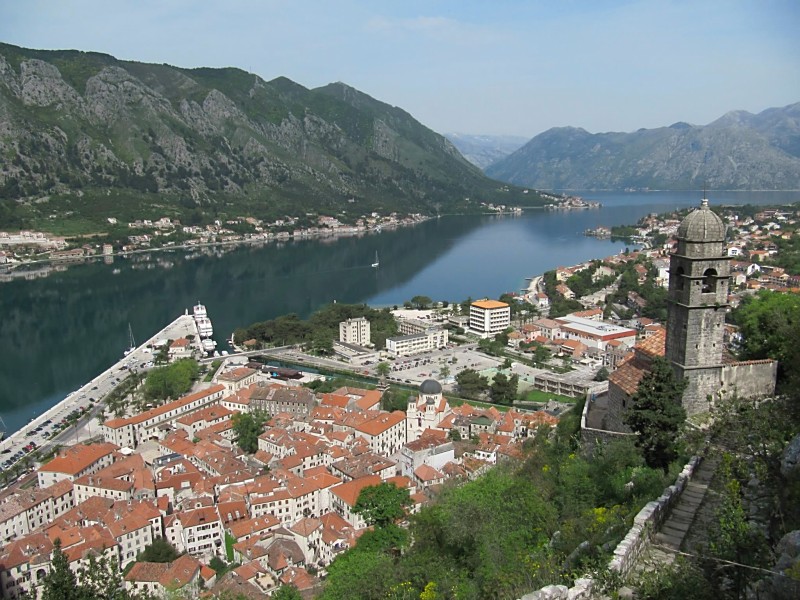
At the very top, you’re rewarded with a stunning view of the bay.

As I said at the beginning, Montenegro is definitely worth the ferry ride from Italy!

Posted by: Caroline | April 30, 2010

Budva in Transition

We had plans to skip over the coastal town of Budva entirely, but so many locals along the way gushed over the place that we amended our plans to include at least a few hours in this reputed Montenegrin paradise. When we mentioned that we were headed for Kotor, the Montenegrins we met responded identically: ”Oh, Kotor is a nice place. But Budva is my favorite!”

But I’m sorry to say that it seems the glory days of this beachside town have faded.

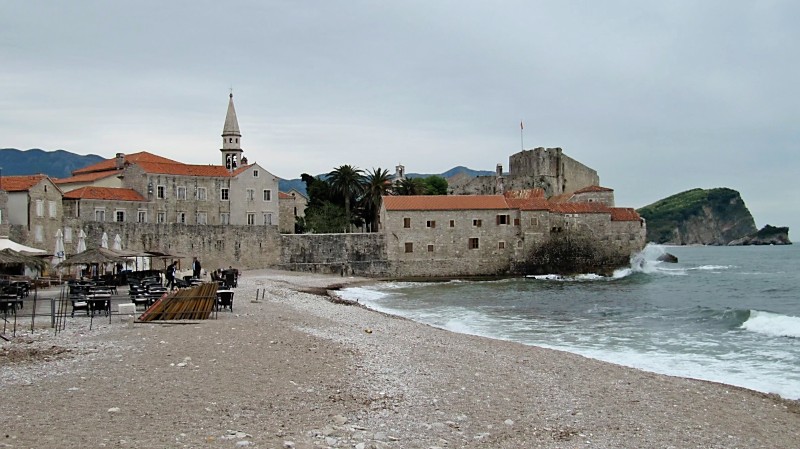
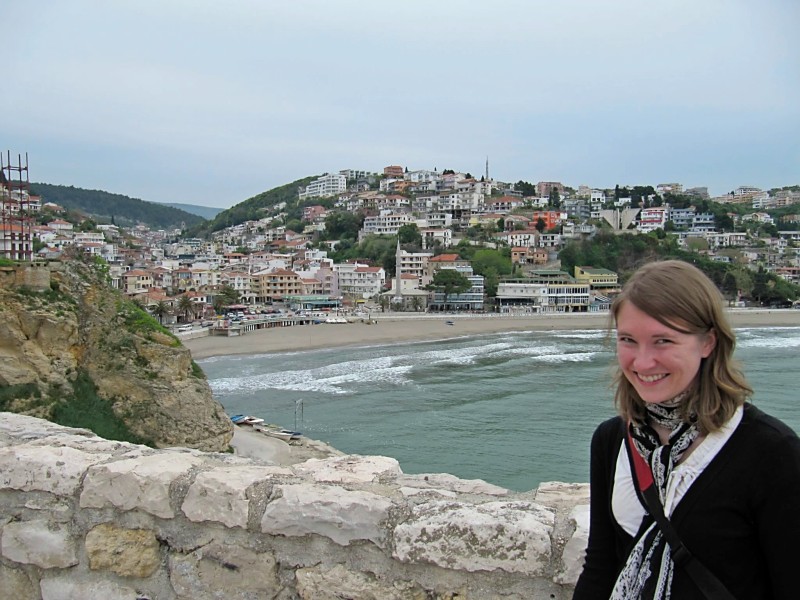
It’s a nice enough place to spend a few hours, with stone city walls enclosing pretty churches and providing a vantage point over the waters below.

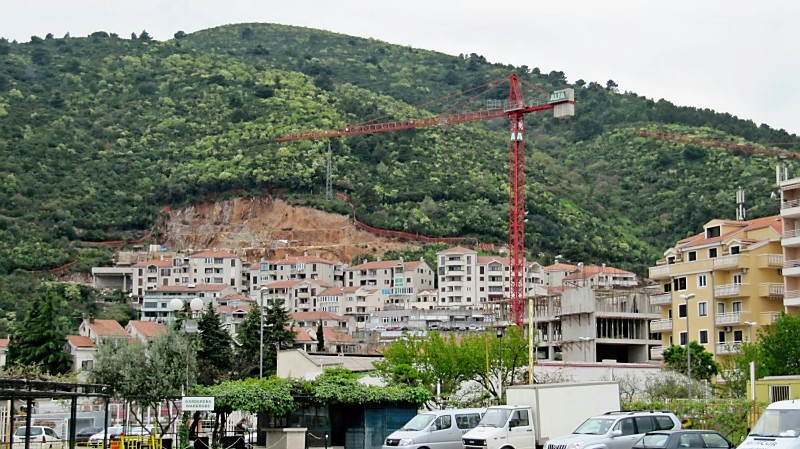
But the rampant development just outside the rebuilt stone walls (the originals were destroyed in an earthquake) detracts from the old city atmosphere…

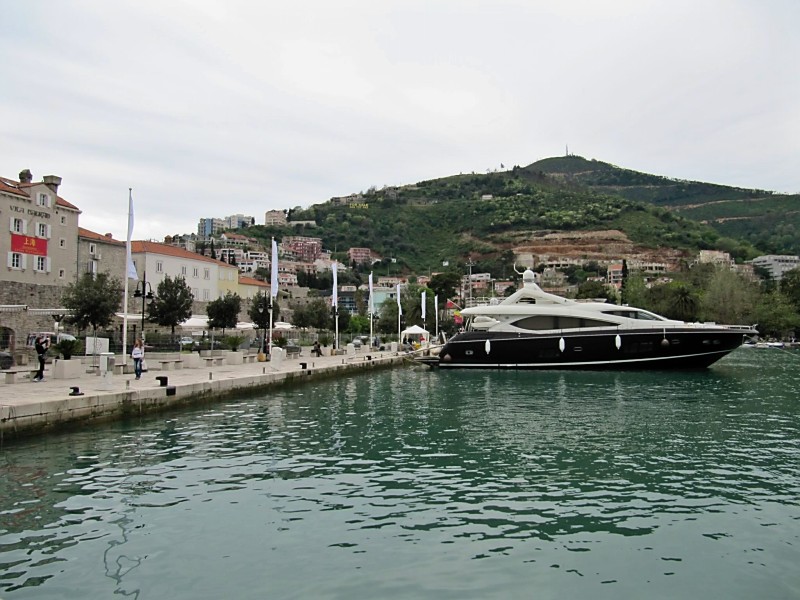
… not to mention those millionaire yachts. Somehow I just cant relax when I’m standing in front of something so expensive.

To be fair, the cloudy day and a long morning of travel affected our experience here. I can see why many people we talked to love the place; it’s a fine beach to spend a weekend if you want your fish dinner by the sea after a day of swimming, lounging, and ogling yachts.

And even though this isnt a place that interests me, I’m glad we saw it–so that I could appreciate gorgeous, awe-inspiring Kotor that much more!

Posted by: Alex MacGregor | April 28, 2010

The Road to Montenegro

We spent a full week getting to know the ins and outs of Albania, but it was time to move on. Next up the coast is Montenegro, a small, newly-independent nation that is culturally and ethnically similar to Serbia, from which it declared independence only a few years ago.

Ever since we had arrived in Europe, the process of crossing a border was simplified dramatically. We have grown used to direct buses from capital to capital, with the border barely even a noteworthy stop. We haven’t had to go through anything like what we had to go through to get from Mozambique to Malawi.

But not so with Albania. We initially hoped for a direct bus from Tirana to Montenegro’s capital, Podgorica (pronounced in such a way that it rhymes with ‘pizza’). But there is none: Albania’s long period of isolation has left it with very weak public transport links with its neighbors.

Instead, we learned that a furgon (minibus) sets off in the morning from a town in northern Albania called Shkodra to a town on Montenegro’s coast called Ulqini, and it’s basically the only way to get between the two countries.

So we set off for Shkodra one afternoon, and spent the evening looking around.
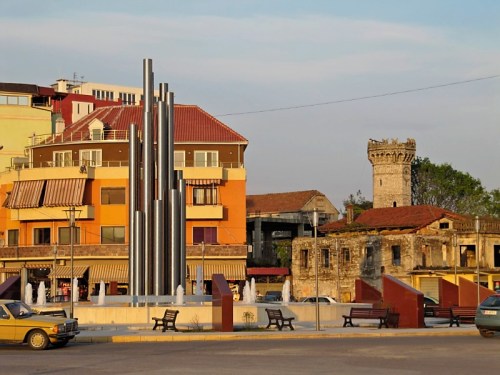
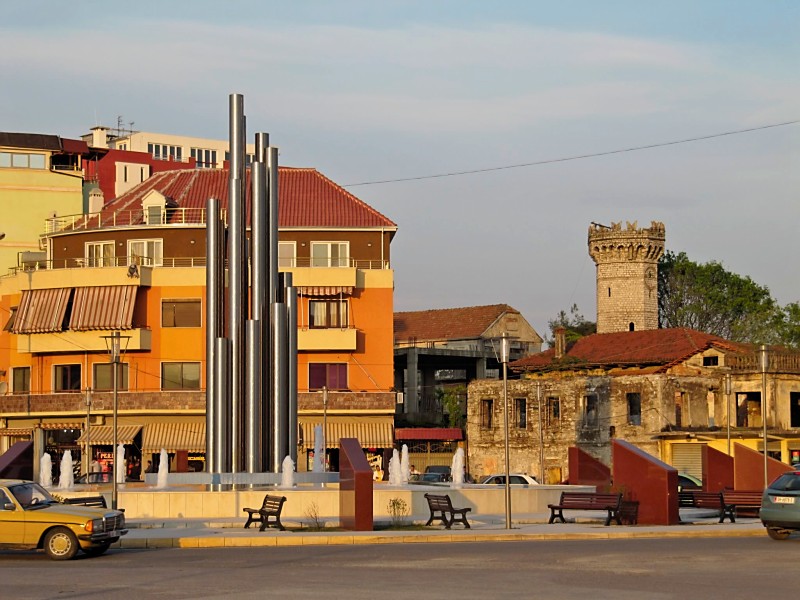
Shkodra’s main square.

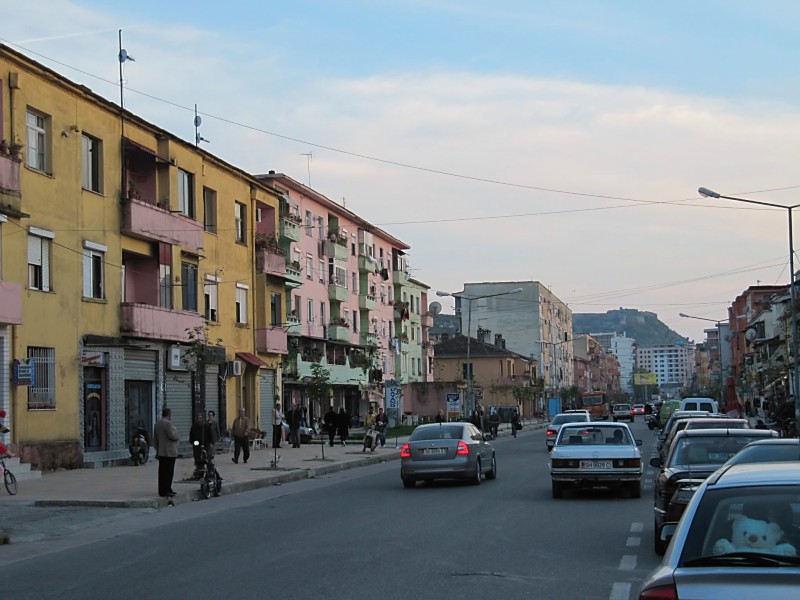
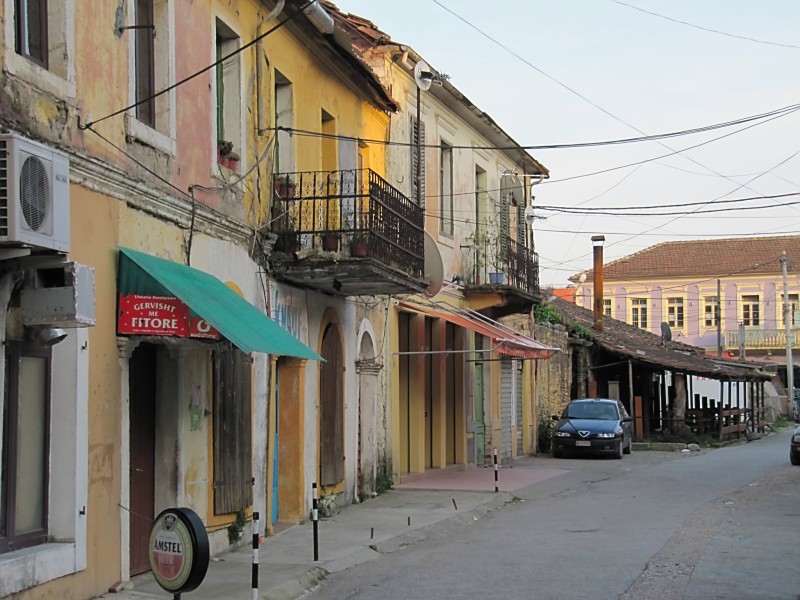
While Shkodra’s main street is flanked by housing blocks, you can find plenty of historic buildings on the side streets.
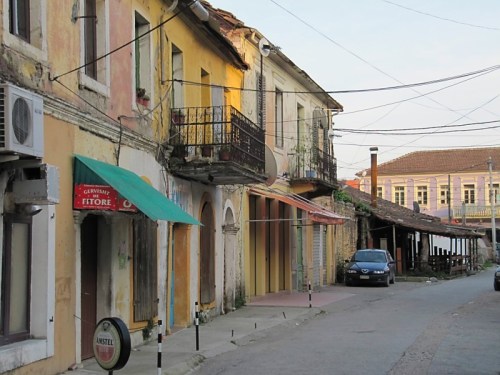
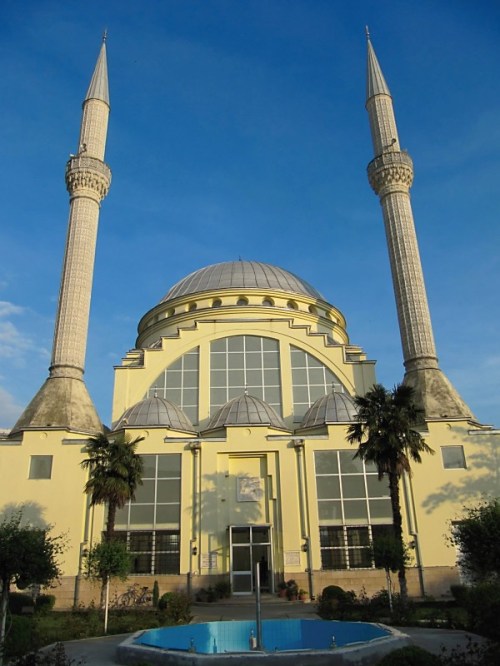
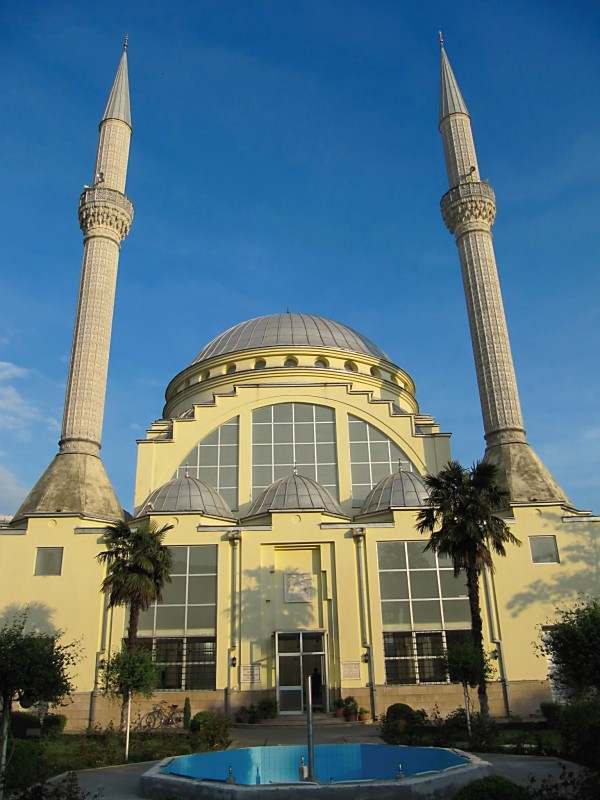
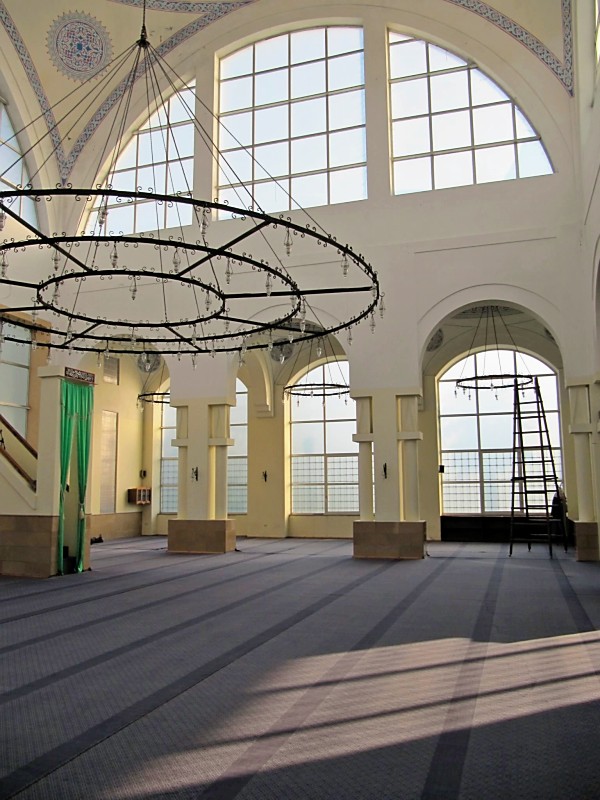
Although the importance of Islam in Albania has declined steeply, Shkodra still has a vibirant Islamic community. Unlike in other parts of Albania, we were even able to check out the city’s main mosque!
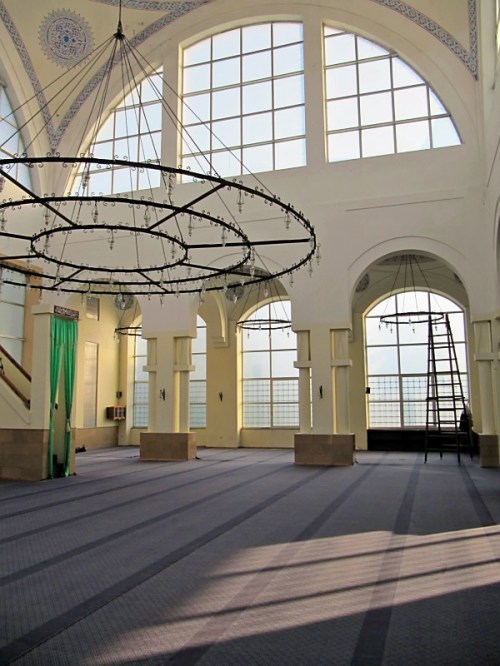
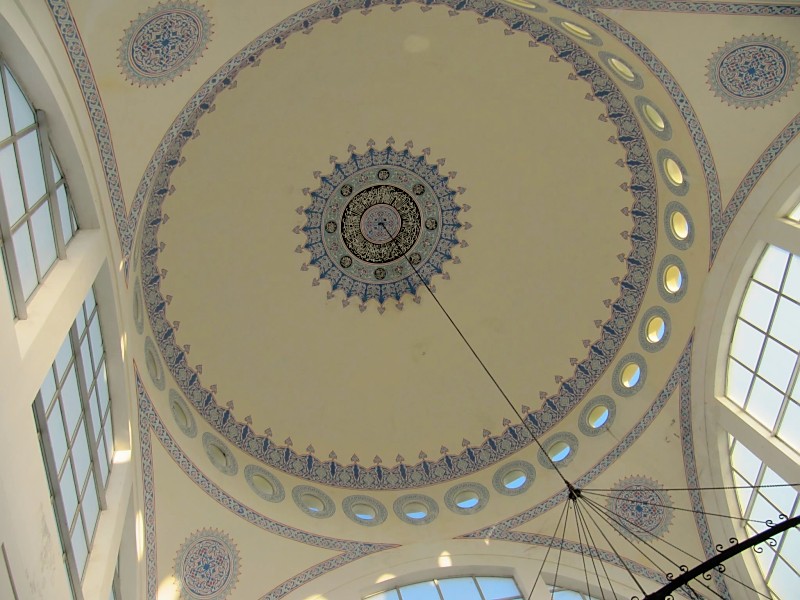
Although this mosque was much newer than some of the ones we saw earlier, it was very impressive.
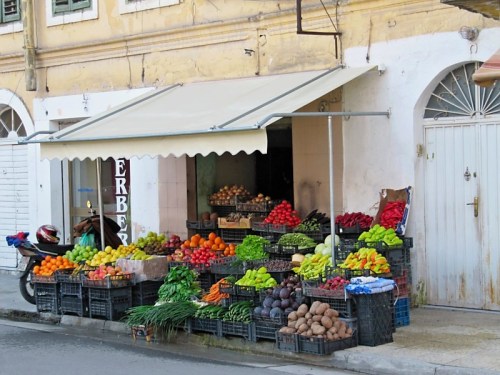
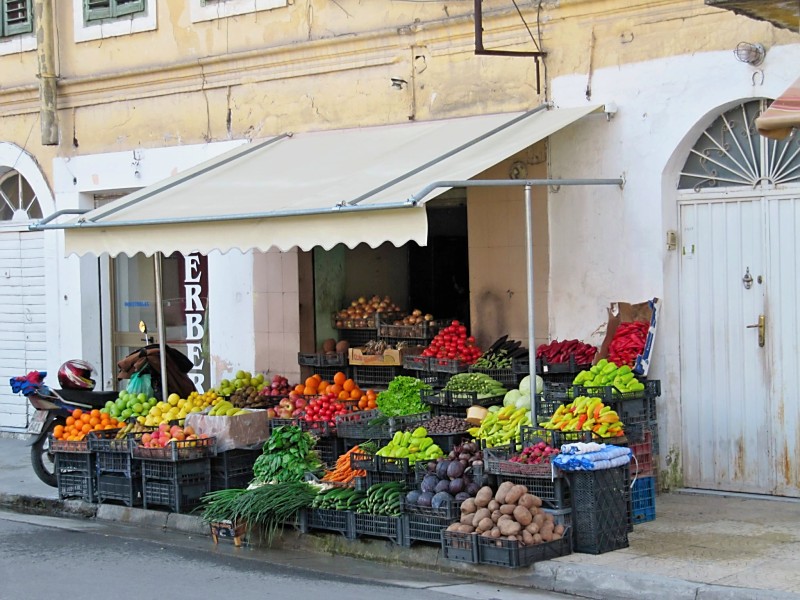
Shkodra has one of the best selections of fruits and veggies we saw the whole trip!
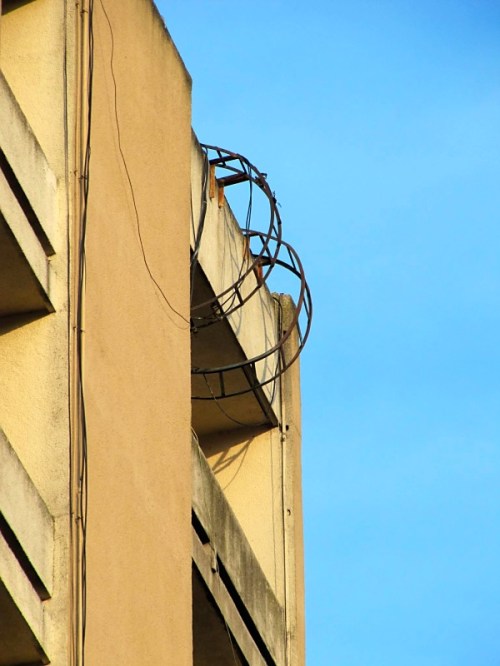
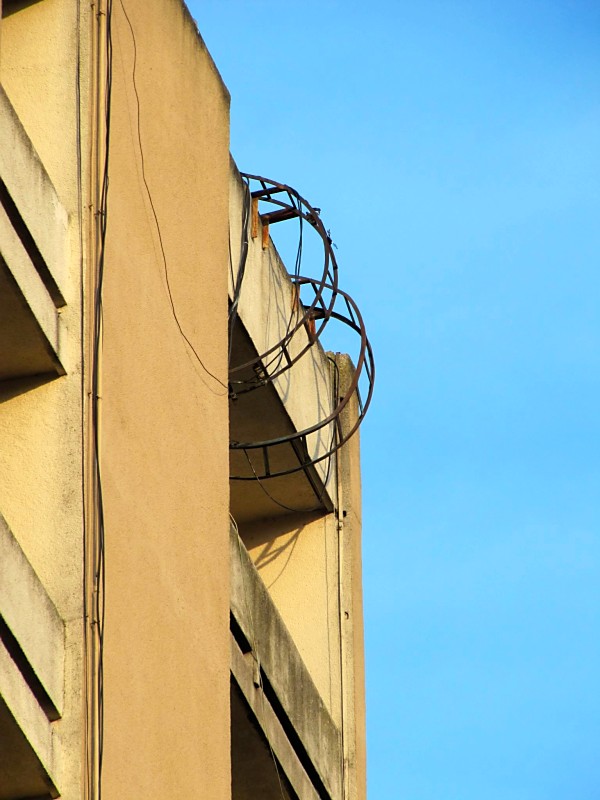
I don’t think that this ladder, on top of a ten-story communist-era building in central Shkodra, would meet OSHA requirements for safe roof access.
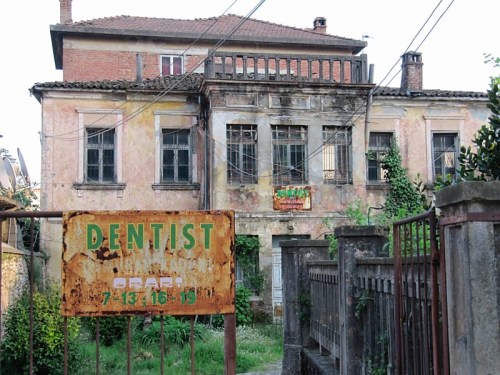
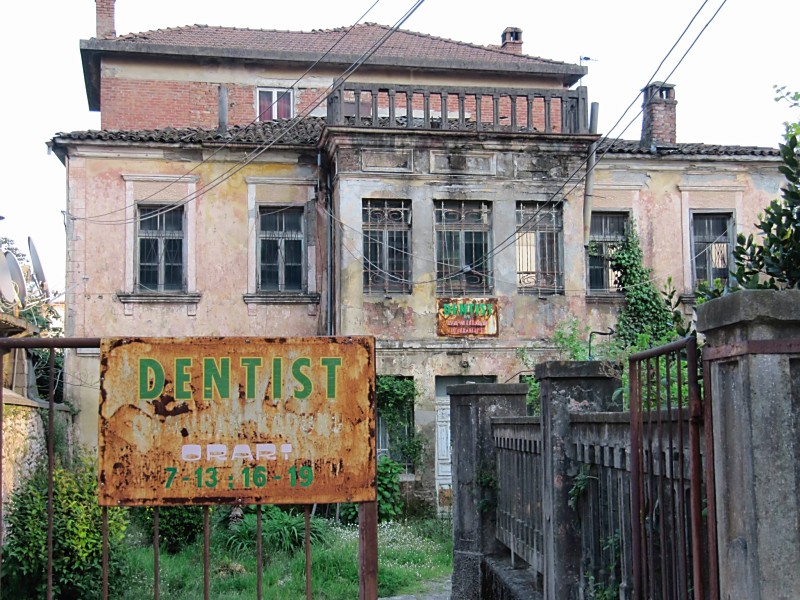
Anyone need a dentist?
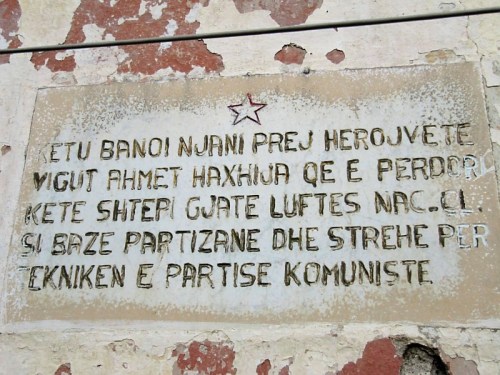
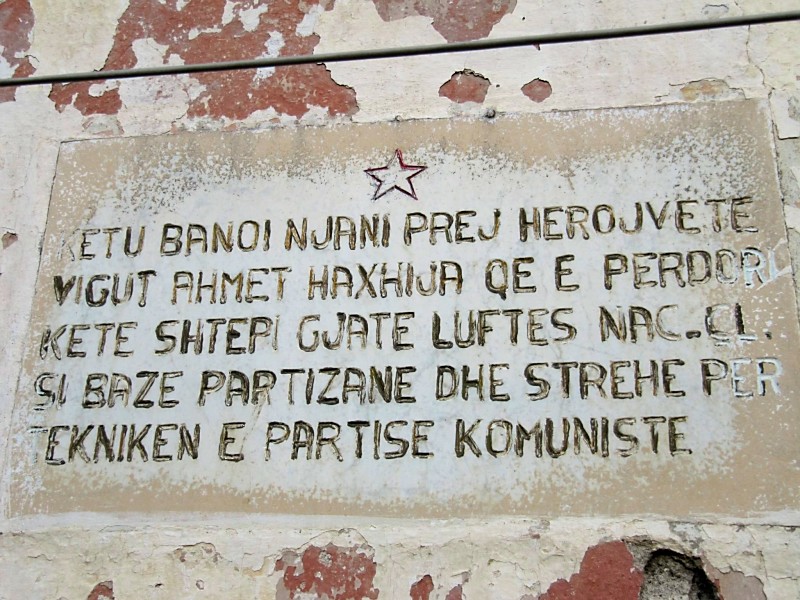
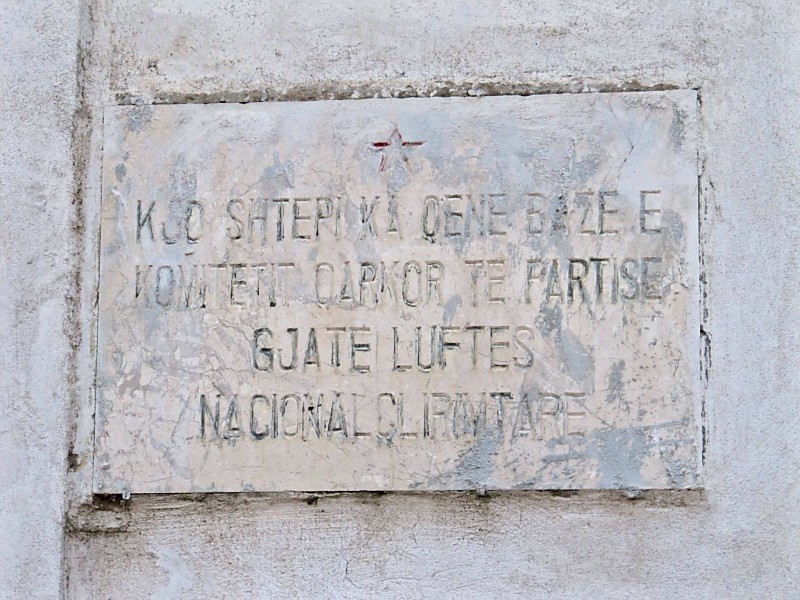
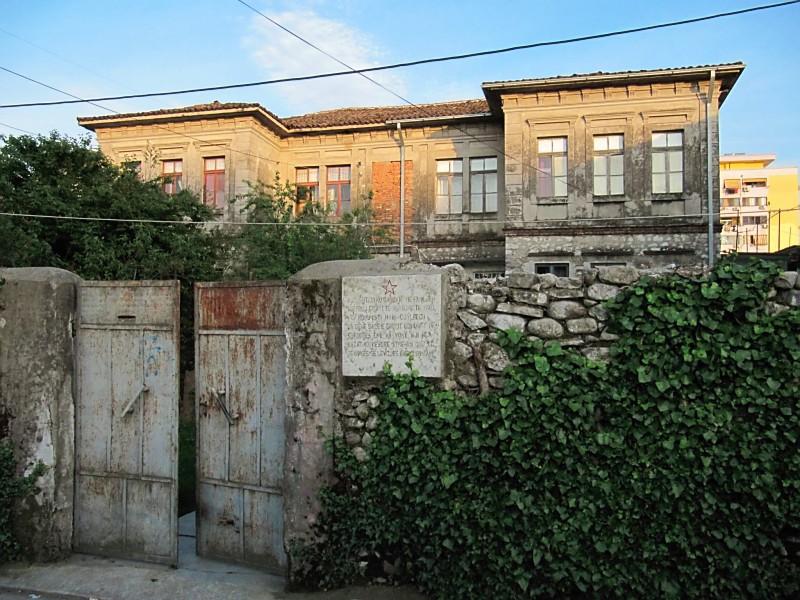
Communist-era tourist placards.

The next day, we set off for Montenegro. We had heard that the furgon would leave at 9AM for Unqini whether there was a full bus or only one person, so we confidently strode out half an hour early to claim our spots.

When we asked about the furgon at the designated place, people responded “no furgon, no autobusi“, and pointed to an empty minibus that said Ulqini, with no driver or passengers in sight. Eventually we found someone who spoke English, who explained that there were no passengers, so the bus wouldn’t be going today.

After a moment of feeling like we were going to be stranded for another night in small Shkodra–a city which would soon be exhausted of attractions of touristic interest if we were stuck for another day or longer–a man came up and said, “It’s okay. Take the Mercedes.”

We were very skeptical–it was just the two of us, and there was no way the man would take us to Montenegro in a Mercedes for the same price as a minibus. But the man insisted that for 5 Euro, we would be taken to the center of Ulqini. Eventually, another passenger materialized and got in the passnger seat. He also said it was okay, as did the half a dozen or so bystanders.

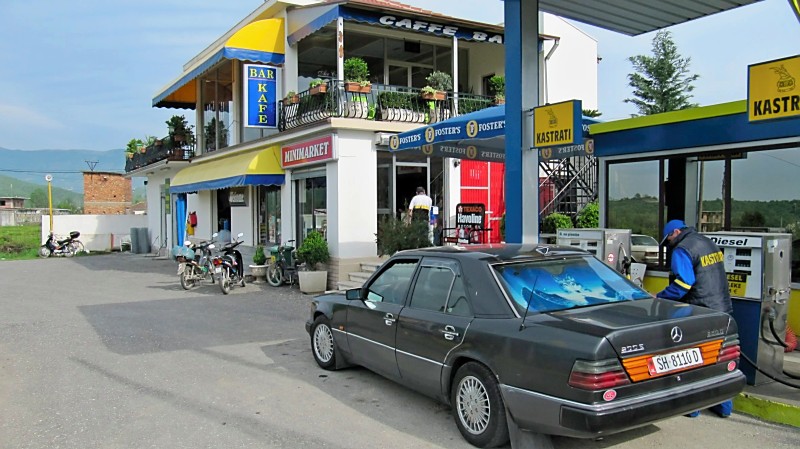
So we agreed, and, at nine o’clock, the four of us were off to Unqini in an old Mercedes Benz.
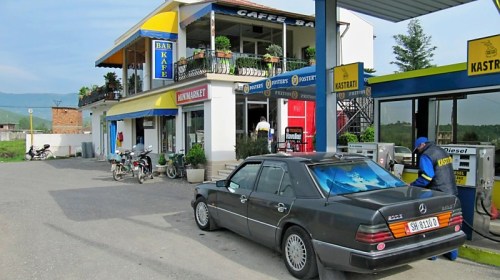
About halfway to the Montenegrin border post, our ‘minibus’ stops to get refueled.

After we made it into Montenegro, the driver showed us his passport, which was covered in such a huge number of identical passport stamps that it probably would be refused at any border post where he wasn’t friends with the border guards. Later, as other people flagged down the car and hopped in, it became clear to us that this black Mercedes was well known in the area as the only public transport that passed by on this road during the slow winter season.

Eventually we made it into Ulqini, and found out we had a couple hours left to wait for a bus to Budva, our first planned stop. Although this is a different country, it might as well have still been Albania.

The town is mostly Albanian, so we were still able to use the familiar Albanian greetings like tungjatjeta (hello) and faleminderit (thank you) as we wandered around and checked out the sights.

Posted by: Caroline | April 27, 2010

Hiking in Llogoraja

The dramatic mountains of Llogoraja are a mere 30km away from Vlore’s beaches, so we hopped on the first southbound furgon (minibus) that drove by Hotel Liro. We thought it would be simple enough–a major highway connects the two–but after stating our destination, the driver and several riders started laughing. A “po” (yes) or “jo” (no) would have been more comforting, but he allowed us to board so we figured he must drive close to the national park.

A few minutes into the ride, a girl about my age came to talk to us in nervous English. She wanted to know if we had a place to stay, which was a pretty good question in the low season and not one we had given a lot of thought to other than finding out that hotels do exist there. She said she had the number of a hotel in the area; would we like the number? We said yes, but then she returned to her seat, so we thought there had been some communication problem. She eventually got off the bus without saying anything more.

We shrugged it off until we were forced off the bus, now headed down a secondary road–and we were still several kilometers away from our destination! I was worried about how in the world we were going to get there–would we have to hitchhike? Or worse, would we not make it at all? But the bus driver quickly ushered us into a truck waiting at the turnoff, and slowly it dawned on us: the girl had gotten the bus driver to call a hotel owner to come give us a (free) ride to the hotel, conveniently adjacent to the national park! Even more amazing than the Albanian propensity to assist travelers is their desire to do so without the expectation of even a thank you. To them, it’s not a big deal; it’s just what you should do!

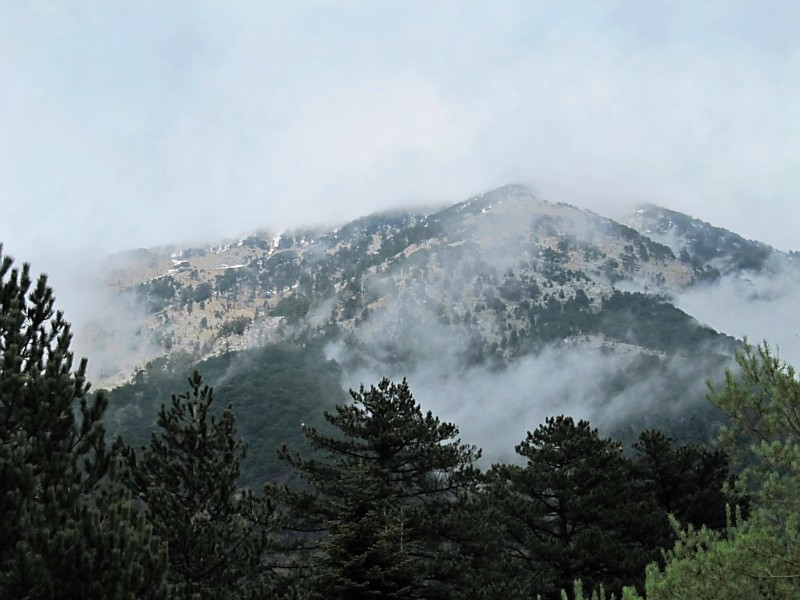
We arrived just in time to get in a decent hike, so we headed up the steep road–not quite in the clouds pictured here, but pretty close. It felt much more like December than April thanks to the impending rain and the Christmas trees covering the hills.

The route passes the famous flag pine. Albanians possess a deep sense of national pride, so this tree vaguely reminiscient of the country’s flag–a double-headed eagle–warrants national monument status.

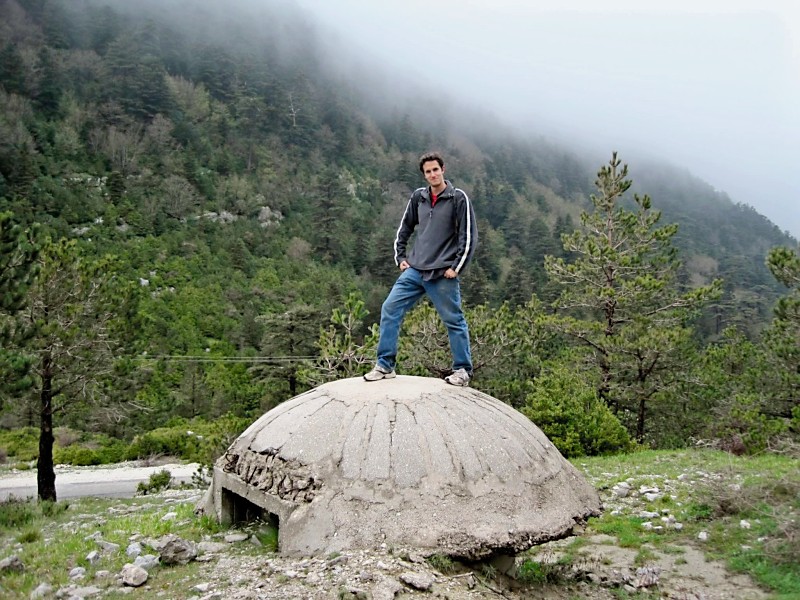
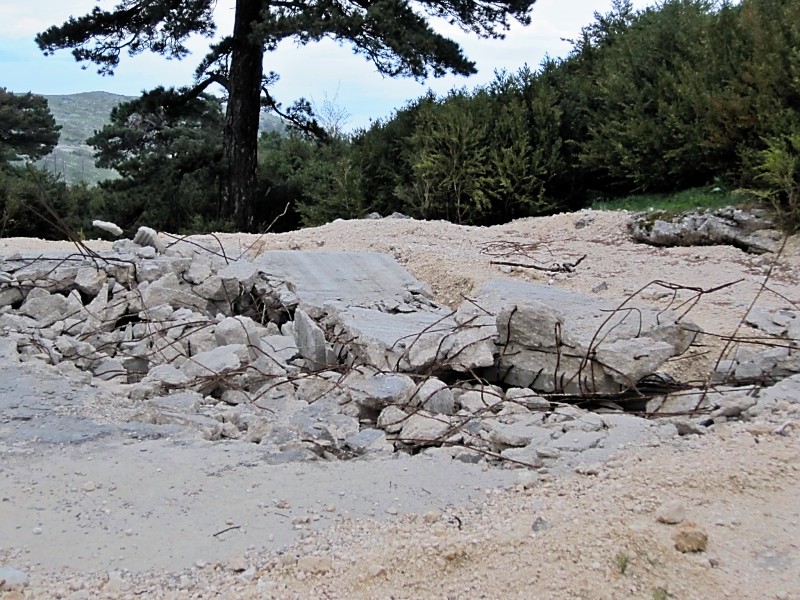
Although these communist-era concrete bunkers pop out of hillsides across the country–estimates are as high as 700,000— this was our first chance to get up close and personal with them. The sheer ubiquity of the nearly indestructible domes reflects President Hoxha’s obsession with defense against an invasion that never occured. Albanians try to work with the eyesores; some have been transformed into gardens or doghouses. But we just see them as a good photo opportunity.

The mess left after attempted destruction of a bunker shows just how strong the concrete and iron structures are.

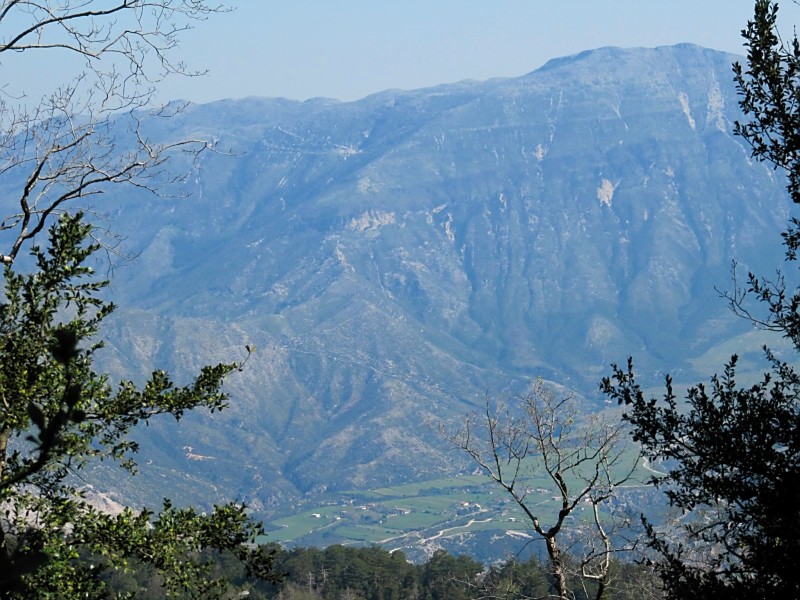
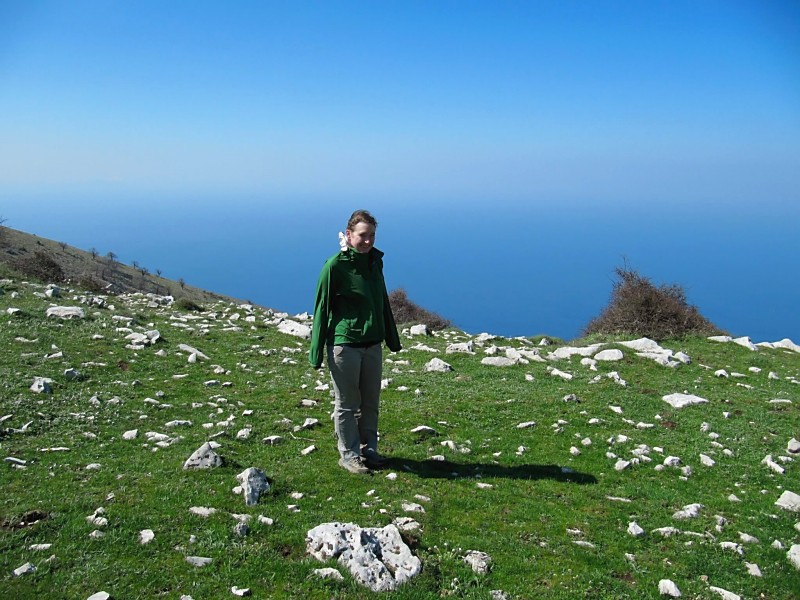
Our reward: a view over the Adriatic just before it started to rain.

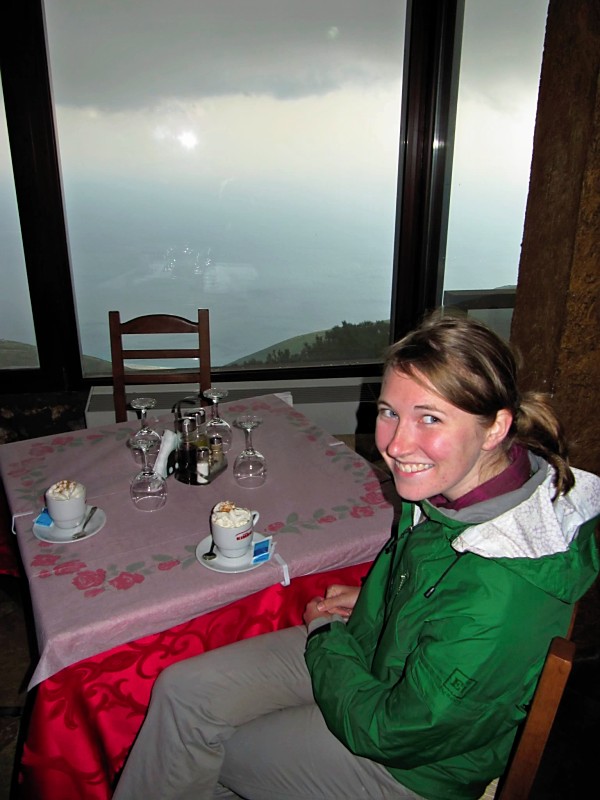
As we’ve come to expect at the end of any Balkan adventure, there was a cafe waiting for us…

… ready to serve up cappucinos with a view over the beach below.

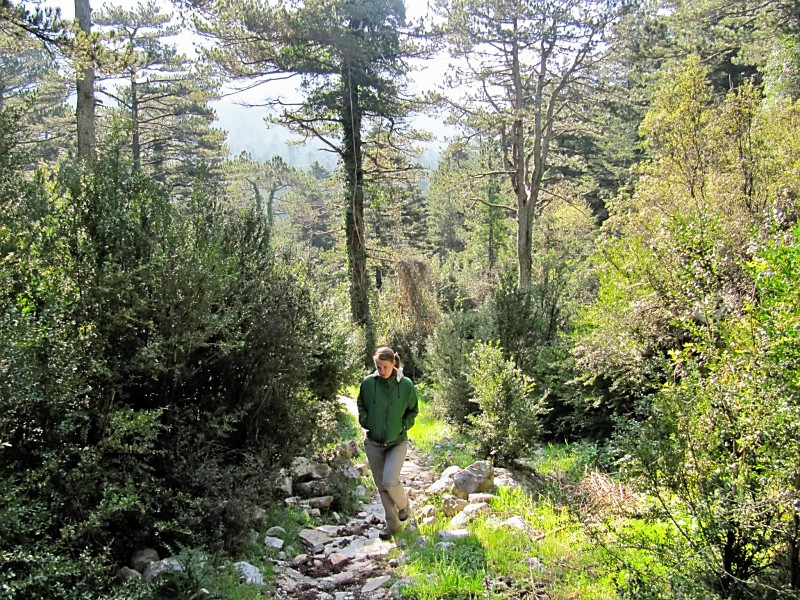
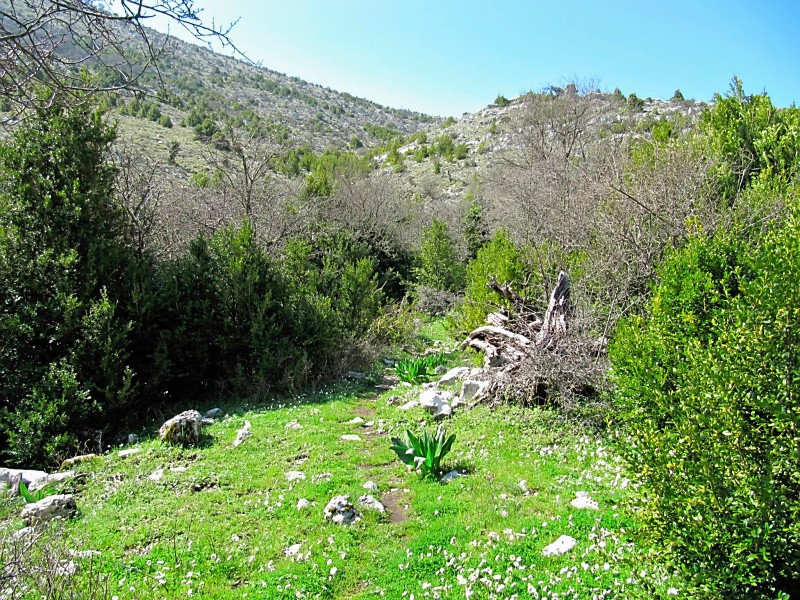
The next day we decided to leave the pavement behind and take a hike through the pine forest.

More rocks–a good sign that we are nearing the top.

An even better sign.

The top of the path. Nice, but where is our Adriatic view?

We kept coming to the crests of hills and hoping we were at the end. Instead, we were greeted by open fields or this water reservoir.

Finally!

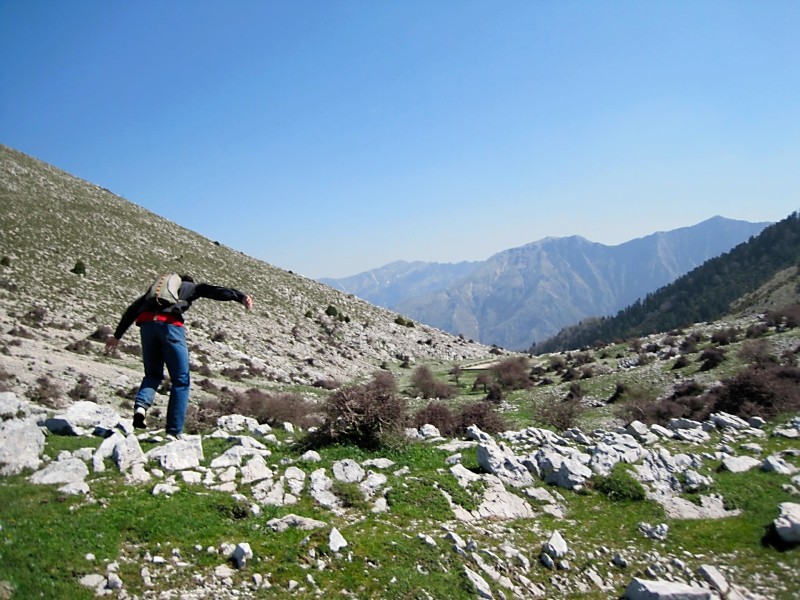
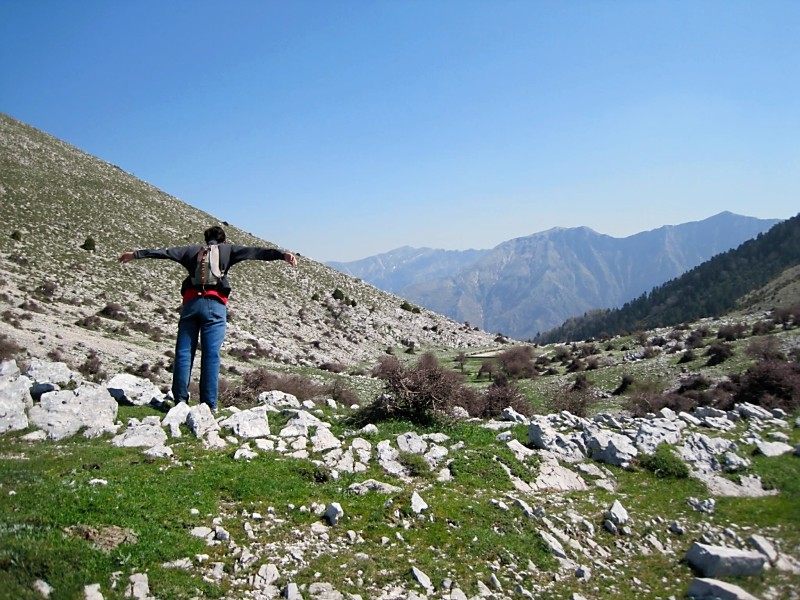
The intense winds added an element of excitement to our descent.

We got back to the highway just in time to wait for the bus that never came.

We did eventually make it back to Vlore and onwards to Tirana again, thanks to some of that famous Albanian generosity.

Posted by: Caroline | April 26, 2010

Albania’s Adriatic Coast

After crossing five borders in two weeks, we were ready for a break from frenzied traveling. So with burek (a Balkan savory pastry) in hand, we boarded a bus to Albania’s beaches.

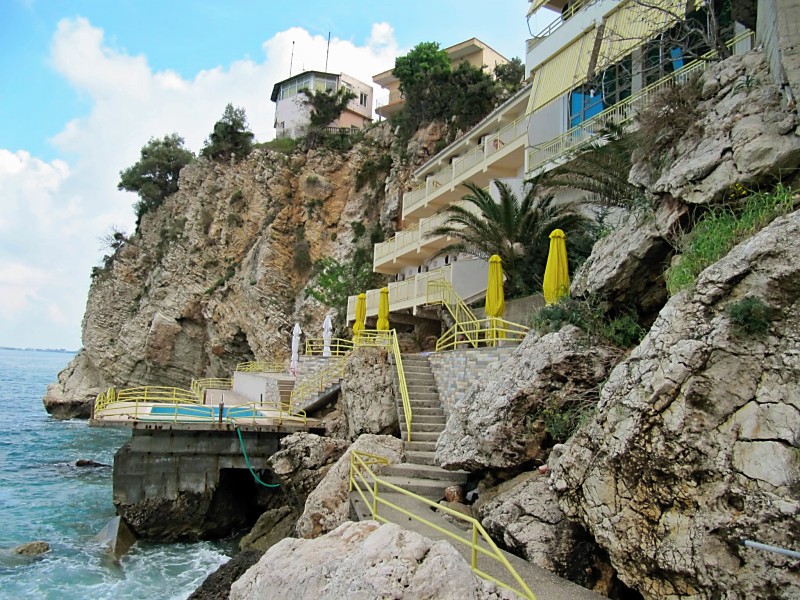
We decided to stay just outside of the port city of Vlore in Hotel Liro, built into the rocks so prominent along the Adriatic coastline.

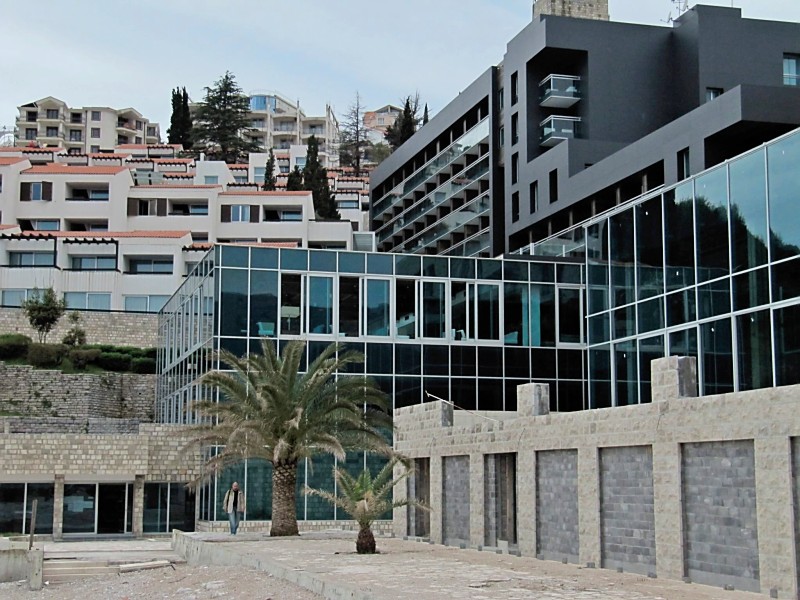
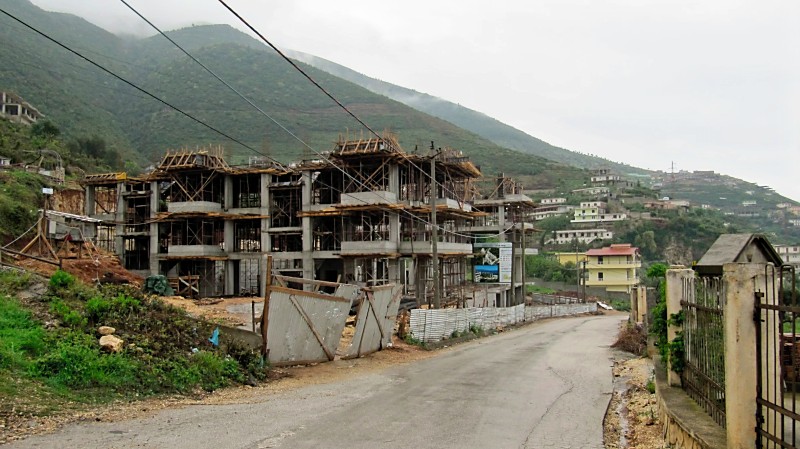
Just minutes away from the azure waters are these concrete monstrosities. Unfortunately beachside development proceeds unchecked.

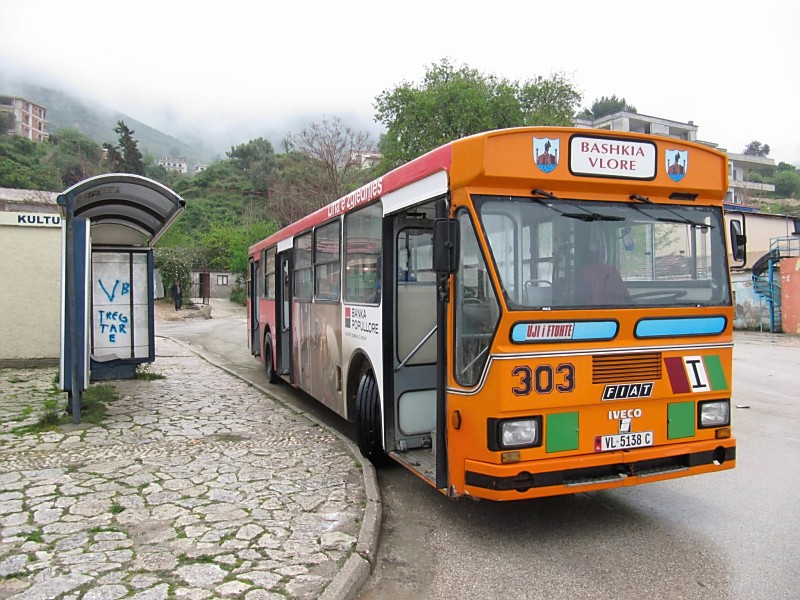
We tried to make the most of an unfortunate rainy afternoon by walking most of the 5 pothole-ridden kilometers to the city center. We rode this city bus the rest of the way, which plodded along the main drag not too much faster than our walking pace. At least we got to sit down?

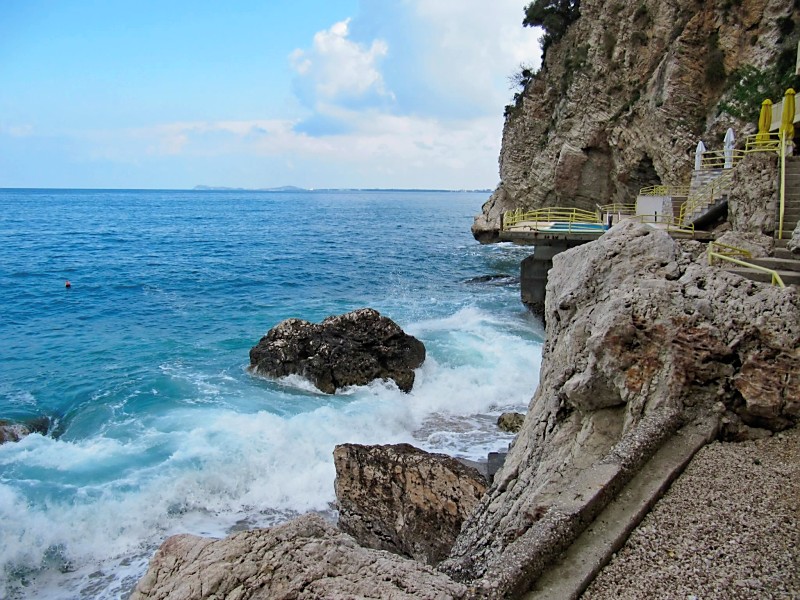
The next morning was rain-free, but the waves remained intense.

All in all, a lovely place to refuel for our next stop: climbing the mountains of Llogoraja National Park.

Posted by: Alex MacGregor | April 25, 2010

The City of a Thousand Windows

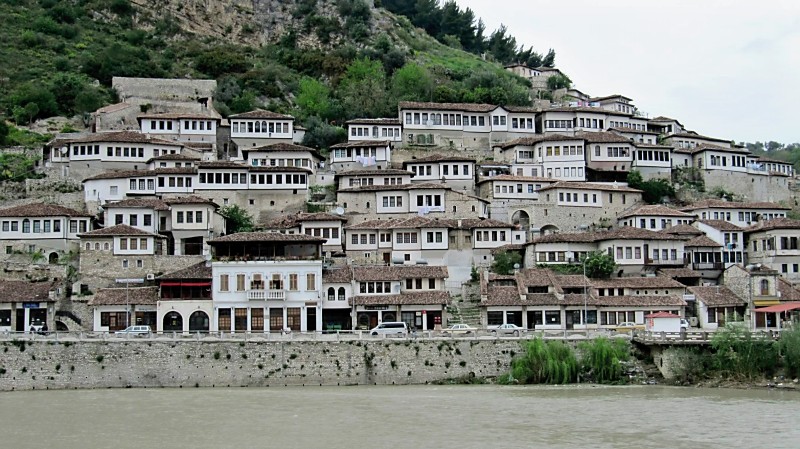
After being surprised by the colorful and hip Albanian capital, we headed for one of country’s most beautiful cities: Berat.

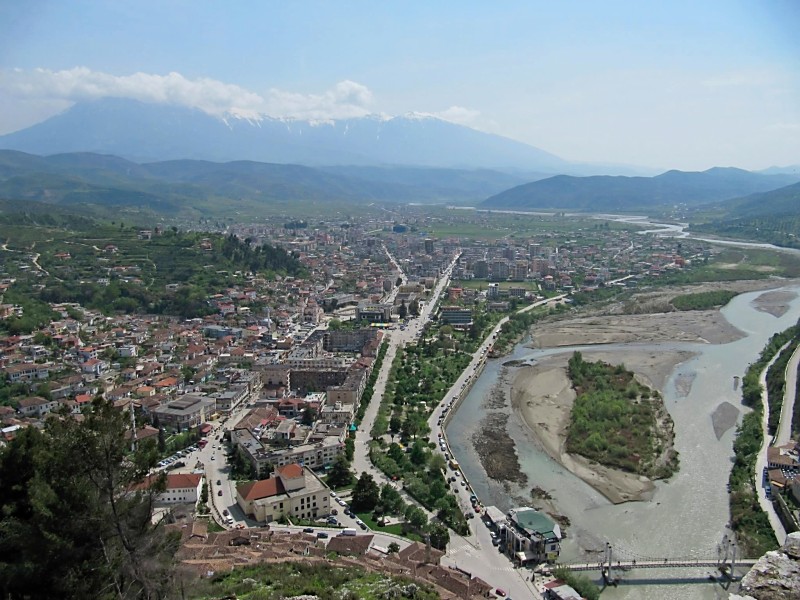
It is set at the foot of one of Albania’s tallest mountains, with a swift river running through the center. But the location is only part of the draw; the white houses that look down on the river through their multitude of windows give Berat its title: “The City of a Thousand Windows”.

Since the area around the river is mainly Muslim, we decided to check out some of the old mosques in the area. Although president Hoxha destroyed most of Albania’s mosques in a quest to remove religion from the land, the ones in Berat were considered too important and beautiful to destroy.

However, we quickly discovered that the mosques are all closed due to lack of interest. It seems Mr Hoxha’s quest turned out somewhat successfully; the country is one of the most secular in the world.

The front of this mosque was apparently made into a clothing shop!

Like any self-respecting fromer Ottoman city, Berat has the ancient stone bridge over its river…

…and the Turkish bath.

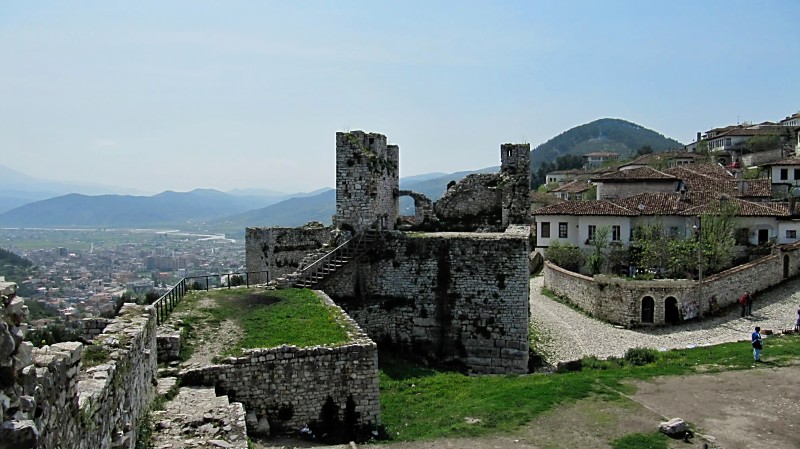
But the most surprising thing about Berat is its magnifcant walled city, peering down over the valley and the rest of town.

The mainly-Christian walled city grew to be very large due to Berat’s excellent defensive position until it was finally captured by the Ottoman Turks. Thereafter, the newer part of the city grew in the valley below.

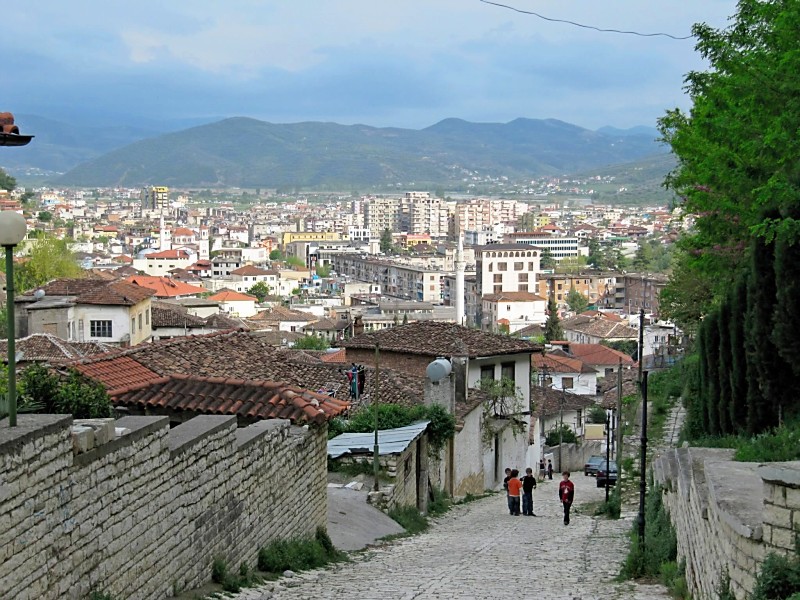
The result is an incredible old quarter with a lost-in-time feel, and spectacular views in every direction.

At the highest point lies ruins of the inner fortress, which apparently makes an ideal spot for wedding photos.

At the fortification on the east side of the fortress, you get the full picture: the river with the roofs of the Muslim quarter on the hill below, the communist-era high rises where most of Berat’s people now live, and snow-capped Mt Tomorri in the background.

To get up to the fortress and old town, you have to earn it. Not only is it a 15-minute walk straight uphill, but a group of local boys all somehow had obtained whistles, which they excrutiatingly blew at passersby of all ages and nationalities.

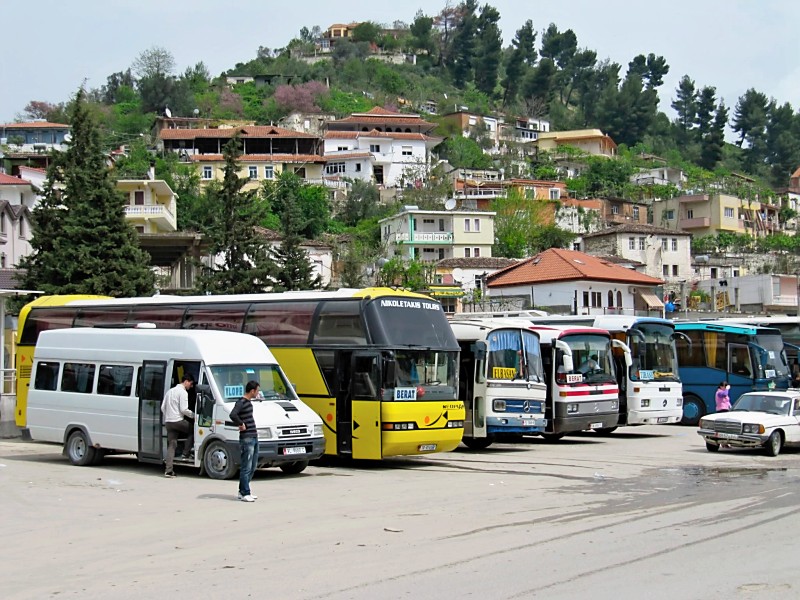
Going back to new town is also going back to Albania’s real world, which you can’t escape even in quaint Berat.

Posted by: Alex MacGregor | April 24, 2010

Albania’s Colorful Capital

Midday was turning into mid-afternoon in Sveti Naum, and it was time to head to theAlbanian border post. After having to take the long way around a Yugoslavian-era military base that makes a great shortcut as long as the gaurds are in a good mood (they weren’t), we were stamped out of Macedonia and crossed the (curiously snake-filled) no-man’s-land by foot to the Albania border post. After a cab ride into the town of Podgorec, we were put onto a furgon–minibus–headed for the capital, Tirana.

We stopped in this valley because the minibus apparently needed to be washed.

On the way, our minibus driver also stops to fill up a container of water that comes down from highland springs. Some people brought dozens of large containers to fill!

We had to change minibuses in Elbasan–a transfer our driver happily worked out for us. Albania has a very strange habit of bending over backwards for tourists, expecting absolutely nothing in return. If you’re getting off a minibus, the driver won’t stop at hailing a cab for you–it’s even possible that he, the taxi driver, and even uninvolved bystanders will get into a discussion of where you are going, how much it should cost, and the best route to get there! After some really wild mountain scenery on the Elbasan – Tirana road, we arrived in the capital at dusk.

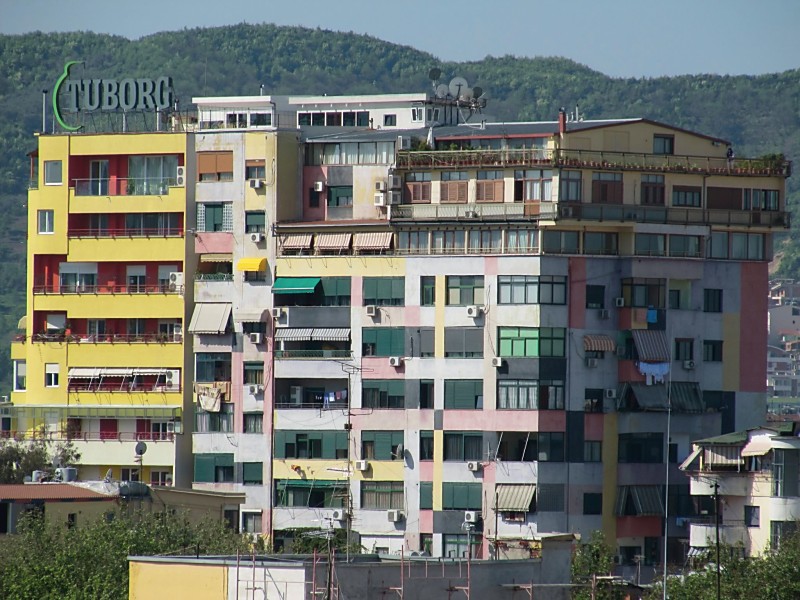
Like some of the other capitals in the Balkans, Tirana grew up during an era of communism. While that normally makes for a pretty drab place, Tirana is a major exception. After the fall of communism, Tirana’s mayor started painting buildings all sorts of colors–like tropical blues, pinks, reds, and oranges. The result is a city that sometimes looks more like Latin America than Eastern Europe.

Albania has a long, strange history. It was despised and invaded by its neighbors until the start of the 20th century. Its only reliable ally was the Ottoman Turks, which always had a fondness for Albania because it converted to Islam under its rule, unlike surrounding nations that maintained their Orthodox Christianity.

Albania has been ruled by just about everyone at some point–Greece, Serbia, Turkey, Italy, the list goes on–and has been invaded by a handful of others at some point. Nonetheless, it managed to be a completely independent state by the end of WWII, at a time when most of its neighbors were uniting to form Yugoslavia, and many minor Eastern European states were satellites to the USSR. Albania’s dictator following WWII, Enver Hoxha, established a hard-line, independent communist regime.

After he deemed Yugoslavia not communist enough, he befriended the USSR, which built the Palace of Culture in Tirana. We enjoyed a cappuccino there.

But after Stalin died and the USSR relented on some of its more extreme measures, Hoxha decided China was the true communist utopia, and, following in Mao Zedong’s footsteps, attempted to eradicate religion from Albania.

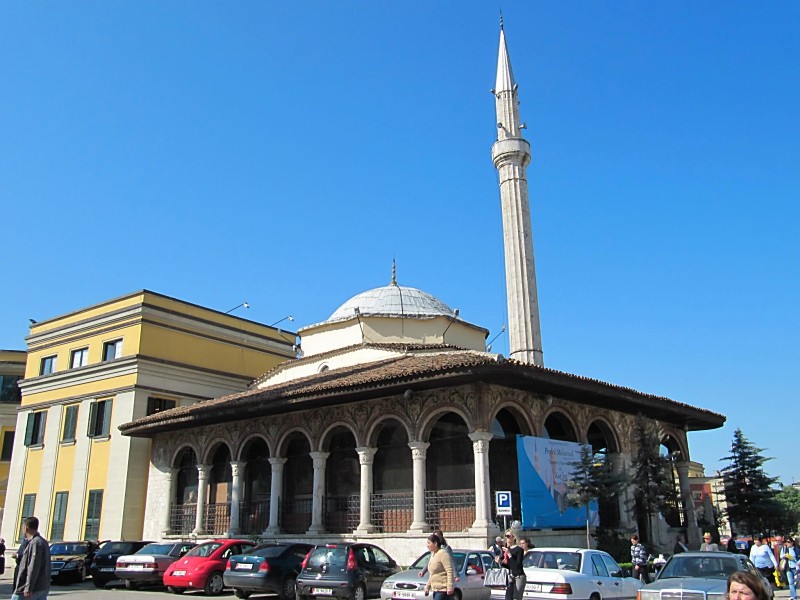
This mosque is one of the only ones that survived the period–due to its age, it was made a landmark.

The dome is incredible.

Hoxha eventually determined that China, too, was not communist enough, and set the country into a decades-long period of isolation. When communism finally fell in the 1990s, cars were rare, and Albania had basically no transport links with the outside world–a problem that still managed to affect us on this trip!

Although the government destroyed almost all things religious, it did erect some structures that now serve as monuments to central planning. When George W Bush visited Albania, it was in front of this strange pyramid that he spoke.

On the other side of the Tana River from the center of town lies a district called the Blloku. Leading a communist country is tough work, so the top comrades needed a special neighborhood to kick back in without disturbance from the common man. Nowadays, the neighborhood is wide open, and the trendiest part of the city.

Stepping into this neighborhood is like stepping into Paris, with tree-lined streets and fancy cafes and boutiques all over the place.

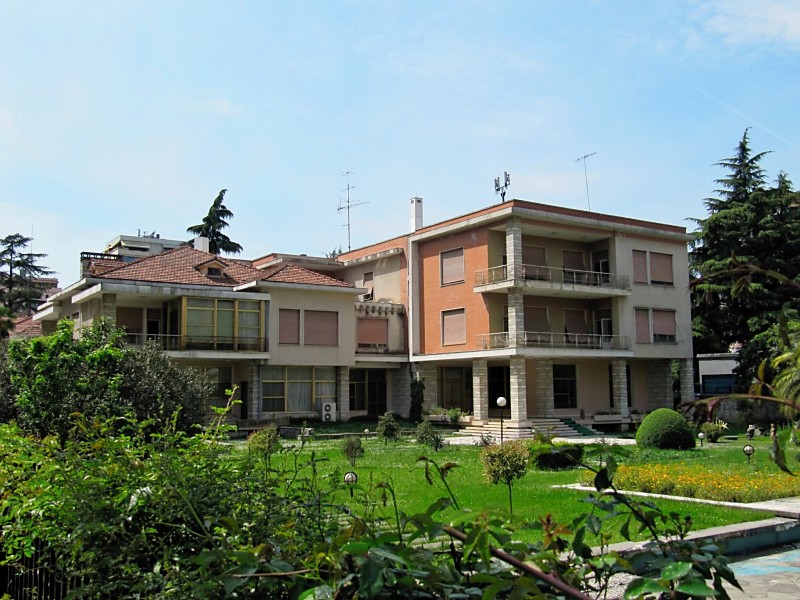
Hoxha’s house still stands in the Blloku

The place is so trendy that there’s even a French restaurant, complete with Macarons!

Posted by: Caroline | April 23, 2010

A Short Stay at Sveti Naum

Typically, border towns are lackluster, confusing areas that serve as good motivation to cross the border as soon as possible. But after our short time spent at tranquil lakeside Sveti Naum, Alex had to drag me across the border to Albania.

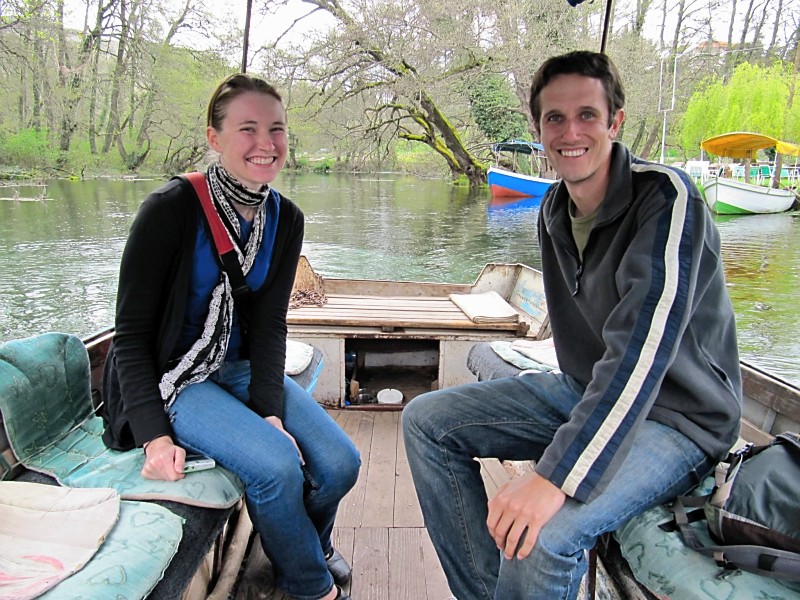
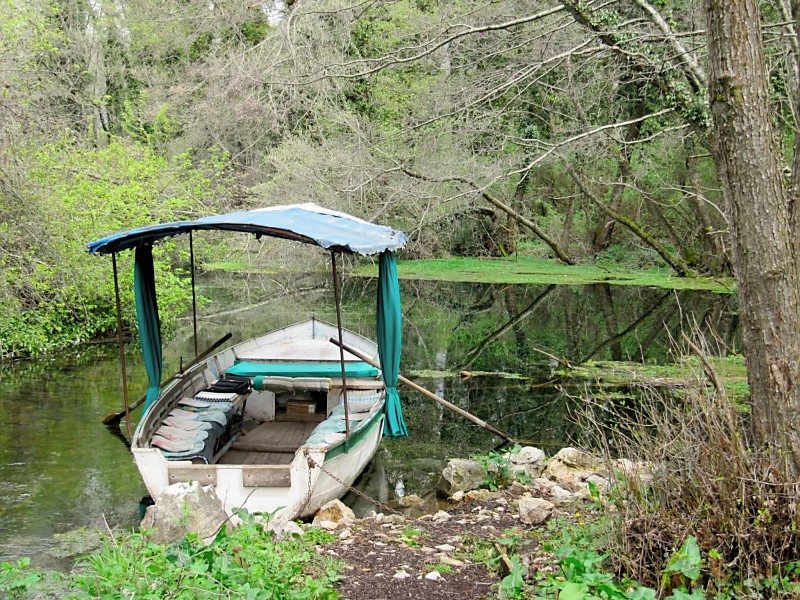
The first thing we did was hop into this boat for a guided tour of the springs that feed into Lake Ohrid.

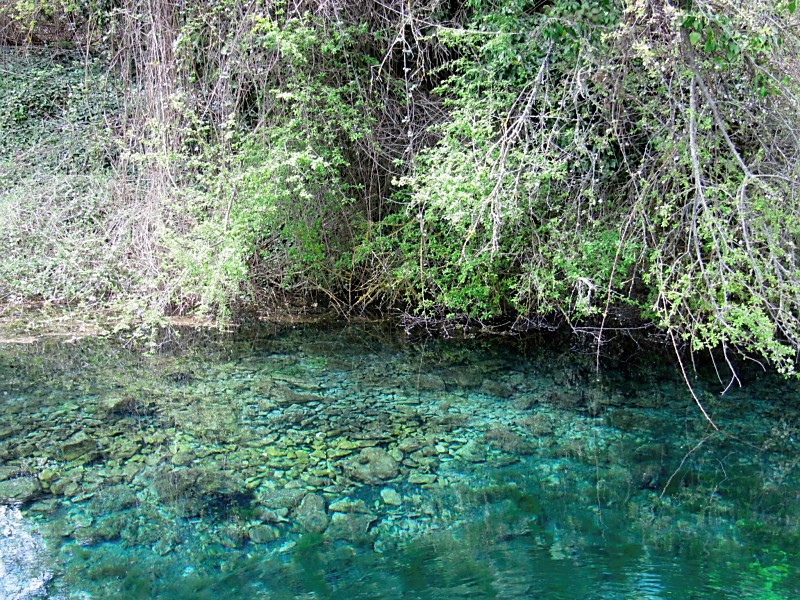
How gorgeous is this water? When you look down, you can see the water bubbling out of the ground.

Our guide said sometimes the waters even take on a violent tinge.

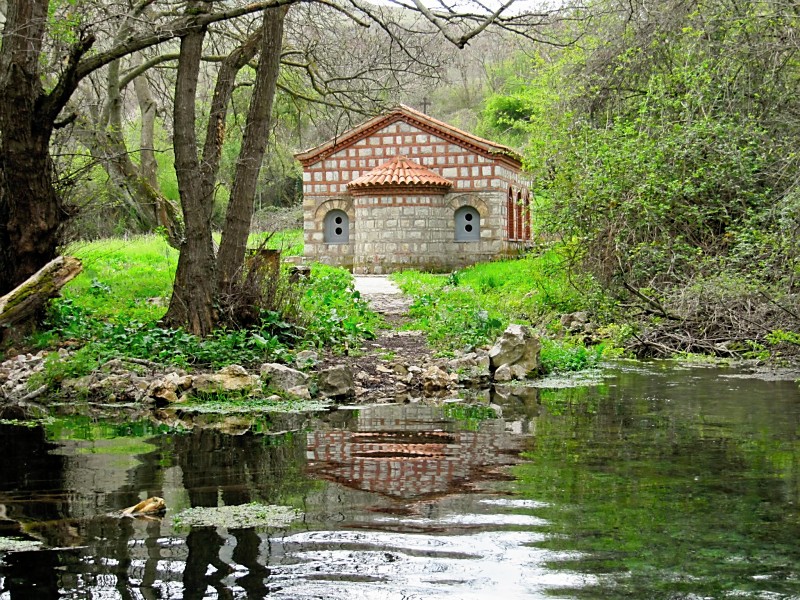
After rowing through the brilliantly-colored waters, we arrived at this secluded church.

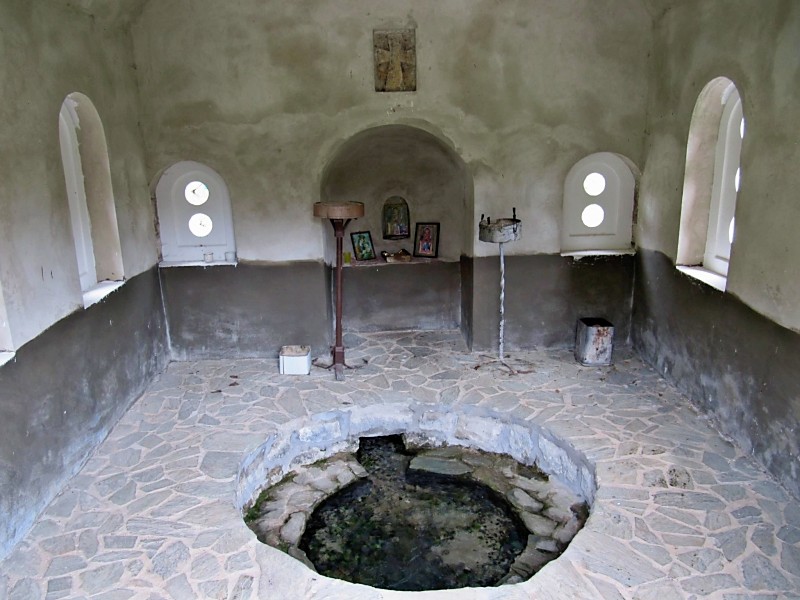
The church has its own natural baptismal pool with water flowing in the shape of a cross.

The springs boat tour was a great way to spend Alex’s birthday.

And he even pitched in with the rowing.

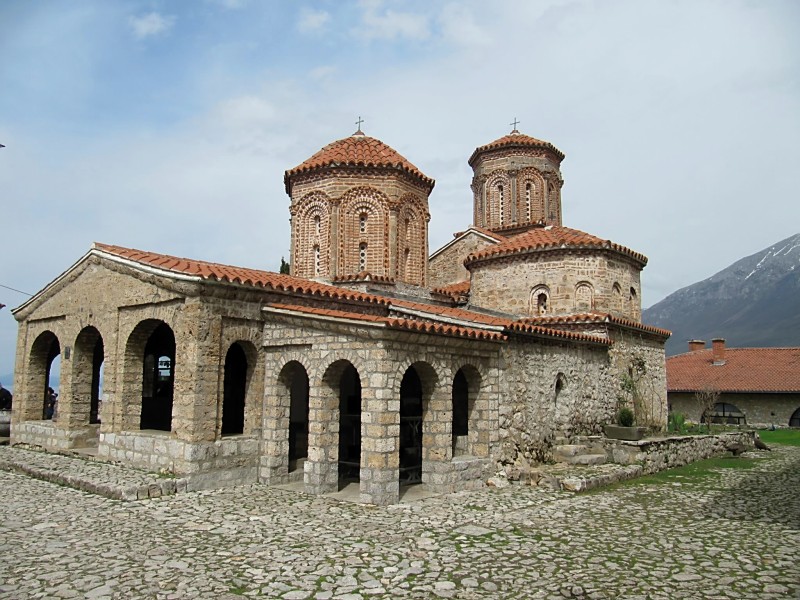
Sveti Naum’s main draw, however, is this monastery.

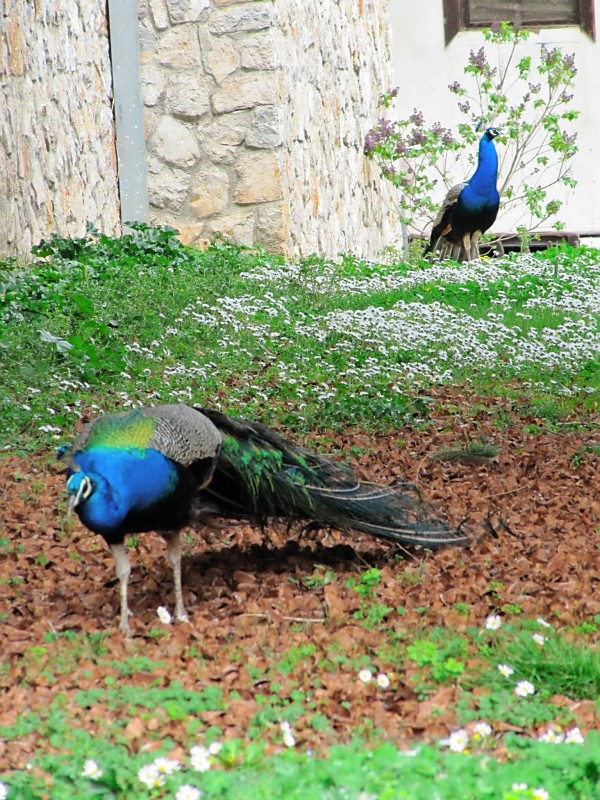
Peacocks roam the grounds looking peaceful enough…

…but this sign leads me to believe they’re not always so docile.

They do put on a great show when they feel like it!

The monastery has a wonderful view of Lake Ohrid and the surrounding mountains.


Travel Info – If you’re trying to cross the border into Albania on foot from Sveti Naum, you’ve got two options: either cross the military base to the adjacent border post, or go around on the road. The military base guards were not in a good mood the day we crossed, so we had to go on the road. Our boat conductor gave us a ride for free. Using the road, it’s 3.5km walking to the border post (although there may be shortcuts), and another .75km to the Albanian post, from which point taxis on to Podgarec are available (negotiate–we were offered 10 Euros but ended up paying 5 after we stormed off towards Podgarec on foot). If you know in advance the military base route is not available and don’t want to take a taxi, ask for your boat conductor to take you to the little church mentioned in this post, then hike from there to the border post. The post is only 1km form the little church, and the road is just uphill from the church.

Happy travels!

Posted by: Caroline | April 22, 2010

Lovely Lake Ohrid

After our side trip to Kosovo, we wanted to explore Macedonia’s tourism jewel: Lake Ohrid.

Macedonia has chosen Ohrid as the star of its heavy advertising campaign on CNN International (you can see the commercial here), and when you’re there, it’s easy to see why.

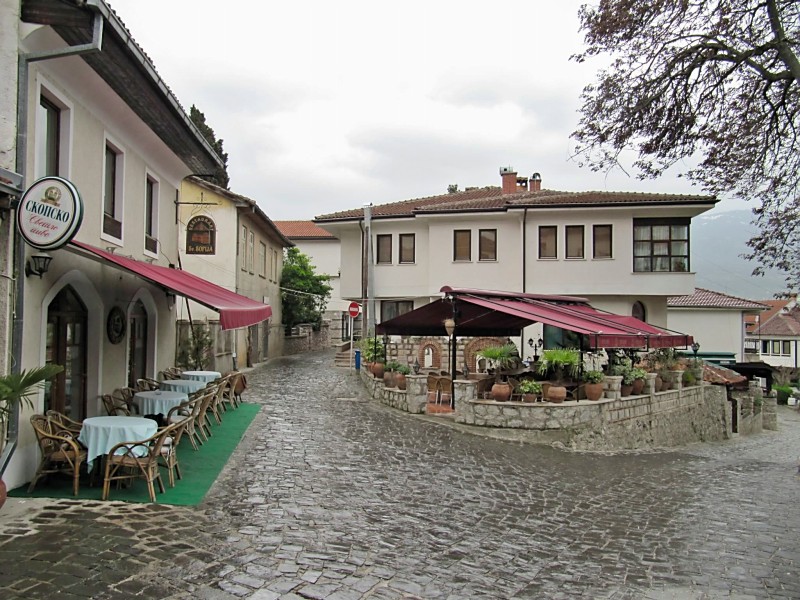
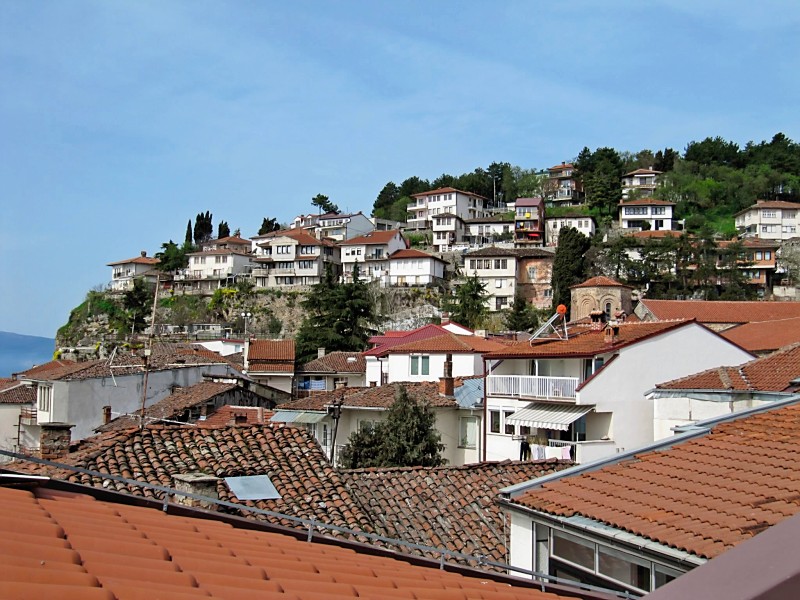
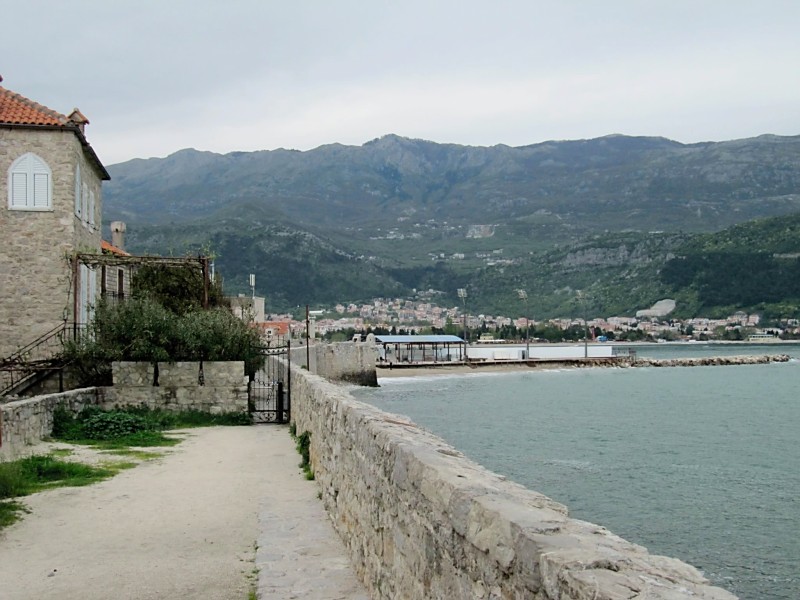
Its lakeside locale is idyllic. Stone streets lead to white lakefront hotels and homes, ancient churches, and hilltop viewpoints.

And at this time of year, the lake is still ringed by snow-capped mountains.
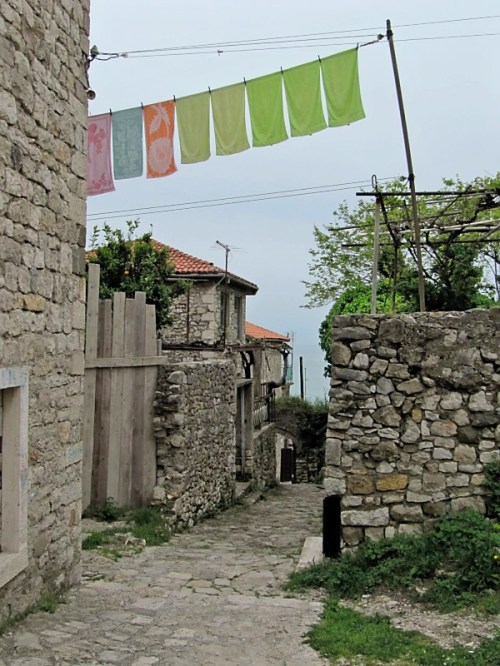
Like any ancient Balkan city, Ohrid has its own fortress…

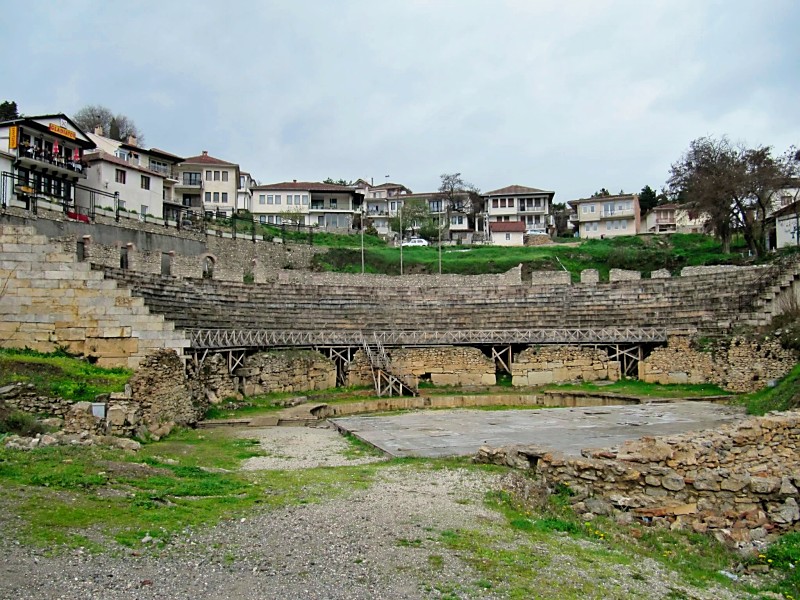
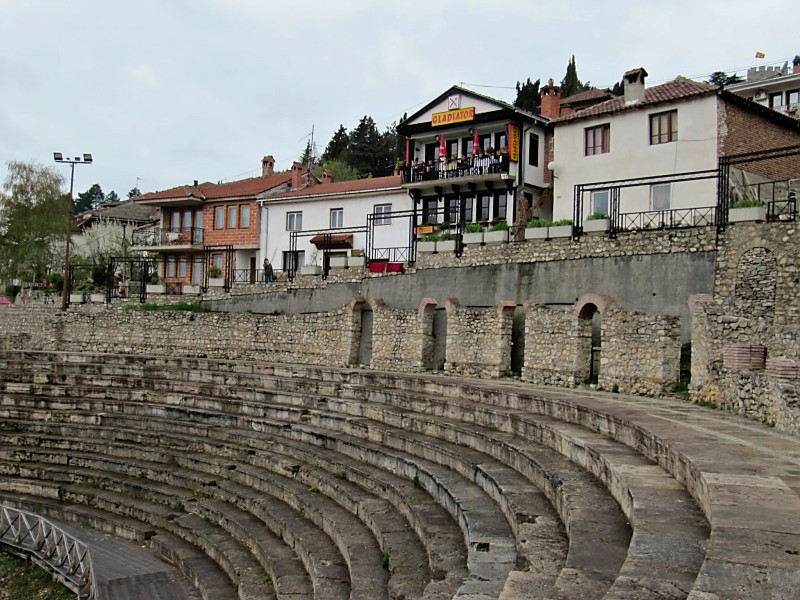
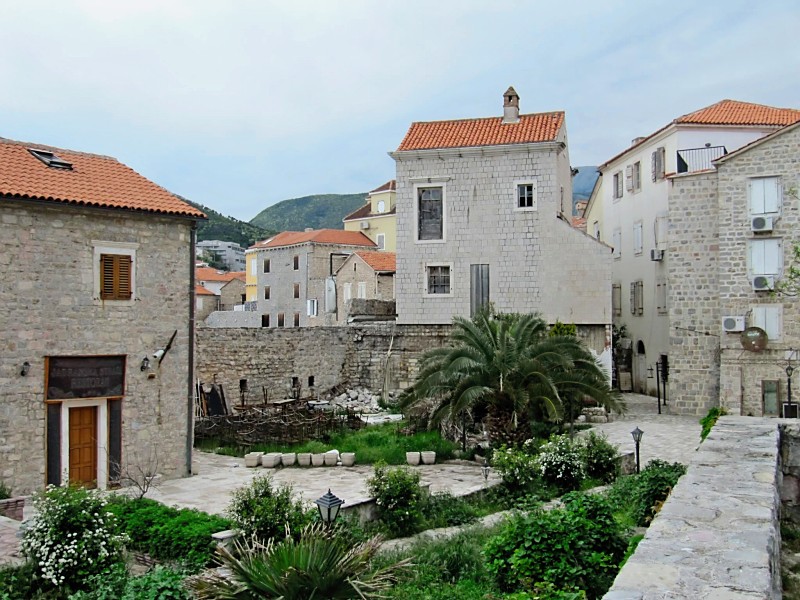
… and amphitheatre.
The Romans transformed this from a theater into a gladiator pit, giving one restaurant overlooking the scene its name.

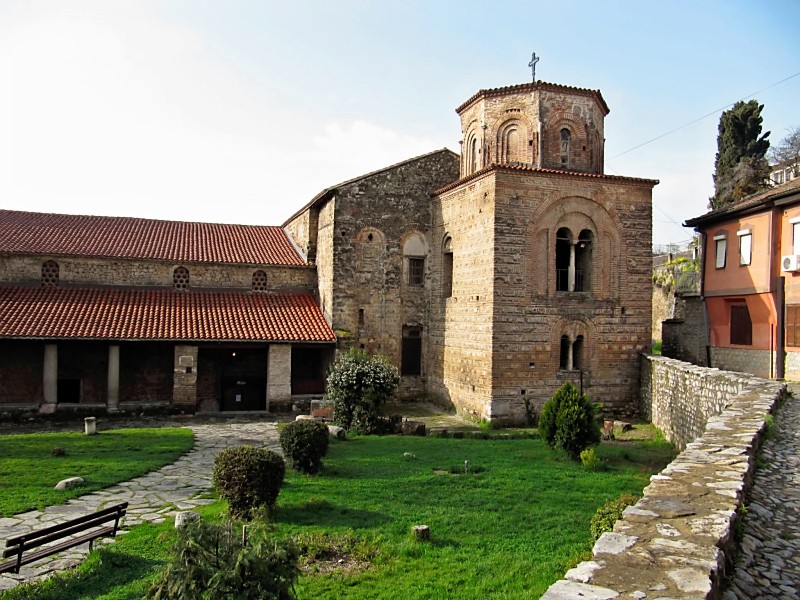
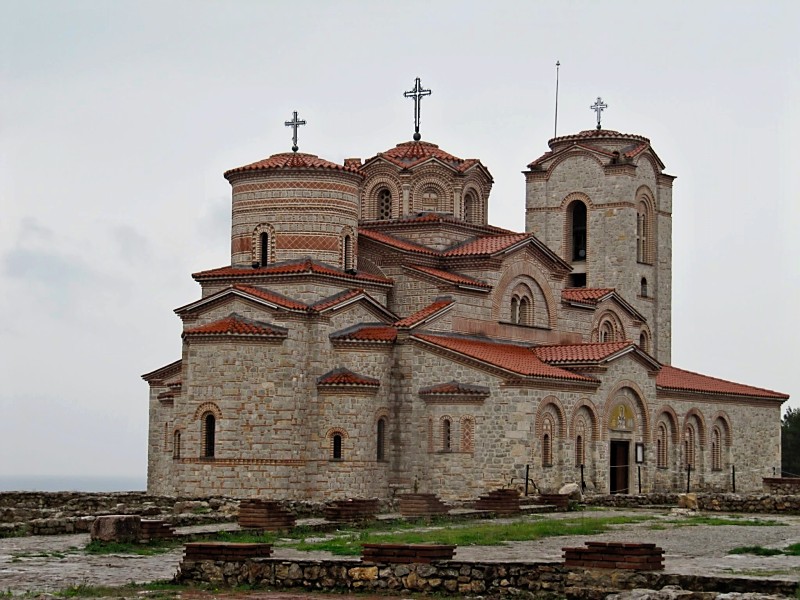
The Byzantine churches are the stars of the show.

This is Sveta Sofija, patterned after Aya Sofia in Istanbul. Unlike its model, it does not allow photographs inside (perhaps because of the disintegrating frescos?).

Sveti Kliment i Pantelejmon is really interesting to see because it was renovated as part of an archaeological project. Much of it looks new, but its older elements are incorporated into the updated design. For example, the remnant pieces of mosaic biblical scenes have been fashioned into new mosaics incorporating a variety of biblical stories–so they are mosaics of the former mosaics.

But unfortunately, we can’t show you any of that. And we certainly can’t show you any of that while wearing our bathing suits.

Ohrid’s prized possession is this church perched on the lake, Sveti Jovan at Kaneo.

The water below is unbelievably clear.

Perhaps the best part of our stay by Lake Ohrid was lucking out on a pleasant lakeview terrace (there are rewards to traveling in low season and dealing with the cold weather!).

Perhaps the worst is that Ohrid is full of lovely pearl shops, and I’ve already spent all my souvenir money. Oops.

« Newer Posts - Older Posts »

Categories